Most people entering the pharma business think the biggest challenge is selling products.
In reality, the bigger risk starts much earlier — manufacturing.
In the last 10+ years working with distributors, franchise owners, and manufacturers across India, one pattern is clear:
Most pharma businesses don’t fail because of lack of demand — they fail because of poor manufacturing decisions.
You’ll find hundreds of blogs explaining what third party pharma manufacturing is, but very few talk about:
- Why delivery delays kill market trust
- How batch variation silently destroys your brand
- Why cheap manufacturers cost you more in the long run
This guide is not theory — it’s based on real field experience, failures, and success patterns.
By the end, you’ll understand:
- How third party pharma manufacturing actually works
- Cost, margin, and risk realities
- Whether this model is right for you
- A step-by-step safe strategy to start
What Is Third Party Pharma Manufacturing In India?
Third Party Pharma Manufacturing in India (also called pharma contract manufacturing) is a business model where:
You outsource the manufacturing of medicines to a licensed pharma company, while you focus on branding, marketing, and distribution.
Simple Breakdown:
- Manufacturer → Produces medicine
- You → Sell under your brand name
Example:
You don’t own a factory.
You partner with a manufacturer who produces tablets/syrups with your brand name printed on packaging.
How Third Party Pharma Manufacturing Actually Works
On paper, it looks simple. On the ground, it’s layered.
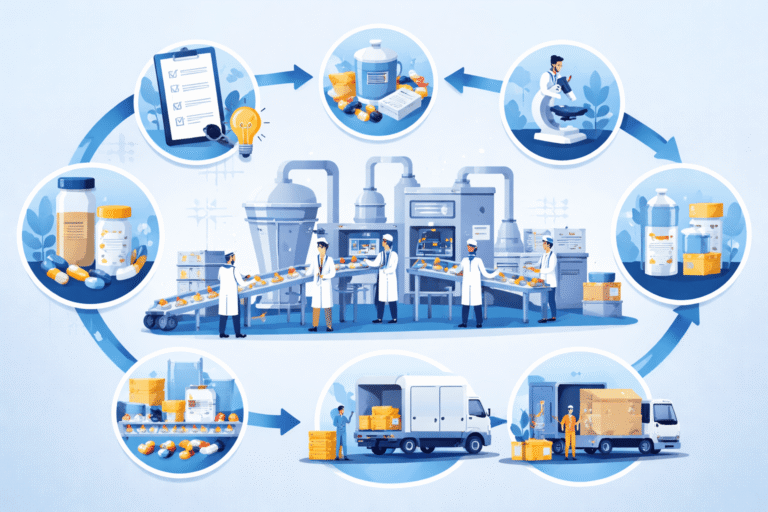
Step-by-Step Flow:
1. Product Selection
This is where you decide which products (SKUs) to launch, such as antibiotics, multivitamins, or syrups. Smart selection is critical because in real markets, only a small percentage of products generate consistent sales. Choosing demand-driven products reduces the risk of dead stock.
2. Manufacturer Finalization
You select a manufacturer based on certifications, pricing, and minimum order quantity (MOQ). However, beyond price, factors like consistency, reputation, and delivery reliability matter more for long-term success.
3. Quotation & Costing
The manufacturer provides a detailed cost breakdown including medicine cost, packaging, GST, and transport. Many beginners focus only on per-unit price, but ignoring hidden costs can reduce actual profit margins significantly.
4. Artwork & Branding
Your brand name, logo, and design are printed on the product packaging. This step defines your market identity, but remember—attractive packaging must be backed by consistent product quality to build trust.
5. Production Timeline
Manufacturers usually promise delivery within 20–30 days, but in practice, delays are common and timelines often extend to 30–45 days. Planning buffer time is essential to avoid stock shortages in the market.
6. Dispatch & Delivery
Once production is complete, goods are dispatched to your location or warehouse. Timely delivery is crucial because any delay directly impacts your supply chain, retailer trust, and ongoing sales momentum.
Ground Reality Insight:
- In 70% of cases, distributors choose manufacturers based on price, not consistency
- Most manufacturers overpromise delivery timelines
- Batch-to-batch variation is common in low-cost setups
Benefits
1. Low Investment Entry
You don’t need to invest in a manufacturing plant, which can cost ₹5–10 crore with licenses and infrastructure. Instead, you can start with a much smaller budget and allocate more funds toward marketing and distribution.
2. Faster Market Entry
Since production is outsourced, you can launch your products within 30–45 days after finalizing formulations and packaging. This allows you to quickly enter the market and start testing demand without long setup delays.
3. Focus on Sales
You can fully concentrate on building your network, doctor connections, and distribution channels. This model works especially well for those targeting where sales execution matters more than manufacturing.
4. Scalability
You can easily add new products without worrying about production capacity or infrastructure. As demand grows, you simply increase orders or expand your portfolio based on market response.
But Here’s the Truth:
These benefits only work if your manufacturer is reliable. Otherwise, they turn into losses.
Hidden Challenges & Failure Reasons
1. Batch Quality Variation
Many assume every batch will have the same quality, but in reality, changes in raw materials and production conditions often lead to inconsistencies. This directly affects patient results, causing doctors to lose confidence, retailers to stop pushing your brand, and long-term damage to your reputation.
2. Delivery Delays
While manufacturers often promise delivery within 25 days, actual timelines frequently stretch beyond 40 days. These delays create stock gaps in the market, forcing retailers to switch to competitor brands and breaking your sales momentum.
3. High MOQ Pressure
Manufacturers usually push for higher minimum order quantities to maximize their production efficiency. This leads to overstocking, where a large portion of your inventory remains unsold and locks up your working capital.
4. Low Product Movement
In most cases, only 20–30% of your product portfolio generates consistent sales, while the rest moves slowly or not at all. This imbalance results in blocked capital, expiry risks, and reduced overall profitability.
What Most Pharma Companies Won’t Tell You
1. Cheap Manufacturer = Expensive Mistake
Choosing a manufacturer based only on low price often leads to compromised quality due to inferior raw materials and weak quality control. This results in poor product performance, low repeat orders, and long-term loss of market trust.
2. Hidden Costs
The initial quotation rarely includes everything—costs like packaging upgrades, freight, and urgent production charges add up later. These hidden expenses quietly reduce your actual profit margin.
3. Monopoly Myth
Many companies promise exclusive monopoly rights, but in reality, the same manufacturer may supply similar compositions to multiple clients. This creates direct competition in the same market, reducing your brand advantage.
4. Margin Illusion
While companies often claim margins of 40–50%, the real profit after discounts, schemes, and operational costs usually drops to 15–25%. Overestimating margins is one of the most common beginner mistakes.
5. Packaging vs Quality Gap
Attractive packaging can help initial sales, but it cannot sustain demand if the product quality is inconsistent. In pharma, results matter—poor efficacy quickly leads to loss of doctor and retailer confidence.
Real Case Scenarios
Case 1: ₹1.5 Lakh Stock Dead
A distributor invested ₹1.5 lakh in 25 products
After 4 months:
- Only 6 products moved
- Rest expired slowly
Reason: Poor product selection + no market validation
Case 2: Cheap Manufacturer Disaster
A startup chose lowest-cost manufacturer
Result:
- Tablets had inconsistent effect
- Doctors stopped prescribing
Outcome: Brand collapsed in 3 months
Case 3: Delivery Delay Breakdown
A company promised supply to retailers Manufacturer delayed by 20 days
Result:
- Retailers lost trust
- Competitor replaced them permanently
Third Party Manufacturing vs PCD Pharma Franchise
Insight:
Who Should & Should NOT Choose This Model
Suitable For:
- Experienced distributors
- People with doctor network
- Those scaling from pharma franchise business mode
Not Suitable For:
- Complete beginners
- No field experience
- Limited capital (under ₹1 lakh)
Step-by-Step Strategy to Start Safely
Step 1: Smart Product Selection
Start with 5–10 fast-moving products that already have proven demand in your target market. Avoid launching too many SKUs initially, as it increases risk of unsold stock and blocks your working capital.
Step 2: Manufacturer Verification
Before finalizing, verify the manufacturer’s WHO-GMP certification, market reputation, and existing client base. A reliable manufacturer ensures consistent quality, timely delivery, and fewer operational issues later.
Step 3: Sample Testing
Always test 2–3 batches before placing a full order to check consistency and effectiveness. Taking feedback from doctors at this stage helps you avoid launching low-quality or non-performing products.
Step 4: Pricing Negotiation
Don’t choose a manufacturer solely based on the lowest price, as it often leads to quality issues. Focus on balancing cost with consistency, reliability, and long-term partnership value.
Step 5: Start with Small Batch
Begin with a smaller investment of around ₹50,000 to ₹1 lakh to reduce risk. This allows you to test product performance in the market without overcommitting your capital.
Step 6: Market Validation
Closely track repeat orders, doctor acceptance, and retailer demand to evaluate product success. Strong repeat sales indicate you’re on the right track, while weak movement signals the need for quick adjustments.
Expert Mistakes to Avoid
- Choosing manufacturer only on price
- Launching 20–30 products at once
- Ignoring delivery timelines
- Not testing samples
- Blindly trusting monopoly claims
- Overestimating margins
Conclusion
Third Party Pharma Manufacturing in India is one of the most powerful business models — but also one of the most misunderstood. It is not a “low-risk shortcut” — it’s a high-control, high-responsibility model.
If done right:
- You build a scalable brand
- Gain higher margins
- Expand faster
If done wrong:
- Stock gets stuck
- Market trust is lost
- Business collapses silently
Smart strategy:
Start small → Validate → Scale gradually
What Is Third Party Pharma Manufacturing In India?
: FAQs
References