
If you talk to any new entrant in the pharma business today, the first thing they look for is low investment + fast market entry. That’s exactly where third party pharma manufacturing becomes attractive.
But here’s the reality most websites won’t tell you:
Third party manufacturing is not a shortcut to success
It’s a leverage model — and leverage works only when controlled properly
In 70% of cases I’ve seen, beginners jump into this model thinking:
- “No factory needed, so no risk”
- “Company will handle everything”
And within 4–6 months, they struggle with:
- Stock not moving
- Delayed supplies
- Margin pressure
This guide is not just about benefits. It’s about how those benefits actually work in real Indian markets — and when they fail.

What is Third Party Pharma Manufacturing
Third party pharma manufacturing means:
- You own the brand + marketing
- Manufacturer handles production + packaging
But here’s the deeper layer:
- You don’t control factory operations
- You depend on their batch planning + raw material availability
- Your business becomes supply-chain dependent
In simple terms:
- You are not a manufacturer
- You are a brand builder + distributor
This is why this model connects directly with:
- PCD pharma franchise in India
- pharma franchise business model
- starting a pharma franchise

How It Actually Works in the Real Market
Let’s break the actual workflow (not brochure version):
Step 1: Product Selection
Most beginners pick:
- Antibiotics
- Multivitamins
- Syrups
Mistake: Choosing too many SKUs (20–30 products)
In reality:
- Only 5–7 products move initially
- Rest stays as dead stock
Step 2: Manufacturer Selection
What companies claim:
- WHO-GMP certified
- Fast delivery
- Best quality
What actually happens:
In 60–70% of cases, selection is based only on lowest quotation
Result:
- Quality compromise
- Batch inconsistency
Step 3: Sample Approval
You receive:
- Visual samples
- Sometimes trial batches
Reality:
- Final production batch may slightly differ
- Especially in syrups & suspensions
Step 4: Batch Production
Promised timeline:
30 days
Actual timeline:
45–60 days (in many cases)
Reasons:
- Raw material delay
- Overloaded production line
- Priority to bigger clients
Step 5: Delivery & Logistics
Hidden truth:
- Dispatch delays are common
- Partial supply happens frequently
Step 6: Payment Cycle
Standard pattern:
- 50% advance
- 50% before dispatch
Risk:
Once advance is paid, your control reduces significantly

Top Benefits
1. Low Investment Entry
Why it works:
- No factory setup (₹5–10 crore saved)
- No labor or machinery cost
Reality:
- You still need ₹1–2 lakh for:
- MOQ orders
- Marketing
- Distribution
Benefit works only if:
- You choose fast-moving products
2. Faster Market Entry
Claim:
- Launch in 30 days
Reality:
- 30–45 days minimum
- Can extend to 60 days
Works only when:
- Manufacturer has ready stock OR fast batch cycle
3. Scalability
Theoretical benefit:
- Add unlimited products
Ground reality:
- Scaling is easy only if supply is consistent
In Tier-2 markets like Ahmedabad, Indore:
Doctors prefer availability over branding
If stock is missing:
- Prescription shifts immediately
4. Focus on Sales & Marketing
You can focus on:
- MR activity
- Doctor visits
- Retailer network
But here’s the catch:
If supply fails → your entire sales effort collapses
5. Wide Product Range Access
Manufacturers offer:
- Tablets
- Capsules
- Syrups
- Injectables
Reality:
Not all categories have same quality control
Example:
- Tablets → stable
- Syrups → higher complaint risk
6. Better Margin Potential
Typical margins:
- 30% to 60%
But:
Margins shrink due to:
- Schemes
- Discounts
- Expiry losses

Hidden Challenges & Failure Reasons
1. Stock Non-Movement
In real markets, unsold stock is the most common reason businesses struggle early. Many distributors over-purchase SKUs without validating demand, leading to blocked capital. When only a small portion of products moves, cash flow gets stuck and reordering becomes difficult. Smart planning and starting with fewer, high-demand products can prevent this.
2. Doctor Dependency
Doctor trust is not built overnight—it usually takes consistent follow-ups and 2–3 months of engagement. Most doctors hesitate to shift to new brands due to patient safety concerns and past experience. If prescriptions don’t start, even good-quality products remain unsold. This makes relationship-building and regular MR activity critical from day one.
3. Supply Chain Risk
Even a single delay in product delivery can impact your credibility in the market. Retailers prefer companies that ensure consistent stock availability, not just good pricing. When supply breaks, retailers quickly switch to alternative brands, affecting repeat business. Reliable manufacturing partners and buffer stock planning are essential to manage this risk.
4. Quality Complaints
Quality issues—especially in syrups and pediatric ranges—can damage trust very quickly. Even minor inconsistencies in taste, packaging, or effectiveness can lead to returns and lost confidence from doctors and retailers. Once a brand’s reputation is affected, recovery becomes difficult. This is why strict manufacturer verification and sample testing are non-negotiable.

What Most Pharma Companies Won’t Tell You
This is where reality hits hard:
1. Batch Variation Risk
In practical scenarios, the same product can show slight differences across batches due to raw material sourcing or production conditions. Even minor variation in effectiveness or consistency can affect doctor confidence over time. I’ve seen retailers hesitate to reorder when such inconsistencies are noticed. Regular quality checks and working with stable manufacturers reduces this risk.
2. Monopoly Trap
Some manufacturers gradually make you dependent by offering good pricing initially, then increasing rates once your market is established. Since your brand and packaging are tied to them, switching becomes difficult. This directly impacts your margins and business control. Diversifying suppliers or keeping backup options is a safer long-term approach.
3. Hidden Delays After Payment
Once advance payment is made, smaller clients often lose priority compared to bulk buyers. In real cases, promised dispatch timelines get extended without clear communication. This creates gaps in supply and affects your market reputation. Clear delivery commitments and follow-ups are necessary before releasing payments.
4. Low MOQ ≠ Good Business
Low MOQ looks attractive for beginners, but it often comes with higher per-unit costs. This reduces your profit margin and limits your ability to compete in pricing or offer schemes. I’ve seen many distributors struggle because their pricing becomes less competitive. A balanced MOQ with better costing usually works better for long-term growth.

Real Case Scenarios
Case 1: ₹2 Lakh Investment Failure
A distributor launched:
- 25 products
After 4 months:
- Only 6 products moved
Result:
70% stock dead
Reason:
- No market research
Case 2: Cheap Manufacturer Mistake
Startup chose lowest price manufacturer
Outcome:
- Syrup complaints
- Retailer returns
Result:
Brand damaged in 2 months
Case 3: Smart Scaling Success
Distributor started with:
- 5 products only
Focused on:
- Antibiotics + multivitamins
Within 6 months:
Reached break-even,Then expanded to 20 products
Third Party vs Own Manufacturing vs PCD Model
| Factor | Third Party | Own Manufacturing | PCD Model |
|---|---|---|---|
| Investment | Low | Very High | Medium |
| Risk | Medium | High | Medium |
| Control | Low | Full | Limited |
| Scalability | High | Slow | Moderate |
| Margin | Medium-High | High | Medium |
Best for beginners: Third party + PCD pharma business in India

Who Should & Should NOT Start
Ideal For:
- Distributors
- Pharma marketers
- PCD franchise seekers
Not Ideal For:
- Zero sales experience
- No doctor network
- Expecting quick profit
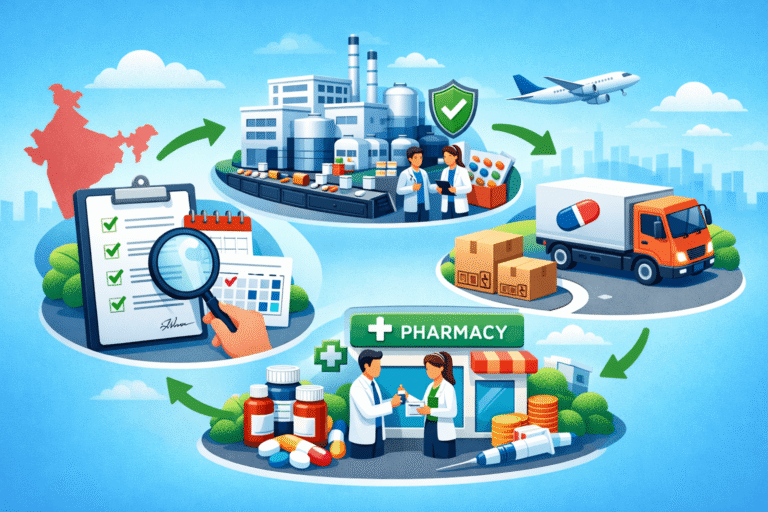
Step-by-Step Safe Strategy
This step-by-step approach is essential for anyone planning a structured pharma franchise setup in India, where product selection and supplier reliability directly impact early success. It also becomes easier to scale once you understand how third-party manufacturing helps pharma businesses grow, especially in terms of reducing investment and improving operational flexibility.
Step 1: Select 5–7 Fast-Moving Products
Starting with a limited range helps you control investment and understand real market demand. In most markets, categories like antibiotics and multivitamins generate quicker movement due to regular prescriptions. I’ve seen beginners fail by launching too many SKUs without demand validation. A focused product range increases your chances of faster rotation and better cash flow.
Step 2: Verify Manufacturer Properly
Manufacturer selection directly impacts your product quality, supply consistency, and brand reputation. Don’t rely only on certifications—check their actual market presence and existing clients. In my experience, distributors who skip this step often face quality or delay issues later. A well-verified manufacturer reduces long-term business risks.
Step 3: Start With Low MOQ
Beginning with a smaller order quantity helps you minimize financial risk and avoid dead stock. Many first-time distributors overstock based on assumptions rather than demand. Keeping MOQ low allows flexibility to adjust products based on market response. It’s a safer way to test without blocking working capital.
Step 4: Test Market First
Before scaling, it’s important to validate how your products perform in real conditions. This involves active promotion through doctors and building relationships with retailers. In most cases, initial feedback determines whether a product will sustain or fail. Market testing helps you make informed decisions instead of guessing demand.
Step 5: Scale Gradually
Expansion should always be based on proven demand, not assumptions. Once you start getting repeat orders and stable prescriptions, you can safely increase product range or quantity. I’ve seen steady growth work better than aggressive expansion in most Tier-2 and Tier-3 markets. Gradual scaling protects your investment and builds a sustainable business.
Expert Mistakes to Avoid
- Choosing manufacturer based only on price
- Launching too many products
- Ignoring supply consistency
- Not building doctor relationships
- Expecting fast returns
Conclusion
Third party pharma manufacturing is not a “low-risk shortcut.” It’s a smart business model when executed with control and strategy.
It gives you:
- Entry advantage
- Scalability
- Flexibility
But only if:
- You control product selection
- You verify manufacturers
- You build market demand
In my experience:
- Success in this model is not decided by the manufacturer
- It’s decided by your market understanding + execution discipline
Benefits Of Third Party Pharma Manufacturing In India - FAQS
1. Is third party pharma manufacturing profitable?
2. How much investment is required?
3. How long does it take to break even?
4. Is it better than starting your own manufacturing?
5. What is the biggest risk?
REFERENCE
ABOUT THE AUTHOR

Mitesh Vyas
My name is Mitesh Vyas, and I am a Pharma Franchise Consultant and Industry Research Analyst specializing in India’s PCD pharma business ecosystem. My work focuses on helping beginners, distributors, and small pharma entrepreneurs understand the real-world functioning of the pharma franchise model. Unlike theoretical content, my insights are based on ground-level observations from Indian pharmaceutical markets, including Tier-1, Tier-2, and Tier-3 cities such as Ahmedabad, Indore, Lucknow, and surrounding business hubs. I regularly share insights on how the pharma franchise business in India works in real market conditions, including investment, product strategy, and growth challenges.