Many people enter pharma manufacturing with one assumption: “High demand + medicines = high profit.”
On paper, that looks logical. On the ground, it’s very different.
Pharma manufacturing is capital-heavy, compliance-driven, and slow to scale. In 60–70% of cases I’ve seen, first-time entrepreneurs either:
- Lock too much money in plant setup
- Underestimate regulatory timelines
- Or fail to build a strong marketing channel
This guide on Step-By-Step Process To Start Pharma Manufacturing Business is not theoretical. It’s built from real on-ground observations across Tier-1, Tier-2, and Tier-3 markets in India.
If you’re serious about entering pharma manufacturing in India, this will help you avoid expensive mistakes.
Understanding Pharma Manufacturing Business in India
The pharma manufacturing ecosystem in India is not just about “making medicines.”
It’s a structured chain:
API suppliers (raw materials)
These are the backbone of your product quality—choosing certified, consistent suppliers ensures your formulations remain stable and compliant. In real practice, unreliable vendors lead to batch failures and regulatory issues.
Formulation manufacturers
They convert raw materials into finished dosage forms like tablets, capsules, or syrups under strict standards. Your entire brand reputation depends on their consistency, documentation, and GMP compliance.
Quality testing labs
Independent or in-house labs verify safety, potency, and stability before products reach the market. Skipping strict testing may save cost initially but can result in product recalls or license risk later.
Distributors & stockists
They move your products from factory to market and control availability across regions. Strong relationships here directly impact your sales velocity and cash flow cycle.
Doctors & prescription networks
Doctors ultimately drive demand through prescriptions, especially in ethical pharma segments. Without doctor acceptance, even high-quality products struggle to generate repeat sales.
In reality, manufacturing is just one part of the business.
The biggest gap?
Production is easier than selling. In Tier-2 cities like Ahmedabad, Indore, or Chandigarh, I’ve seen many WHO-GMP pharma company setups running at 30–40% capacity because they don’t have strong distribution.
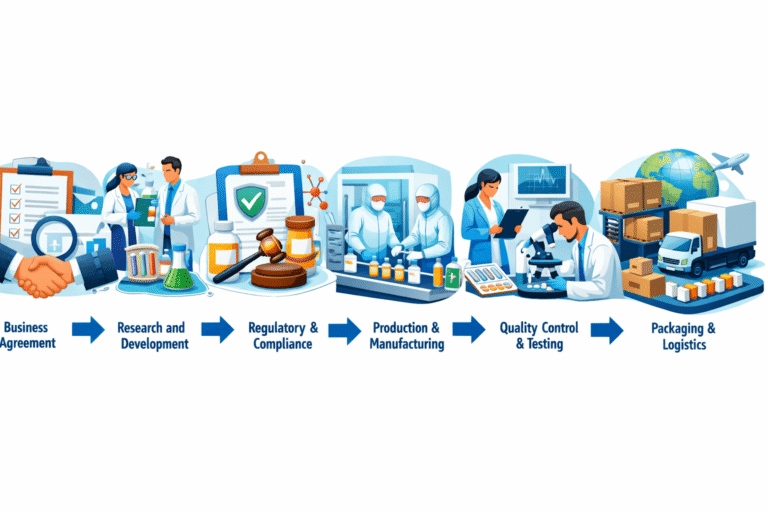
How Pharma Manufacturing Actually Works in Real Market
Here’s how it flows practically:
- Raw materials sourced from approved vendors
- Formulation & production as per standards
- Quality testing & batch release
- Packaging & dispatch
- Marketing through distributors or franchise
Where most beginners fail:
- They focus 80% on plant setup
- But only 20% on sales strategy
Result:
Inventory piles up, cash flow stops. In around 65% of new units, the real struggle is not manufacturing — it’s market penetration.
Step-By-Step Process To Start Pharma Manufacturing Business
Step 1: Decide Business Model (Own vs Third Party)
Before anything else, decide:
- Own manufacturing unit
- Third party pharma manufacturing
Ground Reality:
Most beginners should not jump directly into their own manufacturing.
Why?
- High investment
- Long setup time
- Regulatory complexity
In many cases, starting with third party pharma manufacturing or a PCD pharma franchise in India is safer.
Step 2: Market Research & Product Selection
Don’t select products randomly.
Focus on:
- High-demand segments (antibiotics, general range, derma, etc.)
- Less competition niches
- Doctor prescribing trends
Mistake I’ve seen often:
People choose 30–40 products without demand validation.
Outcome: Dead stock.
Step 3: Investment Planning & Budget Reality
This is where most people go wrong.
Typical small-scale setup cost:
- ₹50 lakh to ₹2 crore (depending on scale)
But here’s the truth:
Most first-time manufacturers underestimate:
- Working capital requirement
- Marketing expenses
- Delay buffer
Realistic buffer needed: +30% extra
Step 4: Company Registration & Legal Setup
Basic structure:
- Private Limited / LLP / Proprietorship
- GST registration
- PAN, bank accounts
Tip:
Choose structure based on future scalability, not just initial convenience.
Step 5: Drug License & GMP Certification
This is the most critical part of the pharma manufacturing license process.
Key licenses:
- Drug Manufacturing License (State FDA)
- GMP Certification
- Pollution Control Board NOC
Process breakdown:
Cause: You apply through state authority
Process: Documentation + site inspection
Ground Reality:
- Delays of 3–9 months are common
- Consultant dependency is high
- Multiple corrections required
Outcome: Timeline often doubles from expectations
Step 6: Plant Setup & Machinery
Includes:
- Land/building (as per GMP norms)
- HVAC systems
- Machinery (tablet, capsule, liquid lines)
Big mistake:
Over-investing in large plants initially.
In 60–70% of cases I’ve seen, capacity remains underutilized.
Step 7: Hiring Technical Staff
Mandatory:
- Qualified pharmacist
- Production manager
- Quality control team
Reality:
Good staff is expensive and hard to retain in smaller cities.
Step 8: Production & Quality Control
- Batch manufacturing
- Testing protocols
- Documentation
Compliance errors here can lead to:
- License suspension
- Product rejection
Step 9: Marketing & Distribution Setup
This is the backbone.
Options:
- Build your own sales team
- Work with distributors
- Launch pharma franchise business model
Many successful manufacturers combine manufacturing + starting a pharma franchise network.
Cost Breakdown of Pharma Manufacturing Setup
1. Land & Building (₹10 lakh – ₹50 lakh+)
Your facility must meet GMP layout norms, not just basic construction—location, layout, and approvals all impact licensing speed. In reality, many investors overspend here without aligning it to actual production needs.
2. Machinery (₹20 lakh – ₹1 crore+)
Machinery cost depends on dosage forms (tablets, capsules, liquids), but buying full-capacity setups early often leads to idle machines. It’s better to match equipment with confirmed demand, not future assumptions.
3. Licensing & Compliance (₹2 lakh – ₹10 lakh)
This includes drug license, GMP certification, and regulatory approvals, often involving consultants. The real challenge is not cost, but delays and repeated corrections during inspections.
4. Staff Salaries (₹2–5 lakh/month)
You’ll need qualified pharmacists, production heads, and QC staff to run operations legally. In practice, retaining skilled professionals becomes a recurring cost pressure, especially in smaller cities.
5. Hidden Costs (Most underestimated)
Electricity, maintenance, audits, and unsold inventory quietly increase your monthly burn rate. These ongoing expenses are the main reason many units face cash flow issues despite good setup.
Real Benefits
- Long-term scalability
- Brand ownership
- Higher margins vs trading
- Contract manufacturing opportunities
But only if:
- Capacity utilization is high
- Sales channel is strong
Hidden Challenges & Why Most Fail
- Delayed licensing
- High fixed costs
- Weak marketing
- Cash flow pressure
- Over-dependence on consultants
In most small setups, break-even takes 12–24 months
What Most Pharma Consultants & Companies Won’t Tell You
This is where reality hits hard.
1. Hidden Costs
Electricity, compliance audits, and staff salaries create a continuous financial load beyond initial setup. In real operations, these recurring expenses often decide profitability more than manufacturing efficiency.
2. Overpromised ROI
Claims like “recover investment in 6–8 months” are common in the market but rarely match ground reality. In most real cases, stable returns take longer due to sales building and regulatory cycles.
3. Licensing Delays
Even with complete documentation, approvals can stretch due to inspection schedules and regulatory backlogs. This delay often impacts launch timelines and increases pre-revenue costs significantly.
4. Idle Plant Problem
Many units operate below capacity because demand generation doesn’t match production capability. In practice, unused machinery and fixed overheads become a major financial burden.
In Tier-2 cities like Ahmedabad, I’ve seen multiple units operating at <50% capacity
Real Case Scenarios
Case 1: Wrong Plant Investment
Entrepreneur invested ₹1.5 crore in plant
Issue: No distribution network
Result: Inventory stuck, EMI pressure
Case 2: Third-Party vs Own Manufacturing Confusion
Started own unit without testing market
Better approach: Start with third-party first
Result: Avoided huge capital risk (in hindsight)
Case 3: Licensing Delay
Expected approval: 3 months
Actual: 9 months
Impact: Rent + salaries without revenue → heavy loss
Who Should & Should NOT Start This Business
You SHOULD start if:
- You have strong capital buffer
- You understand pharma distribution
- You can handle compliance pressure
You should NOT start if:
- You expect quick profits
- You don’t have marketing strategy
- You rely fully on consultants
5-Step Safe Entry Strategy
Start with third-party manufacturing
Work with a reliable WHO-GMP manufacturer to launch products without heavy upfront investment or compliance burden. This lets you test the market with real sales instead of assumptions.
Build product demand
Focus on doctor prescriptions, retailer movement, and repeat orders—not just product launches. Demand validation at ground level ensures you’re scaling what actually sells.
Create distribution network
Develop strong links with stockists, distributors, or a PCD pharma franchise in India to ensure consistent product movement. A solid network turns manufacturing into revenue, not dead inventory.
Scale gradually
Increase product range, territory, and team only after achieving stable monthly sales. Controlled growth protects cash flow and reduces operational risk.
Then invest in own plant
Once demand is predictable and volumes justify it, set up your manufacturing unit for better margins and control. At this stage, your plant runs with purpose—not idle capacity. This reduces risk by 60–70%
Expert Mistakes to Avoid
- Over-investing in infrastructure
- Ignoring marketing
- Choosing wrong consultant
- Poor product selection
- Underestimating working capital
Conclusion
The Step-By-Step Process To Start Pharma Manufacturing Business is not just about licenses and machinery — it’s about strategy, patience, and execution. If done right, it’s a powerful long-term business. If done blindly, it becomes a financial burden.
The smartest approach today is:
- Start lean
- Validate market
- Then scale into manufacturing
Step-By-Step Process To Start Pharma Manufacturing Business -FAQS
REFERENCE