
The Role Of R&D In Veterinary Medicine Manufacturing goes far beyond creating new medicines. Research and development (R&D) forms the backbone of every successful veterinary pharmaceutical company. It helps manufacturers develop safe, effective, and innovative medicines that improve animal health while meeting strict quality and regulatory standards.
Today, livestock farmers, veterinarians, dairy owners, poultry businesses, and pet owners expect veterinary medicines that deliver consistent results with minimal side effects. To meet these expectations, manufacturers invest heavily in veterinary pharmaceutical research and development, advanced laboratories, skilled scientists, and modern technologies.
From identifying active pharmaceutical ingredients (APIs) to conducting formulation studies, stability testing, and quality validation, every stage of the veterinary drug development process depends on strong R&D practices. Without continuous innovation, manufacturers cannot respond effectively to emerging animal diseases, antimicrobial resistance, changing regulations, or evolving market demands.
In this article, we’ll explore why R&D matters in veterinary medicine manufacturing, how it drives product quality and innovation, and why choosing a manufacturer with a strong research foundation benefits veterinarians, distributors, and animal healthcare businesses alike.
What Is the Role Of R&D In Veterinary Medicine Manufacturing?
Research and development (R&D) in veterinary medicine manufacturing focuses on discovering, designing, testing, and improving medicines for animals. It ensures products are safe, effective, stable, and compliant with regulatory requirements before they reach the market.
A strong R&D team contributes to:
- Developing innovative veterinary medicines
- Improving existing formulations
- Ensuring product safety and efficacy
- Maintaining consistent product quality
- Supporting regulatory compliance
- Enhancing manufacturing efficiency
- Addressing emerging animal diseases
- Meeting the changing needs of livestock and companion animals
In simple terms, R&D transforms scientific research into reliable veterinary healthcare products that support better animal health and sustainable farming.
What Is Veterinary Pharmaceutical Research and Development?
Veterinary pharmaceutical research and development refers to the scientific process of creating, evaluating, and improving medicines intended for animals. It combines pharmaceutical science, microbiology, chemistry, biotechnology, pharmacology, and manufacturing expertise to produce high-quality veterinary products.
Unlike simple manufacturing, R&D begins long before commercial production starts. Scientists spend months or even years researching disease conditions, selecting suitable active ingredients, developing stable formulations, and conducting extensive laboratory evaluations.
The goal is not only to manufacture medicines but also to ensure they provide predictable therapeutic outcomes while maintaining safety for animals, handlers, and the environment.
Why Is R&D Essential in Veterinary Pharmaceuticals?
The veterinary pharmaceutical industry faces unique challenges compared to human medicine. Different animal species respond differently to medicines, requiring specialized formulations and dosage strengths. According to the World Organisation for Animal Health (WOAH), maintaining animal health through science-based research and innovation is essential for disease prevention, food security, and public health. This makes R&D in veterinary pharmaceuticals an essential investment rather than an optional business function.
Key reasons include:
1. Development of Safer Medicines
Animal safety remains the highest priority during product development.
Researchers evaluate:
- Toxicity
- Drug interactions
- Species-specific responses
- Dosage accuracy
- Residue levels in food-producing animals
These evaluations reduce health risks and improve treatment outcomes.
2. Better Disease Management
Animal diseases continue to evolve because of changing environmental conditions, intensive farming practices, and microbial mutations.
Continuous animal healthcare research enables manufacturers to develop medicines for:
- Bacterial infections
- Viral diseases
- Parasitic infestations
- Nutritional deficiencies
- Metabolic disorders
Ongoing research helps manufacturers stay prepared for emerging disease challenges.
3. Improved Product Effectiveness
Not every formulation delivers optimal therapeutic performance.
Scientists conduct extensive veterinary drug formulation research to determine:
- Appropriate active ingredients
- Drug compatibility
- Absorption rate
- Solubility
- Stability
- Shelf life
These improvements enhance treatment success while reducing medicine wastage.
4. Compliance with Regulatory Standards
Veterinary pharmaceutical manufacturers must comply with Good Manufacturing Practices (GMP), pharmacopoeial standards, and country-specific regulatory requirements.
R&D teams prepare scientific documentation that supports:
- Product registration
- Stability studies
- Analytical validation
- Safety assessments
- Quality testing
This documentation builds confidence among regulatory authorities and customers.
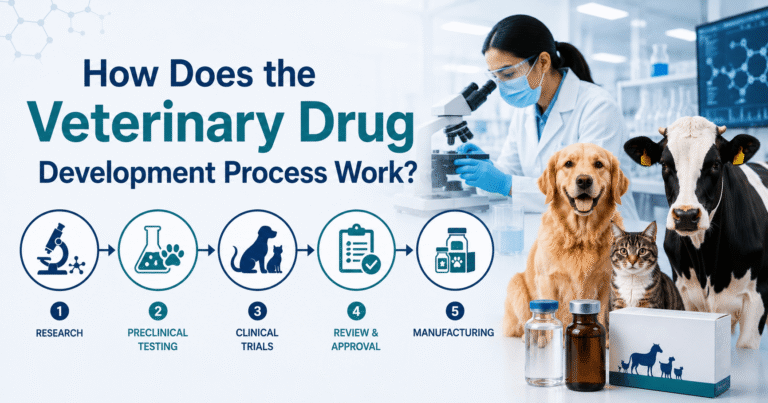
How Does the Veterinary Drug Development Process Work?
Developing veterinary medicines involves several carefully planned stages. Each phase helps ensure the final product meets quality, safety, and efficacy requirements.
Step 1: Identifying Animal Health Needs
The process begins with identifying healthcare challenges affecting livestock and companion animals.
Examples include:
- Tick infestations
- Mastitis
- Foot-and-mouth disease
- Digestive disorders
- Respiratory infections
- Mineral deficiencies
Researchers also gather feedback from veterinarians, farmers, and distributors to understand market needs.
Step 2: Researching Active Ingredients
Scientists study different pharmaceutical ingredients to determine their effectiveness against specific diseases.
During this phase, researchers evaluate:
- Therapeutic benefits
- Safety profile
- Stability
- Compatibility
- Cost-effectiveness
Only the most suitable compounds move forward for formulation development.
Step 3: Veterinary Medicine Formulation Development
This is one of the most critical stages of veterinary medicine product development.
Scientists develop formulations that ensure:
- Accurate dosing
- High bioavailability
- Better palatability where needed
- Stability under different storage conditions
- Ease of administration
Different dosage forms include:
- Tablets
- Boluses
- Oral liquids
- Injections
- Powders
- Suspensions
- Feed supplements
- Topical preparations
The objective is to create products that are both effective and convenient to use.
Step 4: Laboratory Testing
Every formulation undergoes rigorous testing inside a veterinary pharmaceutical laboratory.
Scientists evaluate:
- Chemical stability
- Physical stability
- Sterility
- Dissolution
- Potency
- Uniformity
- Microbial contamination
Products that fail quality benchmarks undergo further refinement before advancing.
Step 5: Veterinary Medicine Testing and Validation
Testing confirms whether the medicine performs consistently under different conditions.
Researchers validate:
- Product performance
- Shelf life
- Packaging compatibility
- Storage stability
- Batch consistency
Only validated formulations proceed toward commercial manufacturing.
How R&D Improves Veterinary Medicine Quality
Quality does not happen by chance. It results from continuous scientific improvement, strict testing, and standardized manufacturing practices.
R&D directly contributes to veterinary medicine quality improvement in several ways.
Better Raw Material Selection
The quality of veterinary medicines begins with pharmaceutical-grade raw materials.
Researchers establish strict specifications for:
- Active ingredients
- Excipients
- Packaging materials
- Preservatives
Careful supplier qualification helps maintain consistent product quality.
Advanced Analytical Testing
Modern R&D laboratories use sophisticated analytical instruments to verify product quality.
Common analytical techniques include:
- High-performance liquid chromatography (HPLC)
- UV spectroscopy
- Dissolution testing
- Microbiological analysis
- Moisture analysis
These methods detect impurities before production begins.
Strong Veterinary Pharmaceutical Quality Control
Quality control teams work closely with R&D scientists throughout manufacturing.
Their responsibilities include:
- Raw material inspection
- In-process quality checks
- Finished product testing
- Stability monitoring
- Batch release approval
This integrated approach minimizes manufacturing defects and ensures reliable performance.
Veterinary Pharmaceutical Innovation: Driving the Future of Animal Healthcare
Innovation has become one of the strongest competitive advantages in veterinary manufacturing.
Instead of simply producing generic medicines, animal healthcare medicine manufacturers continuously invest in veterinary medicine innovation to improve treatment outcomes and address evolving animal health challenges.
Some major innovation areas include:
Improved Drug Delivery Systems
Modern delivery technologies help medicines work faster while improving patient compliance.
Examples include:
- Sustained-release injections
- Water-soluble powders
- Easy-to-administer oral suspensions
- Long-acting formulations
These products reduce treatment frequency and improve convenience for veterinarians and livestock owners.
Better Combination Products
Researchers also develop combination formulations that target multiple health problems simultaneously.
Benefits include:
- Reduced medication burden
- Improved treatment efficiency
- Lower stress on animals
- Better disease management
These innovations provide practical solutions for modern veterinary practice.
Focus on Species-Specific Solutions
Different animals have unique physiological and metabolic characteristics. A medicine suitable for cattle may not be appropriate for poultry, sheep, goats, pets, or aquaculture species.
R&D teams therefore design species-specific formulations with the right dosage strength, delivery method, and ingredient profile. This targeted approach improves treatment effectiveness while reducing the risk of adverse reactions.
How Modern R&D Technologies Are Transforming Veterinary Medicine Manufacturing
Technology has become a major driving force behind veterinary pharmaceutical development. Modern research laboratories use advanced equipment, automation, and digital tools to speed up product development while improving accuracy and consistency.
Some of the latest innovations include:
Artificial Intelligence (AI) in Drug Research
AI helps researchers analyze large datasets, predict formulation stability, and identify potential drug candidates more efficiently. This reduces development time and supports faster innovation.
Advanced Analytical Instruments
Modern laboratories rely on high-precision instruments to verify product quality and detect even trace levels of impurities. These technologies improve product consistency and help manufacturers meet global quality standards.
Automated Manufacturing Systems
Automation minimizes human error during production by ensuring accurate weighing, mixing, filling, and packaging. As a result, manufacturers achieve greater batch-to-batch consistency and higher production efficiency.
Data-Driven Quality Management
Digital quality management systems allow manufacturers to monitor production, document testing results, and maintain complete traceability throughout the manufacturing process. This strengthens compliance and simplifies audits.
The Importance of Veterinary Medicine Clinical Trials
Before a veterinary medicine reaches the market, it must undergo careful evaluation to confirm its safety and effectiveness. Although the scope and regulatory requirements vary by product and country, veterinary medicine clinical trials play an essential role in validating new formulations.
Clinical evaluations help researchers determine:
- Product safety in target animal species
- Recommended dosage and treatment duration
- Therapeutic effectiveness
- Potential adverse reactions
- Ease of administration
- Field performance under practical farming conditions
The information collected during these studies supports regulatory approval and helps veterinarians prescribe medicines with greater confidence.
Benefits of Strong R&D in Veterinary Medicine Manufacturing
Manufacturers that invest in research and development deliver greater value to veterinarians, distributors, and livestock owners.
Improved Product Quality
Continuous research leads to more stable, effective, and reliable formulations that maintain consistent quality across every batch.
Faster Response to Emerging Diseases
New infectious diseases and changing disease patterns require rapid innovation. Strong R&D enables manufacturers to develop appropriate treatment options more quickly.
Better Regulatory Compliance
Well-documented research supports product registration, stability studies, analytical validation, and compliance with national and international quality standards.
Increased Customer Confidence
Veterinarians and distributors prefer manufacturers that demonstrate scientific expertise, transparent quality systems, and ongoing product improvement.
Competitive Market Advantage
Innovation allows companies to introduce differentiated products that better meet market needs while strengthening their reputation in the veterinary pharmaceutical industry.
Common Challenges Faced During Veterinary Pharmaceutical Research
Developing high-quality veterinary medicines is a complex process that requires scientific expertise, financial investment, and regulatory knowledge.
Some common challenges include:
- Developing formulations suitable for different animal species
- Meeting evolving regulatory requirements
- Maintaining product stability under diverse climatic conditions
- Managing rising research and development costs
- Addressing antimicrobial resistance responsibly
- Scaling laboratory formulations for commercial production
- Ensuring consistent raw material quality
Successful manufacturers overcome these challenges through experienced R&D teams, advanced laboratories, and continuous process improvement.
Role of R&D Across the Veterinary Medicine Manufacturing Process
The following table highlights how research and development contributes to each stage of manufacturing.
Manufacturing Stage | Role of R&D | Business Impact |
Disease Research | Identifies unmet animal healthcare needs | Guides product development |
API Selection | Evaluates active pharmaceutical ingredients | Improves safety and efficacy |
Formulation Development | Creates stable and effective dosage forms | Enhances therapeutic performance |
Laboratory Testing | Confirms product quality and stability | Reduces manufacturing risks |
Quality Validation | Verifies consistency and compliance | Builds customer trust |
Scale-Up Production | Optimizes manufacturing processes | Improves production efficiency |
Continuous Improvement | Enhances existing formulations | Supports long-term innovation |
Expert Tips for Choosing a Veterinary Medicine Manufacturer with Strong R&D
If you are selecting a manufacturing partner for third-party manufacturing, exports, or distribution, consider these factors:
Look for Dedicated R&D Facilities
A manufacturer with an in-house research laboratory demonstrates a commitment to product innovation and continuous improvement.
Verify Quality Certifications
Choose companies that follow GMP guidelines and maintain robust quality assurance systems.
Evaluate Product Development Capabilities
Ask whether the manufacturer develops new formulations or only produces existing products. Strong formulation expertise often reflects a mature R&D setup.
Assess Technical Expertise
Experienced scientists, pharmacists, microbiologists, and formulation specialists contribute significantly to product quality and innovation.
Review Product Portfolio
A diverse range of veterinary medicines indicates strong research capabilities and an ability to address multiple therapeutic segments.
Conclusion
The Role Of R&D In Veterinary Medicine Manufacturing extends far beyond developing new products. It drives innovation, strengthens quality assurance, supports regulatory compliance, and improves treatment outcomes across livestock and companion animal healthcare.
From the earliest stages of disease research to formulation development, laboratory testing, quality validation, and large-scale manufacturing, every step relies on a strong scientific foundation. Continuous investment in veterinary pharmaceutical research and development allows manufacturers to respond to changing disease patterns, improve medicine performance, and meet the growing expectations of veterinarians, distributors, and animal healthcare providers.
As the veterinary pharmaceutical industry continues to evolve, companies that prioritize research, advanced technology, and evidence-based product development will remain better positioned to deliver safe, reliable, and high-quality veterinary medicines.
Role Of R&D In Veterinary Medicine Manufacturing - FAQS
What is the role of R&D in veterinary medicine manufacturing?
Why is veterinary pharmaceutical research and development important?
How does R&D improve veterinary medicine quality?
What is the veterinary drug development process?
How does innovation benefit veterinary pharmaceutical manufacturers?
ABOUT THE AUTHOR

Mitesh Vyas
My name is Mitesh Vyas, and I am a Pharma Franchise Consultant and Industry Research Analyst specializing in India’s PCD pharma business ecosystem. My work focuses on helping beginners, distributors, and small pharma entrepreneurs understand the real-world functioning of the pharma franchise model. Unlike theoretical content, my insights are based on ground-level observations from Indian pharmaceutical markets, including Tier-1, Tier-2, and Tier-3 cities such as Ahmedabad, Indore, Lucknow, and surrounding business hubs. I regularly share insights on how the pharma franchise business in India works in real market conditions, including investment, product strategy, and growth challenges.