
Private label manufacturing gives Ayurvedic businesses more control over branding, positioning, and long-term market identity, while contract manufacturing focuses mainly on production outsourcing based on the buyer’s formulation or specifications. In India’s Ayurvedic sector, the right model depends on investment capacity, marketing strength, regulatory understanding, and how much operational control a company wants over formulation, packaging, and distribution.

What Is Private Label Manufacturing in Ayurveda?
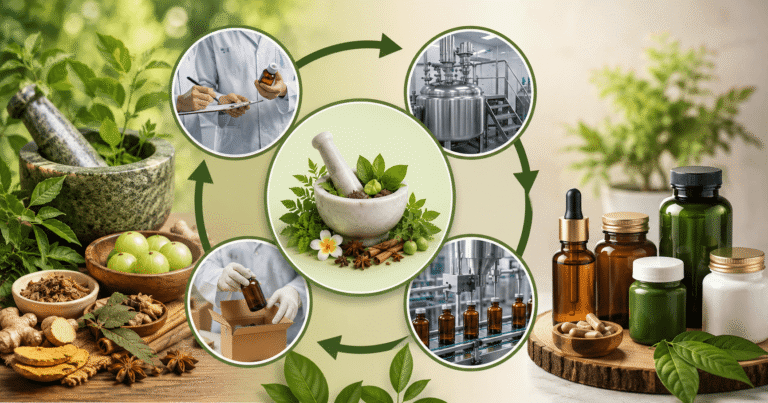
Private label manufacturing means an Ayurvedic manufacturer produces ready-made products that are sold under another company’s brand name.
The formulation, dosage composition, and often the packaging structure are already developed by the manufacturer. The buyer mainly focuses on:
- branding
- marketing
- distribution
- doctor promotion
- retail expansion
This model is common among:
- PCD pharma companies
- new Ayurvedic startups
- distributors entering own-brand business
- doctors launching wellness brands
Example:
A manufacturer already has:
- Ashwagandha capsules
- Liver tonic
- Ayurvedic cough syrup
A distributor simply adds:
- brand name
- logo
- packaging identity
and sells it in the market.
What Is Contract Manufacturing for Ayurvedic Products?
Contract manufacturing services involve manufacturing products according to the client’s custom requirements.
In this model, the buyer usually controls:
- formulation
- ingredient specifications
- dosage strengths
- packaging requirements
- brand ownership
The manufacturer mainly provides:
- infrastructure
- production capacity
- regulatory support
- batch manufacturing
- testing facilities
This model is widely used by:
- established Ayurvedic brands
- export-oriented businesses
- companies developing differentiated formulations
- large distribution networks
It is often called:
- third party manufacturing
- OEM manufacturing
- customized Ayurvedic manufacturing
depending on the agreement structure.
Why This Comparison Matters in the Indian Ayurvedic Market
Many pharma entrepreneurs enter the Ayurvedic segment believing manufacturing is the difficult part. In reality, distribution and market retention are usually harder.
The Indian Ayurvedic sector has become crowded with:
- similar formulations
- aggressive pricing
- duplicated brands
- heavy doctor dependency
- low differentiation
Choosing the wrong manufacturing model creates long-term operational problems such as:
- poor margins
- stock expiry
- weak brand recall
- delivery delays
- lack of exclusivity
- inconsistent product quality
This decision affects:
- profitability
- scalability
- market positioning
- inventory risk
- distributor confidence
especially in competitive states like Gujarat and Punjab where Ayurvedic franchise activity is extremely high.
Private Label Vs Contract Manufacturing — Core Difference
| Factor | Private Label Manufacturing | Contract Manufacturing |
|---|---|---|
| Product Development | Ready-made formulations | Customized formulations |
| Branding Control | Moderate | High |
| Initial Investment | Lower | Higher |
| Product Uniqueness | Limited | Stronger |
| Manufacturing Responsibility | Mostly manufacturer | Shared involvement |
| Speed to Market | Faster | Slower |
| MOQ Flexibility | Usually easier | Depends on project |
| R&D Requirement | Minimal | Higher |
| Market Competition | Higher | Lower if differentiated |
| Long-Term Brand Value | Moderate | Stronger |
Ground Reality in Ayurvedic Pharma Business
Many new distributors assume private label manufacturing guarantees easy profits because they own the brand name. That is not how the market works. Retailers and doctors rarely care whether a product is private label or contract manufactured. They care about product quality, availability, market demand, and whether the company is capable of selecting a reliable Ayurvedic manufacturing company that can maintain consistent supply and batch quality.
- product movement
- doctor prescriptions
- margin support
- repeat demand
- scheme structure
- stock replacement policy
A well-designed private label product can still fail if:
- pricing is unrealistic
- delivery timelines are poor
- retailer margins are weak
- marketing support is absent
Similarly, contract manufacturing can become expensive if:
- batches remain unsold
- formulation approval delays happen
- packaging revisions increase costs
- demand estimation is inaccurate
When Private Label Manufacturing Makes More Sense
1. Low Initial Investment
Private label manufacturing is often suitable for:
- first-time pharma entrepreneurs
- medical representatives
- regional distributors
- Ayurvedic retailers launching own brand
Since formulations already exist, businesses avoid:
- R&D expenses
- formulation trials
- product registration complexity
In many cases, businesses can start with comparatively smaller batch production.
2. Faster Market Launch
Private label products can enter the market quickly because:
- manufacturing processes are standardized
- raw material sourcing is already established
- packaging templates exist
This helps distributors test:
- local demand
- doctor acceptance
- retail movement
without major capital risk.
3. Easier Product Expansion
Many Ayurvedic PCD businesses begin with:
- 10–20 products
- regional monopoly distribution
- semi-urban doctor marketing
Private label manufacturing allows gradual catalog expansion without building full operational infrastructure.
Limitations of Private Label Manufacturing
Limited Exclusivity
One major issue rarely discussed openly:
The same manufacturer may supply nearly identical formulations to multiple companies with different branding.
This creates:
- pricing wars
- distributor confusion
- weak brand identity
Some companies advertise “exclusive monopoly rights,” but the formulation itself may still exist under multiple brands in nearby territories.
Weak Product Differentiation
In the Ayurvedic market:
- liver syrups
- immunity boosters
- calcium tonics
- protein powders
often contain highly similar compositions.
Without strong branding and doctor trust, products become commodity-driven.
Dependency on Manufacturer Quality
If the manufacturer changes:
- herb sourcing
- excipient quality
- batch consistency
the distributor’s market reputation suffers directly.
This is why WHO-GMP certification alone should not be treated as a guarantee of market quality. Operational consistency matters more than certificate display.
When Contract Manufacturing Is the Better Option
1. Building a Long-Term Ayurvedic Brand
Contract manufacturing becomes valuable when companies want:
- differentiated formulations
- premium positioning
- export scalability
- stronger intellectual ownership
This model supports:
- customized packaging
- formulation innovation
- market-specific products
especially in chronic wellness categories.
2. Better Margin Control
Businesses with larger distribution networks often negotiate:
- raw material standards
- packaging procurement
- production planning
This improves profitability over time if volumes increase consistently.
3. Stronger Market Identity
Doctor-focused Ayurvedic brands often prefer customized products because:
- uniqueness improves recall
- competitors cannot easily duplicate positioning
- branding becomes stronger
This matters in:
- gynecology
- diabetic wellness
- liver care
- orthopedic support
- immunity segments
where prescription dependency is high.
What Most Distributors Don’t Realize
Manufacturing Is Only One Part of the Business
Many Ayurvedic businesses fail within the first year not because of poor manufacturing, but because:
- secondary sales remain weak
- doctor conversion is slow
- retailer follow-up is inconsistent
- credit cycles damage cash flow
In smaller towns across Gujarat and Rajasthan, payment recovery itself becomes a major operational challenge.
A distributor may achieve good primary billing initially but struggle with:
- repeat orders
- stock rotation
- prescription generation
This is where real pharma business experience matters.
Common Misconceptions About Monopoly Rights
Myth: Monopoly Means No Competition
Fact:
Most monopoly rights are territory-based distribution understandings, not legal product exclusivity.
Another company may still market:
- similar formulations
- identical compositions
- competing Ayurvedic brands
in the same region.
Some manufacturers also appoint multiple distributors indirectly through:
- sub-stockists
- online channels
- alternate brand names
Always verify:
- territory terms
- product overlap policies
- online selling clauses
before investment.
Compliance Matters More Than Marketing Claims
Before choosing any manufacturing partner, check:
- AYUSH manufacturing license
- GST compliance
- batch testing process
- raw herb sourcing standards
- stability documentation
- packaging approvals
- FSSAI applicability where relevant
For regulated Ayurvedic medicines, businesses should also understand the role of:
- Central Drugs Standard Control Organization
- Drug Controller General of India
Although Ayurvedic licensing primarily falls under AYUSH authorities and state regulators, quality standards and manufacturing practices are also influenced by global guidelines promoted by the World Health Organization.
Hidden Operational Costs Most Beginners Ignore
Packaging Revisions
Even small label modifications can increase:
- printing expenses
- minimum order quantities
- inventory holding cost
Expiry Replacement Pressure
Retailers increasingly demand:
- expiry return support
- near-expiry adjustment
- scheme compensation
Many new distributors underestimate this liability.
Doctor Marketing Costs
Doctor conversion in Ayurveda is no longer inexpensive.
Expenses may include:
- MR salaries
- sample distribution
- CME participation
- clinic visits
- follow-up campaigns
Without prescription support, many Ayurvedic products move slowly in ethical channels.
Logistics and Batch Delays
Delayed production affects:
- retailer confidence
- doctor continuity
- repeat prescriptions
This problem becomes serious during seasonal demand spikes like:
- immunity products
- cough syrups
- digestive formulations
Private Label Vs Contract Manufacturing — Which Is More Profitable?
There is no universal answer.
Profitability depends on:
- distribution strength
- product positioning
- doctor network
- inventory turnover
- operational discipline
However, in practical Indian pharma trade:
Private Label Manufacturing Usually Offers:
- lower entry risk
- faster commercialization
- easier scaling initially
Contract Manufacturing Usually Offers:
- stronger long-term brand value
- better differentiation
- higher control over margins
if managed professionally.
Which Model Is Better for Small Pharma Entrepreneurs?
For most first-time entrants:
- private label manufacturing is operationally safer
because it reduces:
- capital exposure
- formulation complexity
- procurement pressure
But businesses planning serious brand development should gradually move toward:
- customized formulations
- controlled sourcing
- structured contract manufacturing
after validating market demand.
Common Mistakes While Selecting Ayurvedic Manufacturers
Choosing Only on Price
Extremely low pricing often affects:
- herbal extract quality
- packaging standards
- batch consistency
Ignoring Delivery Timelines
Late dispatch damages:
- distributor trust
- retailer confidence
- doctor continuity
Overstocking Slow Products
Many companies push excessive opening stock.
This creates:
- expiry risk
- blocked capital
- reduced working cash
especially in rural markets where product movement is slower.
Trusting Verbal Commitments
Always document:
- monopoly terms
- replacement policy
- payment conditions
- marketing support scope
- dispatch timelines
What to Check Before Investing
Evaluate the Manufacturer’s Operational Stability
Check:
- production infrastructure
- packaging capability
- batch frequency
- testing process
- complaint handling system
Understand Real Market Demand
Do not build product portfolios only based on manufacturer suggestions.
Study:
- prescription patterns
- retailer movement
- regional demand
- price sensitivity
Verify Supply Chain Reliability
A good Ayurvedic supply chain requires:
- raw herb consistency
- timely procurement
- stable packaging vendors
- inventory planning
Frequent stock-outs damage brand credibility quickly.
Decision Framework — Which Option Fits Your Business?
| Business Situation | Better Choice |
|---|---|
| New distributor with low investment | Private label manufacturing |
| Doctor launching own wellness brand | Private label initially |
| Established pharma marketer | Contract manufacturing |
| Export-oriented Ayurvedic business | Contract manufacturing |
| Regional retail-focused business | Private label |
| Custom formulation requirement | Contract manufacturing |
| Fast market entry needed | Private label |
| Long-term brand building | Contract manufacturing |
Conclusion
The debate around Private label Vs Contract Manufacturing is not about which model is universally better. It is about which model aligns with your:
- investment capacity
- market experience
- operational capability
- long-term business vision
Private label manufacturing works well for faster entry and lower operational pressure. Contract manufacturing becomes valuable when businesses want stronger formulation ownership, customization, and scalable brand development.
In the Ayurvedic industry, sustainable growth depends less on fancy brochures and more on:
- consistent supply
- ethical marketing
- retailer trust
- doctor confidence
- disciplined inventory management
Compare manufacturers carefully, verify operational claims practically, and avoid making investment decisions based only on monopoly promises or low pricing.
Private Label Vs Contract Manufacturing - FAQs
What is the difference between private label and contract manufacturing?
Is private label manufacturing profitable in India?
Is contract manufacturing better for Ayurvedic startups?
Are monopoly rights legally protected in PCD pharma?
What certifications should an Ayurvedic manufacturer have?
ABOUT THE AUTHOR

Mitesh Vyas
My name is Mitesh Vyas, and I am a Pharma Franchise Consultant and Industry Research Analyst specializing in India’s PCD pharma business ecosystem. My work focuses on helping beginners, distributors, and small pharma entrepreneurs understand the real-world functioning of the pharma franchise model. Unlike theoretical content, my insights are based on ground-level observations from Indian pharmaceutical markets, including Tier-1, Tier-2, and Tier-3 cities such as Ahmedabad, Indore, Lucknow, and surrounding business hubs. I regularly share insights on how the pharma franchise business in India works in real market conditions, including investment, product strategy, and growth challenges.