
The nutraceutical market in India is booming. From protein powders and multivitamins to herbal capsules and immunity boosters, demand is rising across Tier-1, Tier-2, and even Tier-3 cities.
And because of that, nutraceutical third party pharma manufacturing in India has become the go-to model for:
- New startup brands
- Pharma distributors expanding into wellness
- Influencers launching private-label supplements
On paper, it looks simple:
Choose a product → Find a manufacturer → Launch your brand
But in real market conditions, it rarely works that smoothly.
In my experience auditing and working with multiple brands:
- 60–70% of first-time nutraceutical brands struggle in the first 6 months
- Most failures are not due to marketing — but due to manufacturing decisions
This guide breaks down what actually happens on the ground — not what brochures claim.
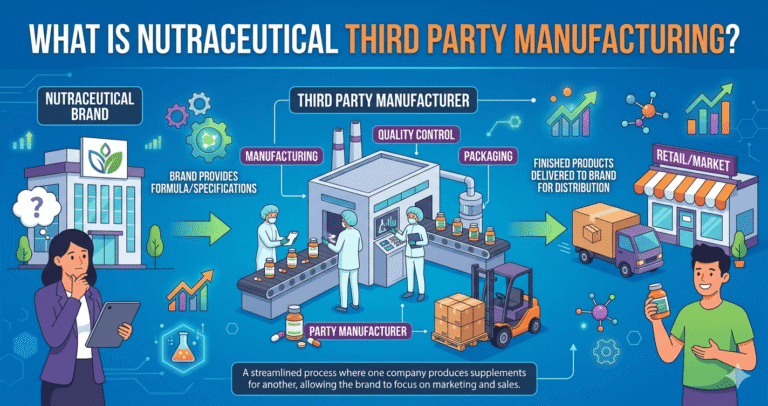
What Is Nutraceutical Third Party Manufacturing?
In simple terms, it means:
A company manufactures nutraceutical products (like tablets, capsules, powders) on your brand name, while you handle branding, marketing, and sales.
It is often confused with:
- Contract manufacturing → More customized, higher control
- White-label manufacturing → Pre-made formulas with your label
In India, most “third party manufacturing” is actually a mix of white-label + semi-custom formulation
How It Actually Works in India
Here’s the real flow — not the ideal one shown in presentations:
Step 1: Product Selection
Most beginners choose common products like multivitamins, protein powders, and calcium tablets because they seem safe. However, these categories are already highly saturated in the Indian market. Without differentiation, your product struggles to stand out or gain retailer interest. Smart selection based on niche demand is critical.
Most beginners pick:
- Multivitamins
- Protein powders
- Calcium tablets
Reality:
In 70% of cases, these categories are already overcrowded.
Step 2: Manufacturer Shortlisting
Many manufacturers claim GMP certification, FSSAI approval, and premium quality standards. But in reality, several outsource production or use inconsistent raw materials to cut costs. Some even showcase outdated or incomplete certifications. Proper verification is essential before finalizing a partner, especially when evaluating third party pharma manufacturing companies.
You’ll find vendors claiming:
- GMP certified
- FSSAI approved
- “Premium quality”
Reality:
Many are:
- Outsourcing further
- Using low-grade raw materials
- Showing certifications that are outdated or partial
Step 3: Sample Development
Getting samples is not enough — testing them properly is where most brands fail. Key factors like taste, dissolution rate, smell over time, and stability in different conditions are often ignored. These directly impact customer experience and repeat sales. A weak sample stage leads to long-term brand damage.
You receive samples.
What most people don’t check:
- Taste (especially powders)
- Dissolution rate
- Smell after 15 days
- Stability in humidity
This is where many brands make their first mistake.
Step 4: MOQ & Pricing
Minimum order quantity (MOQ) varies depending on product type and manufacturer capacity. Lower MOQ may look attractive initially but often results in higher per-unit cost or compromised quality. Understanding the full pricing structure helps avoid hidden losses. Balance between cost and quality is crucial.
Typical MOQ:
- Tablets/Capsules: 1000–5000 units
- Powders: 500–2000 jars
Reality Insight:
Lower MOQ often = higher cost per unit OR compromised quality.
Step 5: Production & Delivery
Manufacturers usually promise delivery within 20–30 days to secure orders. In real scenarios, delays are common due to raw material shortages, batch processing issues, or production overload. This can extend timelines to 35–60 days or more. Such delays can impact your launch plans and cash flow.
Promised timeline: 20–30 days
- Actual timeline (in many cases):
35–60 days (due to raw material delays, batch issues, or overload)
Read More:- Third Party Pharma Manufacturing In Ahmedabad
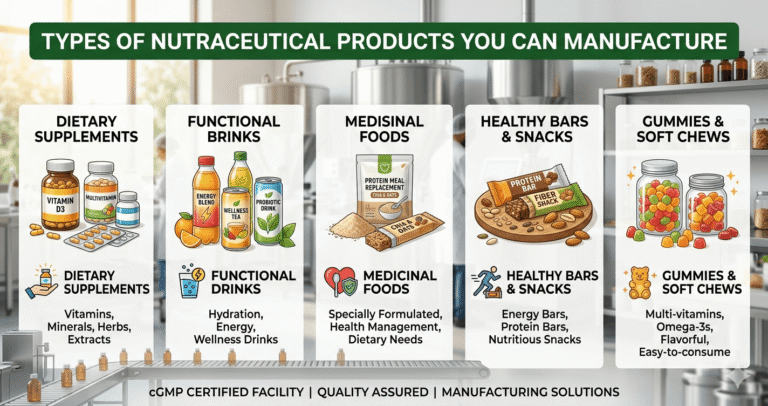
Types of Nutraceutical Products You Can Manufacture
From my field exposure, these are the most commonly outsourced products:
1. Tablets & Capsules
This is the most common and easy-to-manufactured nutraceutical segment, including multivitamins, herbal extracts, and calcium combinations. Production is standardized and widely available across manufacturers. However, competition is extremely high, making it difficult for new brands to stand out. Strong branding and positioning are essential for success.
- Multivitamins
- Herbal extracts
- Calcium + D3
Easy to manufacture, but highly competitive
2. Protein Powders
Protein powders like whey, mass gainers, and plant-based proteins are in high demand, especially among fitness consumers. The biggest challenge is achieving good taste, smooth mixability, and consistency across batches. Poor flavor or texture leads to quick customer rejection. Quality formulation plays a major role in repeat sales.
- Whey protein
- Mass gainers
- Plant protein
Biggest challenge: taste + mixability
3. Sachets & Effervescent Tablets
This category includes energy drinks, vitamin C sachets, and effervescent tablets, which are gaining popularity due to convenience. Manufacturing is more complex due to formulation stability and packaging requirements. Small errors can affect product performance and shelf life. It offers good growth potential but needs the right manufacturer.
- Energy drinks
- Vitamin C
Growing demand, but higher production complexity
4. Syrups & Liquid Supplements
Liquid nutraceuticals like herbal tonics and liver support syrups are widely used in traditional and modern wellness markets. The main challenge lies in maintaining shelf life, proper preservation, and taste stability. Packaging and storage conditions also impact product quality. Careful formulation and testing are critical in this segment.
- Herbal tonics
- Liver support
Shelf-life and preservation become critical
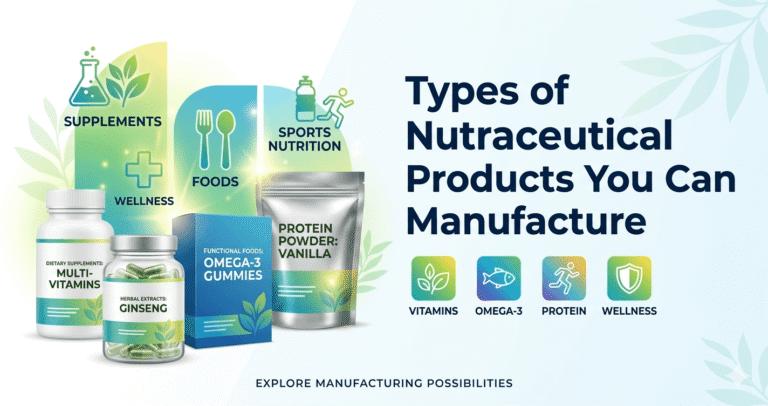
Types of Nutraceutical Products You Can Manufacture
From my field exposure, these are the most commonly outsourced products:
1. Tablets & Capsules
- Multivitamins
- Herbal extracts
- Calcium + D3
Easy to manufacture, but highly competitive
2. Protein Powders
- Whey protein
- Mass gainers
- Plant protein
Biggest challenge: taste + mixability
3. Sachets & Effervescent Tablets
- Energy drinks
- Vitamin C
Growing demand, but higher production complexity
4. Syrups & Liquid Supplements
- Herbal tonics
- Liver support
Shelf-life and preservation become critical
Real Benefits
Let’s be practical — this model does work, but under conditions.
Low Initial Investment
You can start between ₹1.5 lakh to ₹5 lakh
But:
- Poor planning = dead stock
No Manufacturing Setup Needed
You don’t need machinery or licenses like a factory
But:
- You depend entirely on the manufacturer’s reliability
Faster Market Entry
You can launch in 30–60 days
But:
- Only if formulation, packaging, and approvals are aligned
Hidden Challenges & Failure Reasons
This is where most blogs stay silent.
1. Quality Inconsistency
In 60% of cases I’ve seen:
- First batch is good
- Second batch quality drops
Why?
- Raw material source changes
- Cost-cutting by manufacturer
2. Overcrowded Product Selection
Most beginners pick:
- Generic multivitamins
- Basic protein powders
Result: No differentiation → No sales
3. Packaging Mistakes
Real issue:
- Cheap jars
- Poor label design
- Non-compliant labeling
Retailers reject or ignore such products
4. Credit Cycle Pressure
Retailers often demand:
- 30–60 days credit
But manufacturer wants:
- Advance or partial payment
This creates cash flow stress
What Most Nutraceutical Manufacturers Won’t Tell You
This is the part nobody openly discusses.
Hidden Cost Layers
Quoted price often excludes:
- Flavoring cost
- Packaging upgrades
- Lab testing charges
Final cost can increase by 20–40%
White Label Trap
Many manufacturers:
- Offer ready formulas
- Sell same product to multiple brands
You lose uniqueness instantly
Delivery Delays Are Normal
Even “top manufacturers”:
- Delay batches
- Prioritize bigger clients
Small brands get pushed back
No Sales Support
Unlike the PCD pharma franchise in India model:
Manufacturers don’t help in:
- Doctor promotion
- Market strategy
- Distribution
You are on your own.
Real Case Scenarios
Case 1: ₹2 Lakh Investment — No Movement
A startup in Ahmedabad launched:
- Multivitamin tablets
- Protein powder
Problem:
- No differentiation
- Weak branding
Result:
70% stock unsold after 4 months
Case 2: Cheap Manufacturer Choice
A distributor chose a low-cost vendor.
Issue:
- Powder taste was poor
- Complaints from customers
Outcome:
Brand reputation damaged in 2 months
Case 3: Delivery Delay Impact
A brand planned a festive launch.
Manufacturer delay: 25 days
Result:
Missed sales window → heavy loss
Who Should & Should NOT Start This
Ideal For:
- Pharma distributors expanding into wellness
- Digital-first brands (Instagram, Amazon sellers)
- Entrepreneurs with marketing strength
Not Ideal For:
- People expecting “quick profit”
- Those with no sales channel
- Those choosing only based on lowest price
Step-by-Step Safe Manufacturing Strategy
Step 1: Choose a Niche Product
Avoid generic categories
Example: Instead of “multivitamin” → go for “women’s hair nutrition formula”
Step 2: Shortlist 3–5 Verified Manufacturers
Check:
- FSSAI license
- GMP certification
- Real client reviews
Step 3: Test Samples Seriously
Don’t just see — test:
- Taste
- Stability
- Packaging durability
Step 4: Understand Full Cost Structure
Ask clearly:
- Per unit cost
- Packaging cost
- Testing charges
Step 5: Start With Minimum Risk Batch
- Don’t overstock
- Begin with limited quantity
Step 6: Build Sales Before Scaling
Focus on:
- Online channels
- Retail tie-ups
Expert Mistakes to Avoid
Choosing Manufacturer Based on Price Only
Cheap often becomes expensive later
Ignoring Branding
In nutraceuticals:
Branding = Trust = Sales
Overestimating Demand
Most beginners assume fast sales
Reality: Takes 3–6 months
Not Understanding Compliance
FSSAI labeling mistakes can:
Lead to product rejection
Conclusion:
Nutraceutical third party pharma manufacturing in India is a powerful business model — but only for those who approach it strategically.
From what I’ve seen on the ground:
- Success depends more on product positioning + manufacturer selection
- Not just on investment
If you treat it like a shortcut business, it fails.
If you treat it like a brand-building process, it works.
Nutraceutical Third Party Pharma Manufacturing In India: FAQs
1. What is the minimum investment required?
2. Is FSSAI license mandatory?
3. What is the ideal MOQ?
4. How long does manufacturing take?
5. Can I create my own formula?
Reference:
ABOUT THE AUTHOR

Mitesh Vyas
My name is Mitesh Vyas, and I am a Pharma Franchise Consultant and Industry Research Analyst specializing in India’s PCD pharma business ecosystem. My work focuses on helping beginners, distributors, and small pharma entrepreneurs understand the real-world functioning of the pharma franchise model. Unlike theoretical content, my insights are based on ground-level observations from Indian pharmaceutical markets, including Tier-1, Tier-2, and Tier-3 cities such as Ahmedabad, Indore, Lucknow, and surrounding business hubs. I regularly share insights on how the pharma franchise business in India works in real market conditions, including investment, product strategy, and growth challenges.