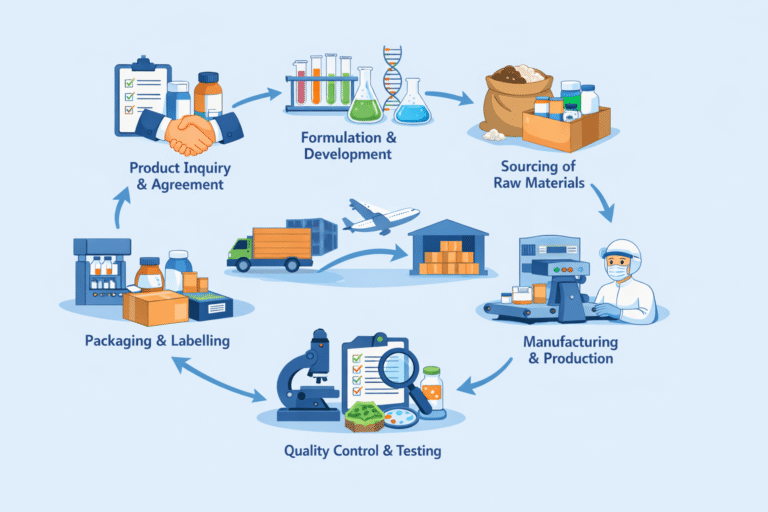
Third party pharma manufacturing works by outsourcing the production of medicines to a licensed manufacturer while you focus on branding, marketing, and distribution. You select products, finalize formulations and packaging, place an order with a manufacturer, and they produce and deliver finished goods under your brand name.
If you’re entering the pharma business today, this is the model almost everyone starts with. But here’s the truth from real ground experience:
In 70% of cases I’ve seen, businesses don’t fail because of low demand — they fail because they don’t understand how third party manufacturing actually works behind the scenes.
This guide breaks down the real process, real risks, and real execution strategy — not just theory.
What is Third Party Pharma Manufacturing?
Third party pharma manufacturing (also called contract manufacturing pharma India) is a business model where you don’t own a factory.
Instead:
- You own the brand
- The manufacturer owns the production
- You handle sales, marketing, and distribution
This model powers:
- Most PCD pharma business in India
- Many startups entering pharma without heavy investment
How Third Party Pharma Manufacturing Actually Works
1. You identify products
You start by selecting the products you want to sell based on market demand and doctor preferences. This decision directly impacts your sales, so choosing the right molecules is more important than just following trends.
2. You approach manufacturers with requirements
Once products are finalized, you contact third party manufacturers and share your requirements like composition, dosage form, and packaging expectations. This is where your business idea starts taking shape into an actual product.
3. They provide pricing based on batch size and specs
Manufacturers give quotations depending on quantity, formulation, and packaging type. Pricing can vary significantly, so understanding what’s included (or excluded) is crucial before making a decision.
4. You finalize: Composition, Packaging design, Brand name
At this stage, you lock the product formula, design your packaging, and decide your brand identity. Strong branding and clear positioning play a big role in how your product is accepted in the market.
5. You place order + advance payment
After finalizing everything, you confirm the order and pay an advance to initiate production. Most manufacturers require partial payment upfront to begin raw material procurement and scheduling.
6. Manufacturer starts: Raw material procurement, Production, Quality testing
The manufacturer sources raw materials, produces the batch, and conducts quality checks as per regulatory standards. This stage ensures your product meets safety and efficacy requirements.
7. Finished goods are packed and dispatched to you
Once production is complete, products are packed with your branding and shipped to your location. Delivery timelines depend on packaging readiness and logistics coordination.
Step-by-Step Process of Third Party Pharma Manufacturing
Step 1: Product Selection
This is where most beginners go wrong.
Mistake: Choosing random high-demand products
Reality: Demand ≠ Sales
In real markets like Ahmedabad, Indore, Lucknow — doctors already have preferred brands.
What works:
- Start with 5–10 focused products
- Choose fast-moving + prescription-friendly molecules
- Avoid overcrowded segments initially
Step 2: Manufacturer Shortlisting
Not all manufacturers are equal.
Beginner mistake: Choosing lowest price
Smart approach:
- Check certifications (WHO-GMP, ISO)
- Verify market reputation
- Ask for existing client references
In 60–70% of cases, new pharma marketers depend entirely on manufacturers — and that’s risky if the vendor is unreliable.
Step 3: Quotation & Negotiation
You’ll receive quotes based on:
- Batch size
- Packaging type
- Composition
Hidden reality:
- Lower price often = compromised quality or delayed delivery
Smart buyer vs beginner:
- Beginner: “Give me cheapest rate”
- Smart: “Give me consistent quality + timely delivery”
Step 4: Documentation & Approvals
This includes:
- Drug license (your side)
- Agreement with manufacturer
- Product approvals
Most beginners misunderstand this step and delay business launch. Without proper documentation, your stock cannot legally move in the market.
Step 5: Production & Quality Check
Here’s what actually happens:
- Raw materials sourced
- Batch manufactured
- Tested for quality compliance
Ground reality:
Production is usually not the delay point — quality checks and approvals are.
Step 6: Packaging & Dispatch
This is where most delays happen. In most cases, delays happen during packaging, not production.
Reasons:
- Design finalization delays
- Packaging material shortage
- Printing errors
Real Business Scenarios
Case 1: Wrong Manufacturer Choice
A distributor invested ₹2 lakh but chose a cheap vendor.
Result:
- Delayed delivery (45+ days)
- Poor packaging quality
- Doctors rejected products
Case 2: Delay Affecting MR Activity
Stock arrived late → medical reps had nothing to promote
Result:
- Market entry failed
- Loss of trust with doctors
Case 3: Overstocking & Expiry
Beginner ordered large quantity to reduce cost
Result:
- Slow movement
- Expiry losses
Benefits of Third Party Pharma Manufacturing
1. Low Investment
Third party pharma manufacturing requires relatively low initial investment compared to setting up your own plant. However, this benefit only holds if you carefully control product selection and avoid overstocking, which can block your capital and increase risk. To make the most of this advantage, it’s important to understand how the third party manufacturing process actually works before making any investment decisions.
2. Faster Market Entry
This model allows you to launch your pharma brand quickly since manufacturing infrastructure is already in place. But in real scenarios, your speed depends entirely on the manufacturer—any delay in production or packaging can disrupt your market entry.
3. No Need for Factory Setup
You don’t need to invest in machinery, staff, or regulatory approvals for a manufacturing unit, making it ideal for beginners. The downside is long-term dependency on the manufacturer for quality, timelines, and consistency.
Hidden Challenges & Failure Reasons
1. Stock Doesn’t Move
One of the most common issues is slow-moving stock, mainly due to lack of doctor trust and weak medical representative (MR) strategy. Even good products fail if they are not properly promoted or prescribed in the local market.
2. Credit Cycle Issues
In the pharma market, retailers and distributors often demand credit, which blocks your working capital. If not managed carefully, this can create cash flow pressure and limit your ability to reinvest in stock or marketing.
3. Doctor Resistance
Doctors are usually loyal to established brands, making it difficult for new products to get prescriptions. Without consistent follow-ups, samples, and relationship building, your brand may struggle to gain acceptance.
What Most Pharma Companies Won’t Tell You
Hidden Costs:
- Packaging upgrades
- Small batch cost increase
- Logistics expenses
Quality Compromises:
Cheap manufacturers may:
- Use lower-grade raw materials
- Cut corners in packaging
Dependency Risk:
You depend on:
- Their timelines
- Their consistency
Biggest Truth:
Manufacturing is easy — selling is the real challenge.
Comparative Analysis
Good Manufacturer vs Poor Manufacturer
Smart Buyer vs Beginner
Who Should Start & Who Should Avoid This Model
Ideal For:
- New entrepreneurs entering pharma
- Distributors expanding business
- People exploring starting a pharma franchise
Avoid If:
- You expect quick profit without effort
- You don’t have sales strategy
- You rely only on manufacturer
5-Step Safe Entry Strategy
Step 1: Market Research
Start by understanding what doctors are actually prescribing in your target area and which brands are already dominating. Studying competitor products helps you avoid saturated segments and identify real opportunities for entry.
Step 2: Product Selection
Choose a focused range of 5–10 products instead of trying to cover everything at once. A limited, well-planned portfolio makes it easier to promote effectively and build trust in the market.
Step 3: Manufacturer Verification
Before finalizing any manufacturer, verify certifications like WHO-GMP and check their market reputation through existing clients. A reliable manufacturer ensures consistent quality and prevents future supply issues.
Step 4: Investment Planning
Plan your budget smartly within ₹1.5–3 lakh by balancing product cost, packaging, and marketing expenses. Avoid over-investing in stock initially and keep funds available for promotion and market expansion.
Step 5: Sales Execution
Your success depends heavily on how well you promote your products to doctors and retailers. Whether you hire a medical representative or do it yourself, consistent follow-ups and relationship building are key to generating prescriptions.
Expert Mistakes to Avoid
- Choosing cheapest manufacturer
- Ordering large quantities initially
- Ignoring branding & packaging
- Depending 100% on manufacturer
- Skipping market research
Conclusion
Third party pharma manufacturing is one of the most practical and scalable entry models in the pharmaceutical industry, especially for beginners who want to start without heavy investment. But the reality is clear — success in this business is not just about getting products manufactured; it’s about making the right decisions at every stage, from product selection to manufacturer choice and, most importantly, sales execution.
In real market conditions, the biggest challenge is not production but generating consistent demand. Many beginners fail because they focus too much on cost and ignore market dynamics like doctor trust, branding, and follow-ups. On the other hand, those who treat this as a structured business — with proper planning, controlled investment, and a strong marketing approach — are able to build a sustainable and profitable pharma brand.
If you approach third party manufacturing with the right strategy, realistic expectations, and focus on long-term growth, it can become a powerful foundation for success in the pharma industry.
How Third Party Pharma Manufacturing Works ? : FAQs
References