
Pharma exports look extremely attractive from the outside—high margins, dollar revenue, and global demand. But in reality, this is one of the most compliance-heavy, relationship-driven, and documentation-sensitive business models in the entire pharma industry.
In my 10+ years of working with Indian pharma manufacturers and export-focused companies, one pattern is very clear:
Almost 60–70% of first-time pharma exporters struggle or fail within the first 18–24 months—not because of demand, but because of poor export strategy.
Most companies assume exporting is just “sending products abroad.” But in real markets like Africa, GCC, LATAM, and CIS countries, export success depends on regulatory alignment, pricing intelligence, buyer credibility, and long-term supply discipline.
This guide breaks down the real export strategy for pharma companies, based on ground experience—not theory.
You will learn:
- How pharma exports actually work in real markets
- Why most companies fail in international expansion
- Country-wise opportunity logic
- Real case scenarios from the field
- A step-by-step export strategy framework
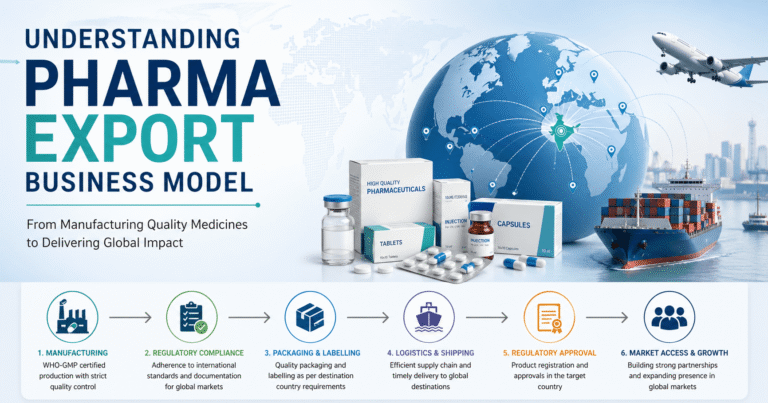
Understanding Pharma Export Business Model
The pharma export business model is not a simple B2B trade model. It operates at the intersection of:
- Regulatory compliance (WHO-GMP, COPP, country-specific approvals)
- International distribution networks
- Tender-based procurement systems (especially Africa & UN agencies)
- Private distributor-based supply chains
In reality, there are 3 dominant export models:
1. Direct Buyer Model
In this model, pharma companies directly connect with international distributors or importers without any intermediaries. It offers better control over pricing, margins, and long-term relationships. However, it requires strong buyer sourcing and trust-building in foreign markets.
2. Agent/Middleman Model
Here, a third-party agent acts as a bridge between the manufacturer and foreign buyers in exchange for commission. It is easier for market entry but often reduces profit margins and limits direct customer relationships. Over-reliance on agents can also create dependency risks.
3. Tender-Based Model
This model involves supplying pharmaceutical products through government, institutional, or NGO tenders such as UN or health ministries. It ensures large-volume orders but comes with strict compliance, documentation, and competitive bidding requirements.
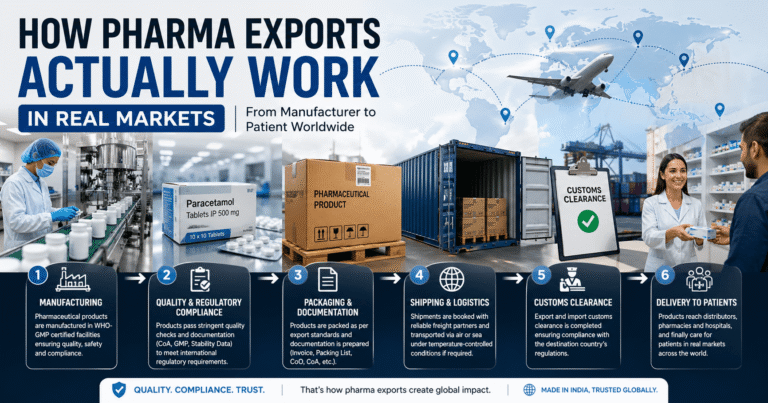
How Pharma Exports Actually Work in Real Markets
On paper, export looks simple:
Manufacturer → Export Documentation → Shipping → Buyer
But in reality, the process is much deeper:
Step 1: Market Entry Selection
Selecting the right country is the foundation of a successful pharma export strategy. Each region has different risk levels, payment behavior, and demand patterns—Africa offers volume but higher risk, while GCC provides stability with strict compliance. Wrong selection at this stage often leads to poor sales and blocked capital.
Choosing the wrong country is the first major mistake. For example:
- Africa = High volume, high risk, payment delays
- GCC = High compliance, stable payments
- LATAM = Branding-driven market
- CIS = Price-sensitive but stable demand
Step 2: Regulatory Approval
Every export destination requires specific documentation such as WHO-GMP, COPP, Free Sale Certificate, and product registration dossiers. These approvals are time-consuming and vary by country regulations. Many companies lose international deals simply because they underestimate the 2–6 month approval timelines.
Each country demands different documentation:
- WHO-GMP
- COPP (Certificate of Pharmaceutical Product)
- Free Sale Certificate
- Product registration dossiers
Many Indian companies lose deals here because they underestimate documentation timelines (often 2–6 months per country).
Step 3: Buyer Validation
Validating buyers is critical in pharma exports because fake inquiries and non-serious agents are very common in global markets. Without proper verification, companies risk shipping to unreliable partners, leading to payment delays or losses. Strong due diligence ensures safer and long-term trade relationships.
In real export markets, fake inquiries are extremely common, especially from unknown agents.
Step 4: Pricing Negotiation
Pricing in pharma exports is influenced by multiple factors including global competition, currency fluctuations, and freight costs. Companies must balance competitiveness with profitability while considering market-specific price sensitivity. Poor pricing strategy can either kill deals or reduce long-term margins significantly.
Margins are decided based on:
- Competition from India, China, Turkey
- Currency fluctuation
- Freight costs
Key Benefits of Pharma Export Business
Despite the complexity, pharma exports remain one of the strongest growth engines for manufacturers.
1. Higher Revenue Potential
Pharma exports usually offer significantly higher margins compared to domestic sales, often in the range of 20–60% depending on the market and product category. This creates strong revenue growth opportunities for manufacturers. However, pricing must still align with competition and compliance requirements to remain sustainable.
2. Currency Advantage
Export business is largely dollar-based, which helps companies reduce dependency on INR fluctuations. Payments in foreign currency provide better financial stability and improve profit predictability. This becomes especially beneficial during domestic market price pressure or inflation cycles.
3. Brand Positioning
Successful pharma exports significantly strengthen a company’s credibility in the domestic market. International presence creates a perception of higher quality and compliance standards. This indirectly improves trust with Indian distributors, hospitals, and franchise partners, especially when companies are associated with reliable pharma contract manufacturing in India.
4. Bulk Order Potential
Export markets often generate large-volume orders compared to domestic sales channels. International buyers prefer consolidated shipments and long-term supply contracts. This helps manufacturers achieve better production planning and improved economies of scale.
International buyers often place larger MOQ orders than domestic markets.
However, these benefits only apply when execution is correct. Otherwise, working capital gets stuck in logistics and unpaid shipments.
Major Challenges in Pharma Export Business
1. Regulatory Complexity
Pharma export regulations vary significantly from country to country, making compliance one of the biggest challenges. A formulation approved in one market like Kenya may require completely different documentation or even reformulation for UAE. This creates delays and increases the cost of market entry for exporters.
2. Payment Risks
Payment cycles in international pharma trade can be unpredictable, especially in African markets where delays of 90–180 days are common. This directly impacts cash flow and working capital planning for manufacturers. Without proper payment security like LC or advance terms, exporters face high financial exposure.
3. Fake Buyers & Middlemen
A major hidden challenge in pharma exports is the presence of non-serious inquiries and broker-driven leads. In my experience, nearly 40% of initial export inquiries do not convert into genuine business. Without proper buyer verification, companies often waste time, resources, and pricing bandwidth.
4. Freight & Logistics Issues
Export logistics in pharma is highly sensitive due to temperature control, customs clearance, and documentation accuracy. Even minor errors can lead to shipment delays or product rejection at ports. Proper coordination between CHA agents, logistics partners, and documentation teams is critical for smooth delivery.
Country-Wise Export Opportunity Analysis
Africa (Nigeria, Kenya, Ghana)
- High volume demand
- Fast-moving generics
- High payment risk
- Strong dependency on Indian manufacturers
In 70% of African deals I’ve handled, success depends more on trust than pricing.
GCC (UAE, Saudi Arabia, Oman)
- Highly regulated markets
- Strong compliance requirement
- Stable payment structure
- High brand value opportunity
LATAM (Brazil, Mexico, Chile)
- Brand-focused buyers
- Requires strong dossier preparation
- Moderate competition
CIS Countries (Russia, Uzbekistan, Kazakhstan)
- Price-sensitive market
- Large institutional demand
- Government procurement-driven
What Most Pharma Companies Won’t Tell You About Exports
This is the reality most brochures hide:
- Many export inquiries are not genuine buyers—they are commission agents
- WHO-GMP alone does not guarantee market entry
- Registration delays can kill cash flow planning
- Some countries intentionally delay payments in bulk supply contracts
- “Guaranteed export orders” from consultants are often misleading
In real-world consulting, I’ve seen companies invest heavily in exports but struggle due to dependency on unreliable intermediaries.
Real Case Scenarios
Case 1: Africa Payment Delay Trap
A Gujarat-based manufacturer shipped ₹1.8 crore worth of antibiotics to West Africa. Payment cycle extended to 210 days, causing severe working capital pressure.
Case 2: GCC Documentation Failure
A mid-sized company lost a UAE tender due to incorrect product labeling format—even after winning price negotiations.
Case 3: Successful CIS Expansion
A small Indian exporter started with 3 SKUs in Uzbekistan and scaled to 25+ products within 18 months using a tender-based supply strategy.
Who Should Enter Pharma Export Business
Suitable For:
- WHO-GMP certified manufacturers
- Companies with strong documentation teams
- Businesses with working capital buffer
- Firms willing to invest in compliance
Not Suitable For:
- Low-capital startups expecting quick returns
- Companies without regulatory understanding
- Businesses dependent only on domestic trade mindset
Step-by-Step Export Strategy Framework
Step 1: Select Target Market Based on Demand + Risk
Choosing the right export destination is the foundation of success in pharma exports. Countries should be selected based on demand potential, regulatory ease, payment behavior, and political risk. Random targeting often leads to wasted effort, blocked inventory, and delayed growth.
Step 2: Build Export Documentation Base
A strong documentation foundation is essential for smooth international approvals. Key requirements include WHO-GMP certification, COPP, and complete product dossiers. Without these, companies often face delays or rejection during regulatory evaluation in target countries.
Step 3: Finalize Product Portfolio
Not all products perform equally in export markets, so selection must be strategic. High-demand categories like antibiotics, injectables, and chronic care medicines generally perform better due to consistent global demand. A focused portfolio improves approval chances and buyer interest.
Step 4: Identify Real Buyers
Finding genuine buyers is one of the most critical steps in pharma exports. Many inquiries come from brokers or non-serious intermediaries, leading to wasted time and pricing confusion. Direct, verified buyers ensure stable long-term business relationships.
Step 5: Build Pricing Strategy
Export pricing must account for multiple cost components including freight, profit margin, and currency fluctuation risk. A poorly structured pricing strategy can either kill competitiveness or reduce profitability. Smart pricing ensures both deal conversion and sustainable margins.
Step 6: Start Small Shipments
Instead of large initial commitments, companies should begin with small trial shipments. This helps build trust, verify buyer behavior, and reduce financial risk. Gradual scaling ensures more controlled and predictable export growth.
Step 7: Scale Through Repeat Orders or Tenders
Sustainable export growth comes from repeat business and institutional tenders rather than one-time orders. Once trust is established, companies can expand volumes or participate in government and NGO tenders for larger contracts and stable demand.
Common Mistakes to Avoid in Pharma Export Business
- Entering too many countries at once
- Ignoring documentation timelines
- Relying only on agents
- Underpricing products for competition
- Not verifying buyer credibility
- Overestimating first export order success
Expert Insights from Field Experience
In my experience:
- Export success is 30% product + 70% execution
- Trust is more important than pricing in Africa
- Compliance delays are the biggest silent profit killer
- Companies that focus on 1–2 regions first scale faster than those targeting 10 countries
Conclusion:
Pharma exports are not just a business expansion strategy—they are a long-term operational transformation.
Companies that treat exports as “just international sales” usually fail. But those that build systems around compliance, documentation, and buyer trust create long-term global businesses.
The real export strategy for pharma companies is simple in principle but difficult in execution:
- Choose the right market
- Build compliance strength
- Validate buyers carefully
- Scale gradually with discipline
If executed correctly, pharma exports can become one of the most stable and scalable revenue streams for Indian manufacturers.
Export Strategy for Pharma Companies: FAQs
1. What is the best country for pharma exports from India?
2. How long does it take to start pharma exports?
3. Is pharma export business profitable?
4. What are the main risks in pharma export business?
5. Do small manufacturers succeed in exports?
Reference:
ABOUT THE AUTHOR

Mitesh Vyas
My name is Mitesh Vyas, and I am a Pharma Franchise Consultant and Industry Research Analyst specializing in India’s PCD pharma business ecosystem. My work focuses on helping beginners, distributors, and small pharma entrepreneurs understand the real-world functioning of the pharma franchise model. Unlike theoretical content, my insights are based on ground-level observations from Indian pharmaceutical markets, including Tier-1, Tier-2, and Tier-3 cities such as Ahmedabad, Indore, Lucknow, and surrounding business hubs. I regularly share insights on how the pharma franchise business in India works in real market conditions, including investment, product strategy, and growth challenges.