
Ayurvedic PCD Pharma Vs Allopathic PCD Pharma : Choosing between Ayurvedic PCD Pharma and Allopathic PCD Pharma is one of the first strategic decisions any pharma franchise seeker must make. Both business models offer attractive opportunities in the Indian healthcare market, but they operate very differently in terms of regulatory requirements, product demand, doctor dependency, investment size, and profit margins.
An Ayurvedic PCD Pharma business focuses on herbal, plant-based, and wellness-oriented formulations regulated by the Ministry of AYUSH. These products are commonly used for immunity, digestion, liver support, joint care, and overall wellness. In contrast, an Allopathic PCD Pharma business deals with conventional medicines such as antibiotics, analgesics, antacids, and chronic care therapeutics regulated by the Central Drugs Standard Control Organization and supervised by the Drugs Controller General of India.
At first glance, both franchise models may appear similar because both provide monopoly rights, promotional materials, and product distribution opportunities. However, the day-to-day business realities are quite different. Ayurvedic products often benefit from rising consumer interest in natural and holistic healthcare, while allopathic products typically depend more heavily on prescription support from doctors and established relationships with chemists.
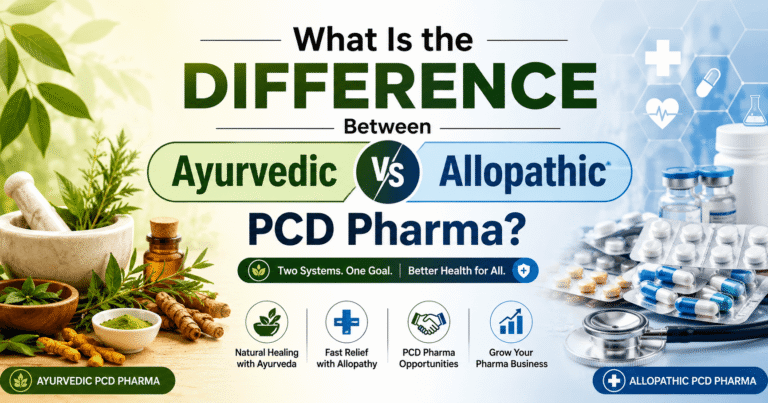
What Is the Difference Between Ayurvedic and Allopathic PCD Pharma?
A PCD (Propaganda Cum Distribution) Pharma franchise allows an individual or distributor to market and sell a company’s products in a defined territory.
- Ayurvedic PCD Pharma deals in herbal, classical, proprietary Ayurvedic, and nutraceutical products.
- Allopathic PCD Pharma deals in conventional medicines such as antibiotics, analgesics, antacids, and chronic care therapeutics.
Both models use similar distribution structures, but their regulatory pathways, doctor dependency, margins, and market behavior differ significantly.
Expert Summary: Why This Comparison Matters
Many new pharma entrepreneurs choose a franchise model based only on product price or promotional materials. In practice, the success of your business depends more on doctor acceptance, product movement, inventory control, and the company’s operational discipline.
Choosing between Ayurvedic and allopathic PCD pharma affects: Ayurvedic PCD Pharma Vs Allopathic PCD Pharma
- Initial investment requirements
- Drug licensing obligations
- Prescription dependency
- Market competition
- Product expiry risk
- Customer acquisition strategy
- Regulatory compliance
The right decision should match your local market realities rather than broad industry trends.
Ayurvedic PCD Pharma vs Allopathic PCD Pharma: Quick Comparison Table
| Parameter | Ayurvedic PCD Pharma | Allopathic PCD Pharma |
|---|---|---|
| Regulatory Authority | Ministry of AYUSH | CDSCO / DCGI |
| Prescription Requirement | Often OTC and recommendation-driven | Primarily prescription-based |
| Drug License Requirement | May be less restrictive for some categories | Mandatory wholesale/retail drug license |
| Competition Level | Moderate but increasing | Extremely competitive |
| Margins | Usually higher | Moderate to high depending on segment |
| Doctor Dependency | Moderate | Very high |
| Market Focus | Wellness, immunity, chronic support | Acute and chronic treatment |
| Product Categories | Syrups, tablets, oils, powders | Tablets, capsules, injectables, syrups |
| Scientific Evidence Expectations | Traditional and practical acceptance | Strong evidence-based positioning |
| Sales Cycle | Can be faster in OTC channels | Slower due to prescription building |
| Expiry Risk | Moderate | High in slow-moving SKUs |
| Regulatory Documentation | AYUSH license, GMP | WHO-GMP, product approvals, drug compliance |
Understanding Ayurvedic PCD Pharma
An Ayurvedic PCD Pharma company markets products rooted in Ayurveda, including:
- Immunity boosters
- Liver tonics
- Digestive syrups
- Pain relief oils
- Rasayana formulations
- Herbal capsules
- Nutraceutical combinations
Products may be:
- Classical formulations based on Ayurvedic texts
- Proprietary formulations developed by the manufacturer
These products are regulated by state AYUSH authorities and generally manufactured in GMP-certified facilities.
Understanding Allopathic PCD Pharma
An Allopathic PCD Pharma company offers modern therapeutic medicines such as: Ayurvedic PCD Pharma Vs Allopathic PCD Pharma
- Antibiotics
- Analgesics
- Antihistamines
- Anti-ulcer medicines
- Cardiac products
- Diabetic medicines
- Pediatric formulations
These products are regulated by the Central Drugs Standard Control Organization (CDSCO) under the supervision of the Drugs Controller General of India (DCGI).
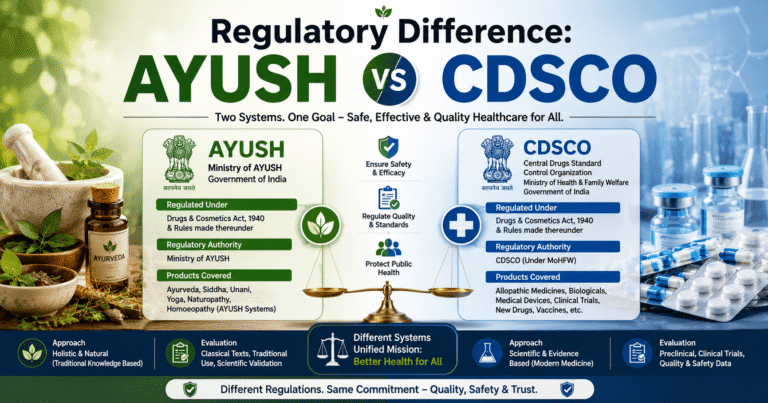
Regulatory Difference: AYUSH vs CDSCO
Ayurvedic Products
Ayurvedic products fall under the Ministry of AYUSH and require:
- AYUSH manufacturing license
- GMP certification
- Batch testing
- Raw herb authentication
Allopathic Products
Allopathic products require: Ayurvedic PCD Pharma Vs Allopathic PCD Pharma
- Drug approvals where applicable
- WHO-GMP compliant manufacturing
- Stability studies
- Detailed documentation
- Strict labeling compliance
Ground Reality
Regulatory compliance in allopathy is more documentation-intensive, involving detailed approvals, stability data, and strict labeling requirements. Ayurvedic manufacturing also requires quality controls and proper documentation, but approval timelines are generally simpler for many product categories. This regulatory difference is one of the key points highlighted in our Ayurvedic vs allopathic pharma franchise comparison, especially for entrepreneurs evaluating which business model aligns better with their investment capacity and operational capabiliti
Investment Comparison
| Expense Head | Ayurvedic Franchise | Allopathic Franchise |
|---|---|---|
| Initial Stock | ₹30,000 to ₹1.5 lakh | ₹75,000 to ₹3 lakh+ |
| Licensing | Lower in some cases | Higher compliance cost |
| Marketing Expenses | Moderate | Higher due to doctor promotion |
| Working Capital | Moderate | Significant |
| Cold Chain Need | Rare | Required for some products |
Margin Comparison
Ayurvedic products often offer higher gross margins because branding and wellness positioning allow better pricing flexibility.
Typical gross margin ranges:
- Ayurvedic PCD Pharma: 30%–60%
- Allopathic PCD Pharma: 20%–45%
Actual profitability depends on:
- Credit given to retailers
- Secondary discounts
- Expiry losses
- Promotional costs
- Collection efficiency
Doctor Dependency: A Critical Difference
Ayurvedic Franchise
Sales can come from: Ayurvedic PCD Pharma Vs Allopathic PCD Pharma
- Ayurvedic doctors (Vaidyas)
- General practitioners
- Retail chemists
- Wellness stores
- E-commerce channels
Ayurvedic Franchise
Prescription support is central. Without doctor conversion, stock movement can remain slow.
What Most New Distributors Don’t Realize
Doctors rarely start prescribing after one visit. Consistent follow-up, scientific detailing, and uninterrupted stock availability are usually required for several months before meaningful prescriptions begin.
Competition and Price Pressure
Allopathic PCD markets are heavily crowded. Multiple companies often promote similar compositions at comparable prices.
Ayurvedic products face competition too, but differentiated herbal positioning can reduce direct price wars if the formulation and branding are credible.
Read More : Difference Between Ayurvedic And Allopathic Pharma Franchise: Which Is More Profitable In 2026?
Product Acceptance and Market Behavior
Ayurvedic Products Sell Better When:
- Consumer awareness is strong
- Immunity and wellness demand is high
- Retailers actively recommend products
- Repeat usage is common
Ayurvedic Products Sell Better When:
- Doctors prescribe consistently
- Retailers trust product quality
- Therapy demand is established
- Patient outcomes are predictable
Stock Expiry Risk
Expiry management is a major issue in both models.
Ayurvedic Products
- Often have a longer shelf life.
Some products move steadily through OTC channels.
Allopathic Products
- Larger portfolios may include slow-moving items.
- Acute-care products can remain unsold without prescriptions.
Practical Observation
Many first-year distributors overstock broad product lists. It is usually safer to begin with 20–40 proven SKUs and expand only after market traction is visible.
Monopoly Rights: Myth vs Reality
| Myth | Fact |
|---|---|
| Monopoly rights guarantee success | Sales depend on market execution |
| No competition means easy profits | Doctors and retailers still need convincing |
| Exclusive territory prevents price pressure | Online and neighboring competition may still affect business |
Marketing Support vs Real Business Support
Some companies advertise: Ayurvedic PCD Pharma Vs Allopathic PCD Pharma
- Visual aids
- MR bags
- Sample packs
- Gift items
These materials help, but operational support matters more.
Real Support Includes
- Consistent stock availability
- Transparent pricing
- Fast dispatch
- Batch traceability
- Expiry replacement policy
- Responsive accounts team
A distributor benefits more from dependable service than from elaborate promotional materials.
Payment Cycle and Cash Flow Reality
Most distributors work on credit cycles.
Typical scenarios include:
- Retailers asking for 30–60 days credit
- Doctors expecting free samples
- Slow collections from institutional buyers
If your company requires advance payment while your market collects slowly, working capital pressure can increase quickly.
Common Mistake
Investing heavily in stock without estimating collection timelines often creates avoidable cash flow stress.
Rural vs Urban Market Potential
Ayurvedic Franchise
Often performs well in:
- Semi-urban areas
- Rural markets
- Wellness-focused retail channels
Allopathic Franchise
Stronger in: Ayurvedic PCD Pharma Vs Allopathic PCD Pharma
- Urban prescription markets
- Specialist-driven segments
- Hospital-linked territories
Licensing and Compliance Requirements
Before starting either model, confirm requirements such as:
- GST registration
- Drug license (where applicable)
- FSSAI registration for certain nutraceutical categories
- Trade documentation
Consult a qualified regulatory professional to verify what is needed for your business structure and product mix.
Which Business Model Is Easier for Beginners?
For many first-time entrepreneurs, Ayurvedic PCD can be easier to start because:
- Investment may be lower
- Consumer demand can be driven by wellness trends
- Sales are not always entirely prescription-dependent
- Margins are often attractive
Allopathic PCD can scale significantly, but usually requires stronger doctor relationships and greater operational discipline.
When Ayurvedic PCD Pharma Makes More Sense
Choose Ayurvedic franchise if you want to focus on: Ayurvedic PCD Pharma Vs Allopathic PCD Pharma
- Herbal and natural products
- Preventive health and wellness
- OTC and retailer-driven sales
- Lower initial investment
This model suits distributors in markets where consumers actively seek plant-based products and immunity solutions.
When Allopathic PCD Pharma Makes More Sense
Choose allopathic franchise if you have:
- Strong doctor networks
- Experience in prescription selling
- Adequate working capital
- Ability to manage licensing and compliance
This model is often preferred by medical representatives and professionals with established physician relationships.
Common Reasons Distributors Fail in the First Year
Regardless of the segment, common causes include: Ayurvedic PCD Pharma Vs Allopathic PCD Pharma
- Selecting a company based only on price.
- Overstocking too many products.
- Expecting monopoly rights to create demand.
- Ignoring expiry replacement terms.
- Underestimating credit requirements.
- Weak follow-up with doctors and retailers.
- Choosing companies with inconsistent dispatch performance.
What to Check Before Investing
Evaluate the company on these points: Ayurvedic PCD Pharma Vs Allopathic PCD Pharma
- Manufacturing certifications (GMP or WHO-GMP where relevant)
- Product quality consistency
- Transparent pricing
- Delivery timelines
- Monopoly terms
- Expiry replacement policy
- Promotional support
- Customer feedback
- Documentation and compliance standards
Decision Matrix: Which Model Fits You?
| If You Have... | Better Option |
|---|---|
| Limited investment and retail access | Ayurvedic PCD Pharma |
| Strong doctor relationships | Allopathic PCD Pharma |
| Interest in wellness and herbal products | Ayurvedic PCD Pharma |
| Prescription-selling experience | Allopathic PCD Pharma |
| Rural and semi-urban reach | Ayurvedic PCD Pharma |
| Institutional and specialist connections | Allopathic PCD Pharma |
Conclusion
There is no universal winner in the Ayurvedic PCD Pharma vs Allopathic PCD Pharma debate.
- Ayurvedic PCD Pharma is often more suitable for entrepreneurs seeking lower investment, wellness-oriented products, and less dependence on prescriptions.
- Allopathic PCD Pharma is better suited to those with strong medical networks, higher working capital, and experience in prescription-driven selling.
The most successful distributors choose a model aligned with their territory, relationships, and financial capacity rather than chasing broad market claims. Ayurvedic PCD Pharma Vs Allopathic PCD Pharma
Compare companies carefully, review operational policies, and build realistic expectations before investing in any pharma franchise opportunity.
Ayurvedic PCD Pharma Vs Allopathic PCD Pharma - FAQs
Which is more profitable: Ayurvedic or Allopathic PCD Pharma?
Is a drug license required for Ayurvedic franchise business?
Is allopathic PCD more difficult for beginners?
Are monopoly rights enough to succeed?
Can Ayurvedic products be sold without doctor prescriptions?
ABOUT THE AUTHOR

Mitesh Vyas
My name is Mitesh Vyas, and I am a Pharma Franchise Consultant and Industry Research Analyst specializing in India’s PCD pharma business ecosystem. My work focuses on helping beginners, distributors, and small pharma entrepreneurs understand the real-world functioning of the pharma franchise model. Unlike theoretical content, my insights are based on ground-level observations from Indian pharmaceutical markets, including Tier-1, Tier-2, and Tier-3 cities such as Ahmedabad, Indore, Lucknow, and surrounding business hubs. I regularly share insights on how the pharma franchise business in India works in real market conditions, including investment, product strategy, and growth challenges.