
Table of Contents
ToggleThe PCD pharma franchise in India is often marketed as a “low-investment, high-return” opportunity. Every day, I meet new distributors who enter this business with dreams of quick profits, monopoly rights, and easy doctor conversions.
But here’s the uncomfortable truth: In 70% of failed cases I’ve seen, the problem was not the market — it was wrong expectations, poor strategy, and lack of ground understanding.
Most blogs and companies only talk about benefits. Very few talk about why people lose money, get stuck with dead stock, and quit within 6–12 months.
In this guide, I’m breaking down:
- Real reasons behind failure
- Ground-level reality from Tier-2 & Tier-3 markets like Ahmedabad, Surat, Indore
- What companies don’t tell you
- How to avoid costly mistakes

Understanding The Pharma Franchise Business Model
The pharma franchise business model works on a simple idea:
You:
- Purchase medicines from a pharma company
- Promote them to doctors
- Generate prescriptions
- Supply to retailers/chemists
Sounds simple, right?
But in reality, starting a pharma franchise is not a trading business — it’s a relationship-driven prescription business. If doctors don’t prescribe → retailers won’t stock → your inventory won’t move.
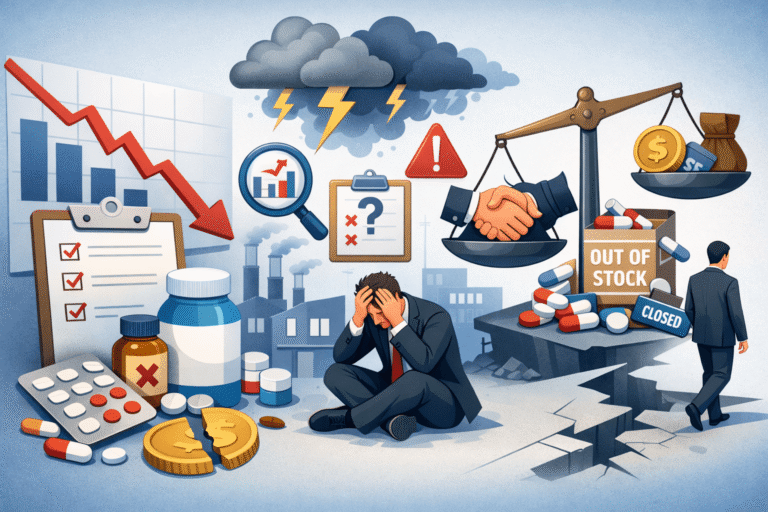
Why 70% Pharma Franchise Businesses Fail (Deep Analysis)
1. Wrong Assumption: “ Take Stock, Sale Ho Jayega”
Cause: Beginners believe demand already exists
Ground Reality: Demand must be created through doctors
Outcome: No prescriptions → No sales
Loss: Dead stock + blocked capital
2. Overcrowded Product Selection
Cause: Choosing common antibiotics, syrups, and tablets
Ground Reality: These segments are already dominated by established brands
Outcome: Doctors ignore new brands
Loss: Zero movement despite heavy investment
3. Doctor Conversion Takes Time (Biggest Shock)
Cause: Expecting quick prescriptions
Ground Reality: Doctors take 2–6 months to trust a new brand
Outcome: Slow start → frustration
Loss: Early exit before break-even
4. Poor Company Selection
Cause: Choosing companies based on price or promises
Ground Reality: Many companies lack brand recall and field support
Outcome: No doctor trust
Loss: Unsellable stock
5. Credit Cycle Destroys Cash Flow
Cause: Giving credit to retailers
Ground Reality: Payments get delayed (30–90 days)
Outcome: Working capital gets blocked
Loss: Cannot reinvest → business stalls
6. No Field Work Mindset
Cause: Treating it like a passive income business
Ground Reality: Requires daily doctor visits (like MR work)
Outcome: No relationship building
Loss: No prescriptions → failure

How It Actually Works in Real Market (Doctor + Retail Reality)
Doctor Behavior
- Prefer trusted brands
- Avoid experimenting with unknown companies
- Need consistent follow-ups
Retailer Behavior
- Stock only fast-moving products
- Avoid blocking money in unknown brands
- Push what doctors prescribe
This creates a chain: Doctor → Prescription → Retailer → Sales
Break the chain → Business fails.
Real Benefits
Let’s be honest — the PCD pharma business in India can be profitable, but only when:
- You build strong doctor relationships
- You select niche or differentiated products
- You stay consistent for 6–12 months
Successful distributors earn because they understand the process — not because of monopoly rights.
Read More: How To Choose Best PCD Pharma Company ?

Hidden Challenges & Failure Triggers
High Competition from MRs
In most markets, you’re not just competing with other distributors—you’re competing with full-time Medical Representatives (MRs) from established pharma companies in India . These MRs visit doctors daily, build strong relationships, and promote trusted brands. As a new entrant, breaking this existing network is extremely difficult. Without consistent field effort, your products often get ignored.
Price Wars in Generic Segments
Generic medicine markets are highly price-sensitive, where multiple companies offer the same molecule at different rates. This leads to constant undercutting and reduced profit margins. Even if you offer a lower price, retailers and doctors may still prefer established brands. In the long run, price wars make the business unsustainable for new distributors.
Lack of Brand Recall
Doctors prefer prescribing brands they recognize and trust. New or unknown brands struggle to gain attention, especially without strong promotion. This lack of recall leads to hesitation in prescribing, even if your product quality is good. As a result, building initial traction becomes slow and challenging.
Expiry Risk on Unsold Stock
Medicines come with a limited shelf life, and slow-moving products can quickly turn into dead stock. Beginners often over-purchase without understanding demand, leading to expiry losses. In many failed cases, 20–40% of stock remains unsold and expires. This directly impacts profitability and cash flow.
Pressure from Companies to Buy More
After onboarding, many companies push distributors to place frequent or bulk orders. They may offer schemes or discounts to encourage higher purchases. However, without actual market demand, this leads to overstocking. This pressure creates unnecessary financial burden and increases the risk of unsold inventory.

What Most Pharma Companies Won’t Tell You
1. Monopoly Rights Are Misleading
Many companies attract beginners by offering “exclusive rights” for a particular area. It sounds powerful, but in reality, monopoly has very limited practical value. The same molecules are available under multiple brand names, and doctors choose based on trust, not territory. Without prescriptions, exclusivity means nothing—so monopoly does not guarantee sales.
2. Fake Marketing Support Promises
Companies often claim they will help with promotions and doctor conversions. On ground level, this support is usually limited to visual aids or samples, not actual fieldwork. No company sends representatives to build your doctor network. In reality, your growth depends entirely on your own effort and daily follow-ups.
3. Overloaded Product Lists
At the time of onboarding, companies showcase 200–300 products to appear strong and diverse. However, in real market conditions, only 10–15 products generate consistent demand. Beginners get confused and invest in multiple slow-moving items. This leads to scattered focus and higher chances of unsold or expired stock.
4. No Prescription Backing
Most pharma companies don’t have an existing doctor base in your area. They expect you to create demand from scratch by convincing doctors to prescribe their brands. Without prior prescription support, initial sales become very slow. This gap between expectation and reality is where most new distributors struggle and lose confidence.
Real Failure Case Scenarios
Case 1: ₹2 Lakh Investment, Zero Movement
- Distributor invests in antibiotics
- No doctor prescriptions
- Retailers refuse stock
- 40% stock expires
Loss: ₹80,000–₹1,20,000
Case 2: Wrong Company Selection
- Attractive pricing and monopoly promise
- Poor brand recall
- Doctors reject products
Outcome: Business shuts in 6 months
Case 3: Credit Trap
- Distributor gives 60-day credit
- Retailers delay payments
- No cash to reorder
Result: Business collapses despite demand

Who Should & Should NOT Start This Business
Suitable For
- People ready for field work like MR
- Long-term mindset (6–12 months)
- Basic understanding of pharma market
Not Suitable For
- Passive income seekers
- Quick profit expectations
- No sales or relationship-building skills

How To Avoid Failure (Step-by-Step Framework)
Step 1: Market Research
Before investing even ₹1, you must understand how your local market works. Identify which brands doctors are already prescribing and why they trust them. Study competitor products, pricing, and availability at chemist shops. In real markets, success depends on insight, not assumption—blind entry is one of the biggest reasons for failure.
Step 2: Doctor Mapping
Instead of targeting every doctor, focus on 20–30 active prescribers in your area. These are the doctors who regularly write prescriptions and influence demand. Build a list based on specialty, patient flow, and openness to new brands. Consistent follow-ups are key—relationships, not visits, drive prescriptions.
Step 3: Smart Product Selection
Avoid entering overcrowded segments like common antibiotics where competition is extreme. Instead, choose niche or combination products with less saturation and better acceptance chances. Your product selection should match doctor demand, not company offerings. In most failed cases, wrong product choice leads to zero movement.
Step 4: Budget Allocation
Don’t spend all your money on stock—this is a common beginner mistake. Allocate around 60% for inventory and keep 40% for promotion activities like doctor visits, samples, and follow-ups. Without promotion, stock won’t move. A balanced budget ensures both availability and demand generation.
Step 5: First 90-Day Plan
The first 3 months decide your survival in this business. Focus on daily doctor visits, consistent follow-ups, and building trust rather than expecting immediate sales. Track which doctors are responding and which products are getting traction. This phase is about planting seeds—results come later, but only if effort is consistent.

Successful vs Failed Distributor Strategy
| Successful Distributor | Failed Distributor |
|---|---|
| Chooses niche products | Chooses overcrowded antibiotics |
| Builds doctor relations | Depends on company promises |
| Focuses on long-term | Expects quick profits |
| Manages credit carefully | Gives uncontrolled credit |
| Works daily in field | Treats as side business |

Expert Mistakes To Avoid
Investing Heavily Without Market Research
Many beginners invest ₹1–2 lakh without understanding doctor demand or market dynamics. They assume products will sell automatically, but in reality, no prescriptions mean no movement. This leads to stock lying idle and eventually expiring. In most failed cases, lack of initial research directly results in financial loss.
Trusting Company Claims Blindly
New distributors often believe promises like monopoly rights, high margins, and full marketing support. On ground level, most companies provide only products—not actual sales support. When expectations don’t match reality, sales don’t happen. This blind trust is a major reason why beginners feel cheated and exit early.
Ignoring Doctor Relationship Building
The pharma business runs on prescriptions, not schemes or offers. Without strong doctor relationships, even the best products won’t sell. Many beginners avoid regular visits or give up too early. As a result, they fail to generate trust, leading to zero prescriptions and no repeat business.
Choosing Price Over Brand Quality
Low-price products may seem attractive for higher margins, but doctors prefer trusted and quality brands. Cheap products often face rejection due to lack of confidence and poor perception. This creates a situation where neither doctors prescribe nor retailers stock, resulting in dead inventory.
Entering Without a Sales Plan
Starting without a clear execution strategy is one of the biggest mistakes. Many distributors don’t plan doctor visits, product focus, or follow-up schedules. Without a structured approach, efforts become inconsistent and ineffective. This leads to slow or no growth, ultimately causing business failure.
Conclusion
The pharma franchise business model is not a shortcut to success. It’s a doctor-driven, relationship-based, patience-heavy business.
In 70% of failed cases I’ve seen:
- The market was not the problem
- The strategy was
If you:
- Understand ground reality
- Avoid common mistakes
- Stay consistent
You can survive and grow. But if you enter with:
- Wrong expectations
- No field effort
- Blind trust in companies
Failure is almost certain.