
Table of Contents
ToggleHow To Get Drug License In India Without Mistakes: Getting a drug license in India looks simple on paper — fill a form, submit documents, get approval. But in reality, it’s very different.
In my experience working with 50+ distributors across cities like Ahmedabad, Indore, and Lucknow, 60–70% of applications face delays or rejections due to small but critical mistakes.
Most beginners think:
- “The agent will handle everything for me.”
- “I just need to submit the documents.”
- “Once I get the license, the business will automatically start.”
But the truth is:
- Drug license is not just a document — it’s a compliance system
- One small mistake can delay your business by 1–3 months
- Wrong setup can impact your entire pharma franchise business
In this guide, I’ll break down:
- Real process (not textbook)
- Hidden mistakes beginners make
- Ground realities of approvals
- A practical strategy to get your license without errors
What is Drug License in India
A drug license is a legal permission issued by the State Drug Control Department that allows you to:
Sell medicines (Retail License)
A Retail Drug License allows you to sell medicines directly to patients through a medical store or pharmacy. In real practice, this license requires a registered pharmacist because correct dispensing and patient safety are critical in day-to-day operations.
Distribute medicines (Wholesale License)
A Wholesale Drug License lets you supply medicines to retailers, hospitals, and clinics instead of selling directly to customers. From my experience, this model focuses more on stock management, billing, and building a strong distribution network rather than patient interaction. Without it, you cannot legally run a pharma business, including a Trusted PCD pharma franchise in India.
Types of Drug Licenses
1. Retail Drug License (RDL)
- Required for medical shops/pharmacies
- Direct selling to customers
- Requires a registered pharmacist
2. Wholesale Drug License (WDL)
- Required for distributors and stockists
- Supply to retailers, hospitals, doctors
- Pharmacist not always mandatory, but a competent person is required
How to Get Drug License in India (Step-by-Step Process)
Step 1: Finalize Your Premises
- Minimum space:
- Retail: ~10 sq. meters
- Wholesale: ~10–15 sq. meters
In 50% of rejections I’ve seen, premises issues are the root cause.
Step 2: Arrange Required Documents
Includes:
- ID & address proof
- Rent agreement or ownership proof
- Pharmacist registration certificate
- Qualification proof
- Affidavits
Step 3: Apply Online/Offline
- Apply via State Drug Control portal or office
- Submit all documents
Most beginners rely fully on agents here — that’s where errors begin.
Step 4: Inspection by Drug Inspector
This is the most critical stage.
Inspector checks:
- Storage conditions
- Refrigerator availability
- Documentation
- Setup readiness
Step 5: Approval & License Issuance
- Official timeline: 20–30 days
- Real timeline: 30–60 days in most cases
In Tier-2 cities, delays often happen due to file backlog or minor objections.
Documents Required
Mandatory Documents
- Aadhaar/PAN
- Rent agreement (properly notarized)
- Pharmacist certificate
- Premises proof
- Application form
Optional but Helpful
- Electricity bill
- Layout plan
- NOC from owner
Common Documentation Mistakes
In 70% of cases I’ve handled:
- Rent agreement not matching application name
- Pharmacist certificate outdated
- Signature mismatch
These small errors can delay approval by 2–4 weeks
Cost & Time Required
Approximate Cost
- Government fees: ₹3,000 – ₹10,000
- Agent/consultant: ₹10,000 – ₹50,000
- Setup cost: ₹20,000 – ₹1 lakh
Real Timeline
- Ideal: 20–30 days
- Practical: 30–60 days

How It Actually Works in Real Market
What companies/agents say:
You’ll get the license in 15 days.
What actually happens:
- The file often goes back for corrections
- Inspector visits get delayed
- Pharmacist may not be available on time
- Minor objections are raised
In cities like Ahmedabad or Indore:
- Inspectors usually handle a heavy workload
- Files tend to move slower than expected
You need to be prepared for delays — don’t assume a smooth or quick approval process.

Hidden Challenges & Failure Reasons
1. Premises Rejection
Cause:
- Wrong layout
- Poor storage setup
Effect:
- Application rejected or delayed
2. Pharmacist Dependency
Most beginners underestimate this.
Reality:
- Pharmacist may leave anytime
- Without pharmacist → license invalid (for retail)
3. Documentation Errors
Cause:
- Agent mistakes
- Lack of verification
Outcome:
- File rejection or resubmission

What Most Agents & Pharma Companies Won’t Tell You
1. “Guaranteed Approval” is a Myth
No consultant or agent can truly guarantee approval because the final decision always lies with the drug inspector. In real cases, even small compliance gaps can lead to objections or delays, regardless of who handles your file.
2. Hidden Costs
Many applicants underestimate the actual cost involved beyond government fees. In practice, expenses like repeated visits, document corrections, and additional compliance requirements can increase your overall investment.
3. Pharmacist Risk
For retail licenses, your business depends heavily on a registered pharmacist. I’ve seen cases where pharmacists leave after approval, which can suddenly halt operations and create compliance issues.
4. Local Authority Behavior
Approval timelines are not the same everywhere. They often depend on the city, inspector workload, and how accurately your file is prepared, which is why some applications move faster than others.

Real Case Scenarios
Case 1: Rent Agreement Mistake
A distributor in Indore:
- Agreement in father’s name
- Application in son’s name
Result: 25-day delay
Case 2: Pharmacist Issue
Ahmedabad-based beginner:
- Pharmacist left after 2 months
Shop had to stop operations temporarily
Case 3: License Approved, Business Failed
Investor spent ₹1.5 lakh:
- Got license
- Took stock
But:
No doctor network
No demand
Business failed in 4 months
Retail vs Wholesale License (Comparison)
| Factor | Retail | Wholesale |
|---|---|---|
| Target | Customers | Retailers |
| Pharmacist | Mandatory | Not always |
| Investment | Medium | Lower |
| Risk | Moderate | Lower |
| Scalability | Limited | High |

Who Should Apply
You Should Apply If:
- You want to start a pharma franchise business model
- You have long-term business vision
- You can manage compliance
Avoid If:
- You want quick profits
- You don’t understand pharma market
- You depend fully on others
Read More: Pharma Franchise Investment Cost In India
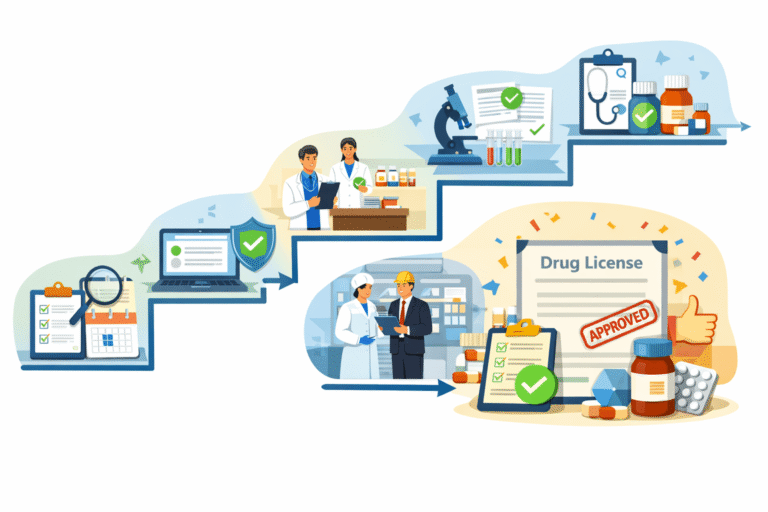
7-Step Safe Strategy to Get Drug License Without Mistakes
Step 1: Choose the Right Location
Your premises must meet minimum space norms and allow proper storage conditions for medicines. In real cases, poor location selection leads to inspection objections or rejection before the process even begins.
Step 2: Verify Documents Twice
Small errors in names, addresses, or signatures are one of the most common reasons for delays. Always cross-check every document carefully, because even minor mismatches can send your file back for correction.
Step 3: Select a Reliable Pharmacist
For retail licenses, a qualified pharmacist is not just a formality—it’s a legal requirement. Avoid temporary or “on-paper” arrangements, as losing your pharmacist can directly stop your business operations.
Step 4: Choose the Right Consultant (If Needed)
A good consultant can simplify the process, but the wrong one can create delays and errors. In my experience, going for the cheapest agent often leads to poor documentation and repeated corrections.
Step 5: Prepare for Inspection
Before the inspector visits, ensure your setup is fully ready—storage, refrigerator, and documentation. Many applications get delayed because applicants treat inspection casually instead of preparing properly.
Step 6: Follow Up Regularly
Don’t assume your application will move automatically. Regular follow-ups with the department help you stay updated and resolve issues quickly if any objections are raised.
Step 7: Plan Your Business Before Getting the License
A drug license is just the starting point, not the business itself. You should already have a plan for products, suppliers, or even starting a pharma franchise, and clearly understand the complete process of obtaining a drug license in India, so you can begin operations without wasting time after approval.
Expert Mistakes to Avoid
- Ignoring documentation accuracy
- Choosing wrong location
- Trusting agents blindly
- Not planning business after license
- Underestimating pharmacist role
Conclusion
Getting a drug license in India is not difficult but getting it without mistakes requires awareness.
In my experience:
- Success depends more on preparation than process
- Most failures happen due to small oversights
- License is just the beginning, not the business
If you plan to enter the PCD pharma business in India, treat this step seriously — it defines your foundation.