
Hidden Costs in Pharma Franchise Business in India: Low investment business? Not exactly. If you’ve been researching the PCD pharma franchise in India, you’ve probably seen claims like:
- “Start with just ₹50,000–₹1 lakh”
- “High margins up to 30–40%”
- “Monopoly rights ensure success”
On paper, it looks like one of the easiest entry points into the pharmaceutical industry.
But in real on-ground pharma markets, especially in cities like Ahmedabad, Indore, or Lucknow, the story is very different.
In my experience working with 50+ distributors, most failures don’t happen because of lack of opportunity — they happen because of hidden costs that quietly eat profits.
This blog will expose:
- The real financial picture behind the pharma franchise business model
- The costs no company explains upfront
- And how you can avoid getting stuck financially

Understanding the Pharma Franchise Business Model
The Hidden Costs in Pharma Franchise Business in India model is simple in theory:
- You partner with a pharma company
- You get rights to sell their products in a specific area
- You earn margin between purchase and selling price
But in reality, this model is not just about buying and selling medicines.
It is:
- A doctor-driven business
- A relationship-based market
- A cash flow-sensitive system
And most importantly:
It is a working capital game, not just an investment game.
Where Most People Miscalculate Costs
Here’s the biggest mistake:
Most first-time investors only calculate stock purchase cost — not the cost of selling that stock.
In 60–70% of cases I’ve seen:
- People invest ₹1–2 lakh in stock
- Expect rotation in 30–45 days
- But actual movement takes 90–120 days
Why?
Because:
- Doctors don’t prescribe immediately
- Retailers don’t push unknown brands
- Market trust takes time
Result: Money gets blocked without returns
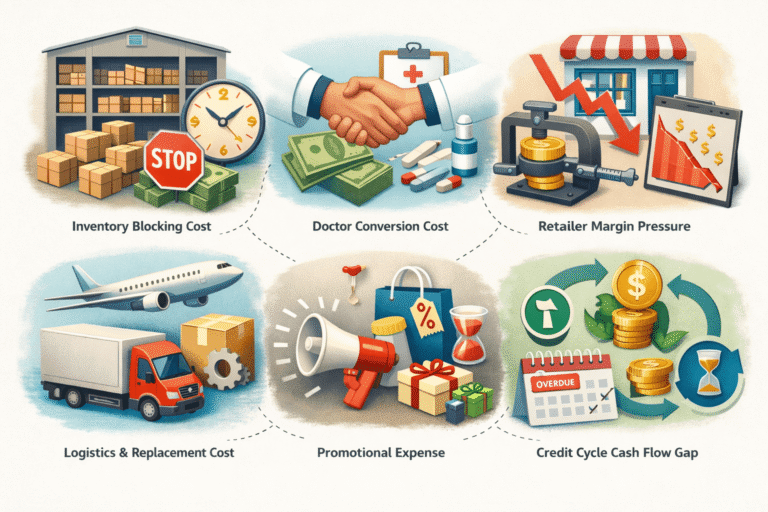
Hidden Costs in Pharma Franchise Business in India (detailed breakdown)
1. Inventory Blocking Cost
This is the money that gets stuck in unsold stock, especially when companies push bulk orders or slow-moving products. It directly affects your cash flow, making it difficult to reinvest in high-demand medicines or manage daily business expenses.
WHEN it occurs:
Right at the start — during initial stock purchase
Who Should NOT Start This Business
- 30–50% products remain unsold initially
- Expiry risk increases
WHAT happens if ignored:
- Dead stock
- Capital stuck for months
In most Tier-2 markets, 50–60% stock doesn’t rotate in the first 3 months
2. Doctor Conversion Cost
Doctor conversion cost includes all the expenses required to convince doctors to prescribe your products, such as samples, field visits, and ongoing relationship-building efforts. These often-overlooked costs can have a significant impact on your overall profitability in the pharma franchise business, especially during the initial growth phase.
WHY it exists:
Doctors don’t switch brands easily — trust takes time
WHEN it occurs:
First 2–6 months of business
HOW it impacts profit:
- Free samples
- Continuous visits
- No guaranteed prescriptions
WHAT happens if ignored:
- No prescriptions → No sales
In real markets, it takes 20–30 consistent visits to convert even one doctor
3. Retailer Margin Pressure
Retailer margin pressure refers to the need to offer higher margins or discounts to chemists to push your products. This reduces your overall profit margins and makes it harder to sustain long-term profitability in the pharma franchise business.
WHY it exists:
Retailers prefer fast-moving brands
WHEN it occurs:
At the time of product placement
HOW it impacts profit:
- Extra discounts (5–10% more)
- Credit demand
WHAT happens if ignored:
- Retailers won’t stock your product
Reality: Margin shown by company ≠ margin you actually keep
4. Logistics & Replacement Cost
Logistics & replacement cost includes expenses for transportation, damaged stock returns, and product replacements. These often-overlooked costs can eat into your margins and disrupt cash flow in a pharma franchise business.
WHY it exists:
Medicine is sensitive to damage and expiry
WHEN it occurs:
During transport or slow movement
HOW it impacts profit:
- Replacement delays
- Additional courier costs
WHAT happens if ignored:
- Loss on expired/damaged goods
5. Promotional Expense
Promotional expense covers the cost of marketing, samples, doctor gifts, and campaigns to boost product visibility. High promotional spending can significantly impact profits if not planned strategically in a pharma franchise business.
WHY it exists:
Doctors need brand recall
WHEN it occurs:
Continuously
HOW it impacts profit:
- Visual aids
- MR travel
- Gifts and reminders
WHAT happens if ignored:
- No visibility → No prescriptions
This becomes a monthly recurring burn, not a one-time cost
6. Credit Cycle Cash Flow Gap
Credit cycle cash flow gap arises when payments from distributors or retailers are delayed, creating a shortfall in working capital. Managing this gap is crucial to maintain smooth operations and profitability in a pharma franchise business.
WHY it exists:
Retailers and stockists demand credit
WHEN it occurs:
After initial sales
HOW it impacts profit:
- Payments delayed 30–90 days
- Cash stuck in market
WHAT happens if ignored:
- Business stops despite sales
Read More:- Pharma Franchise Investment Cost In India

How These Costs Impact Your Actual Profit Margin
Hidden costs in a pharma franchise business can significantly reduce your actual profit margin if not managed properly, which directly affects your overall PCD Pharma Franchise Investment in India. Expenses like promotional spending, credit losses, unsold stock, and logistics often go unnoticed but directly impact earnings. Understanding and controlling these costs is essential to maintain sustainable profitability.
Claimed vs Real Scenario
| Factor | Company Claim | Actual Market Reality |
|---|---|---|
| Margin | 20–30% | 8–15% net profit |
| Stock Movement | Fast | Slow (2–4 months) |
| Investment | Low | Moderate + recurring |
| Growth | Quick | Gradual |

What Most Pharma Companies Won’t Tell You
1. “Low investment” is a half-truth
While the initial investment to start a pharma franchise may seem low, ongoing costs like marketing, inventory replenishment, and operational expenses can quickly add up. Ignoring these can hurt long-term sustainability.
2. Monopoly doesn’t guarantee sales
Even if you have exclusive rights for a product in a region, sales depend entirely on doctor prescriptions and market demand. Without active promotion and relationship-building, monopoly alone won’t generate profits.
3. High margins ≠ high profit
Products with high profit margins may appear attractive, but if their demand is low, turnover slows. True profitability comes from balancing margin with market demand and consistent sales.
4. Post-sales struggle is real
Many companies focus on onboarding new franchisees but offer limited support afterward. Without guidance on marketing, doctor engagement, and stock management, franchisees may struggle to sustain and grow their business.

Real Case Scenarios from the Market
Case 1: ₹1.5 Lakh Investment Gone Stuck
- Stock purchased
- No doctor support
- 40% inventory unsold
Result: Working capital blocked for 6 months
Case 2: High Margin, Low Movement Trap
- Selected 30% margin products
- No prescription demand
Result: Cash flow crisis within 3 months
Case 3: Credit Cycle Collapse
- Retailers given 60–90 day credit
- Payments delayed
Result: Sales happening, but business stuck

Who Should & Should NOT Start This Business
Suitable for:
- People ready for fieldwork
- Long-term mindset
- Strong follow-up capability
Not Suitable for:
- Passive income seekers
- People expecting quick returns
- No sales or pharma experience

6-Step Cost Control Strategy for Beginners
Step 1: Start with Limited SKUs
Begin with 20–30 fast-moving products instead of a large inventory. Focusing on a smaller range helps manage cash flow, simplifies stock management, and improves sales efficiency.
Step 2: Choose Demand-Based Products
Select products based on actual market demand rather than just high margins. Demand-driven products ensure faster turnover and sustainable profits.
Step 3: Track Stock Rotation Weekly
Monitor how quickly your inventory moves each week. If a product doesn’t sell within 30 days, reconsider stocking it to avoid blocked capital.
Step 4: Control Credit Strictly
Limit credit exposure for distributors and retailers initially. Strict credit management protects your cash flow and reduces financial risk.
Step 5: Invest in Doctor Relationships Early
Build strong connections with doctors from the start. Their prescriptions directly drive your sales, making relationship-building a top priority.
Step 6: Avoid Over-Promotional Spending
Promotional activities are important, but overspending without measurable ROI can drain profits. Focus on cost-effective marketing strategies.
Expert Insights: Mistakes That Kill Profit
- Over-investing in stock initially
- Choosing wrong company
- Ignoring doctor conversion time
- Giving excessive credit
- Expecting fast returns
Most first-time distributors make at least 2–3 of these mistakes
Conclusion:
The Hidden Costs in Pharma Franchise Business in India is not a bad opportunity — but it is misunderstood.
Yes, you can build a profitable business.
But only if you understand:
- It’s not just about buying stock
- It’s about moving stock
- It’s not just margin
- It’s about cash flow management
If you are planning on starting a pharma franchise, don’t just calculate investment.
Calculate survival. [Hidden Costs in Pharma Franchise Business in India]