
Difference Between PCD And Pharma Franchise starting in the pharma distribution space looks simple on the surface—but in reality, PCD and Pharma Franchise are among the most misunderstood business models in India.
In my 10+ years of working with 50+ distributors across Tier-1, Tier-2, and Tier-3 cities, I’ve seen one common pattern:
In 70% of cases, beginners don’t clearly understand the difference between PCD and Pharma Franchise—and that confusion directly leads to losses, dead stock, and business shutdowns within 12–18 months.
Many people assume both models are the same because companies use the terms interchangeably. But on the ground, the difference is not just terminology—it’s about control, investment, risk, and growth potential.
In this guide, I’ll break down:
- Real differences (not textbook definitions)
- Practical challenges you’ll actually face
- Hidden truths companies don’t tell you
- A clear decision framework to choose the right model

What is PCD Pharma?
PCD (Propaganda Cum Distribution) is usually positioned as a low-investment entry model in the PCD pharma business in India.
But here’s the reality:
- You buy products from a company and sell them independently
- There is limited or no field support
- You rely mostly on your own network (doctors, chemists)
- Promotion is usually done through visual aids, samples, and personal visits
In real markets, 60–70% of PCD distributors operate without MR (Medical Representative) support, especially in smaller cities.
What companies claim:
- Monopoly rights
- Full marketing support
- High margins
What actually happens:
- Monopoly is often loosely defined
- Marketing support is limited to basic materials
- Sales depend completely on your effort

What is Pharma Franchise?
The pharma franchise business model is more structured and often closer to a mini-distribution + marketing setup.
In this model:
- You work more like a business partner than just a distributor
- You may appoint your own MRs
- The company may provide better promotional support and branding
- Investment is higher, but so is the expected scale
In most cases, franchise setups require 2x–3x higher investment than PCD models, especially if you build a team.
Ground Reality:
- You’re expected to actively build the market
- Companies expect consistent order flow
- Growth pressure is higher
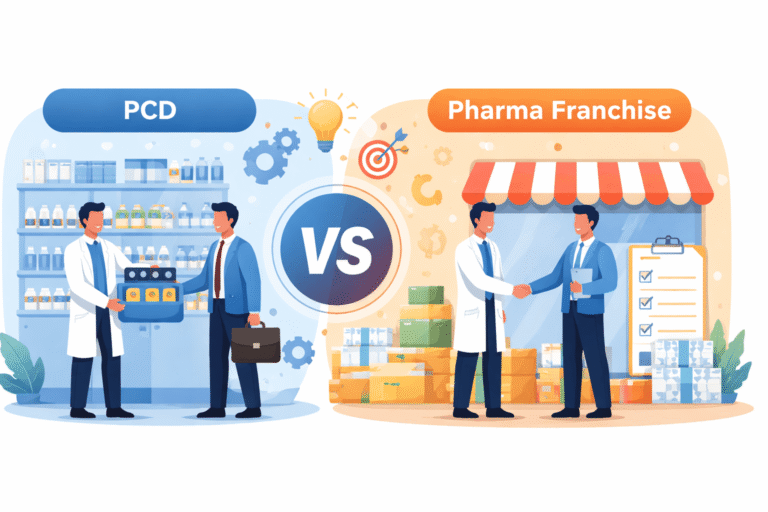
Key Difference Between PCD and Pharma Franchise
PCD vs Pharma Franchise – Complete Comparison
| Parameter | PCD Pharma | Pharma Franchise |
|---|---|---|
| Investment | Low (₹20K–₹1L typical start) | Medium to High (₹1L–₹5L+) |
| Risk Level | Lower (limited stock) | Higher (bulk purchase pressure) |
| Control | High independence | Moderate (company expectations) |
| Company Support | Limited (mostly materials) | Better (MR guidance, strategy) |
| Scalability | Slow to moderate | High if managed well |
| Profit Margin | Slightly higher per unit | Balanced with volume growth |
| Territory Rights | Often unclear | More structured but conditional |
| Dependency on Prescriptions | Very high | High but supported with marketing |

Benefits of Each Model
PCD Benefits:
- Low risk entry
- Flexible operations
- Ideal for part-time or beginners
Works best only if you already have doctor connections
Franchise Benefits:
- Higher growth potential
- Better brand push
- Structured expansion
Works best only if you can manage a team and invest consistently

Hidden Challenges & Failure Reasons
PCD Model Failures:
- No doctor network → no prescriptions
- Over-dependence on company promises
- Lack of follow-up marketing
Franchise Model Failures:
- Heavy stock burden
- Hiring MRs without proper training
- Cash flow mismanagement
Most first-time distributors fail because they underestimate how dependent pharma sales are on doctor prescriptions.

What Most Pharma Companies Won’t Tell You
1. “PCD” is often just a marketing term
Many pharma companies use the term “PCD” loosely to attract newcomers, especially those exploring a PCD Pharma Franchise for Beginners in India, even when the actual business model is closer to standard distribution. In reality, there is often no clear difference in support or operations. This creates confusion for new entrants who expect exclusive benefits. Always verify what the company truly offers beyond just the label.
2. Monopoly rights are rarely absolute
Companies often promise monopoly rights, but in practice, these are conditional and not strictly enforced. If your order volume is low, they may appoint another distributor in the same area. Territory control usually depends on performance, not just agreement. Written clarity is essential before starting.
3. Stock pressure in franchise model
Franchise partners are often encouraged to buy bulk stock through attractive schemes like “Buy 10 Get 5.” While it increases margins on paper, it also raises the risk of unsold inventory. If demand doesn’t match expectations, expiry losses become a major issue. Smart inventory planning is critical.
4. Promotional support is limited
Most companies provide visual aids, MR bags, and sample kits, but that alone doesn’t generate sales. Real growth depends on consistent doctor visits and relationship-building. Many beginners overestimate company support and underestimate field effort. Success is driven more by execution than materials.

Real Case Scenarios
Case 1: Low Investment PCD Distributor
- Investment: ₹30,000
- No MR team
- Result: Slow growth but stable survival
Lesson: Works if expectations are realistic
Case 2: Franchise Partner with High Stock Load
- Investment: ₹3L
- Took bulk scheme
- Couldn’t sell → expiry loss
Lesson: High investment without planning = risk
Case 3: Wrong Model Choice
- Beginner chose franchise without network
- Couldn’t manage MRs
- Business closed in 10 months
Lesson: Model must match capability

Which Model Should You Choose?
Choose PCD If:
- You want to start small
- You have limited budget
- You’re testing the pharma market
- You have some doctor contacts
Choose Franchise If:
- You have strong doctor network
- You can hire/manage MRs
- You can invest ₹1L+ comfortably
- You want to scale aggressively

Step-by-Step Strategy to Start Safely
1. Start with small product range
Begin with a limited number of products instead of launching a full portfolio. This helps you manage investment, reduce risk, and understand which products actually move in your area. A focused approach prevents unnecessary stock buildup. It also makes your sales pitch clearer and more effective.
2. Test demand with doctors
Before making a significant investment, verify which medicines doctors are actively prescribing. Gather feedback through visits, sample distribution, and direct discussions. This provides real market insights instead of relying on assumptions and helps you identify the most suitable pharma franchise opportunities in India based on actual demand. Validating demand at this stage can prevent future losses and ensure a smoother start to your business.
3. Avoid bulk schemes initially
Attractive offers like “Buy 10 Get 5” may look profitable, but they increase your inventory risk. In the beginning, your sales flow is uncertain, so large stock can lead to expiry losses. Focus on smaller, faster-moving orders. Scale only after consistent demand is confirmed.
4. Focus on 1–2 therapy segments
Instead of targeting multiple categories, concentrate on one or two therapy segments like antibiotics or general range. This helps you build expertise and stronger doctor relationships in that niche. It also improves brand recall. Gradual expansion works better than scattered efforts.
5. Build relationships before scaling
In pharma, business growth depends heavily on doctor trust and consistent follow-ups. Spend time building strong relationships rather than pushing for immediate sales. Once prescriptions start flowing regularly, scaling becomes easier. Long-term success is relationship-driven.
6. Market validation is more important than model selection
Whether you choose starting a pharma franchise or PCD, your success depends on real market demand. A good model cannot compensate for poor product-market fit. Always validate before expanding investment. Ground reality matters more than business structure.

Expert Insights / Common Mistakes
1. Confusing margin with profit
Many beginners assume high margins mean high earnings, but that’s not the full picture. Profit depends on actual sales, expenses, and stock movement. If products don’t sell, even a 50% margin means nothing. Always calculate net profit after all costs.
2. Ignoring expiry management
Expiry is one of the biggest hidden risks in pharma business. Unsold stock can quickly turn into dead loss if not tracked properly. Beginners often ignore batch tracking and slow-moving products. Regular monitoring and timely liquidation are essential.
3. Trusting verbal monopoly promises
Companies often promise exclusive rights verbally to close deals quickly. However, without written agreement, these promises hold no value. Many distributors later find competitors in the same area. Always get clear, documented terms before investing.
4. Not understanding doctor dependency
Pharma sales are heavily driven by doctor prescriptions, not just product availability. Without strong doctor connections, sales remain slow regardless of stock. Many beginners underestimate this factor. Building trust with doctors is the core of the business.
5. Over-investing too early
New distributors often invest heavily at the start expecting fast returns. Without tested demand, this leads to blocked capital and expiry losses. It’s better to start small and scale gradually. Controlled investment reduces risk and improves sustainability.
Conclusion
There is no “better” model between PCD and Pharma Franchise.
There is only:
Right model for your current situation
- If you’re new → start with PCD pharma franchise in India approach
- If you’re experienced → scale using franchise model
The biggest mistake is choosing a model based on company pitch instead of ground reality