
India’s veterinary pharmaceutical industry is growing rapidly due to increasing demand for quality medicines for livestock, poultry, companion animals, and aquaculture. However, manufacturing veterinary medicines is a highly regulated activity. Every manufacturer must obtain the required approvals, comply with the Drugs and Cosmetics Act, follow Good Manufacturing Practices (GMP), and meet quality standards before commercial production begins.
Whether you are a pharmaceutical entrepreneur, veterinary medicine manufacturer, PCD pharma company, or startup planning to enter the animal healthcare sector, understanding the Veterinary Manufacturing Approval Process is essential for legal compliance and long-term business success.
This guide explains every stage of the approval process, including regulatory authorities, licensing requirements, facility standards, documentation, inspections, and best practices for obtaining manufacturing approval in India.
Veterinary Manufacturing Approval Process: A Beginner's Guide
The Veterinary Manufacturing Approval Process is the legal procedure that allows a pharmaceutical company to manufacture veterinary medicines in India. The process involves obtaining manufacturing licenses from the State Licensing Authority (SLA), complying with the Drugs and Cosmetics Act, implementing Good Manufacturing Practices (GMP), establishing a quality management system, validating manufacturing facilities, and passing regulatory inspections before commercial production begins.
Manufacturers must also maintain continuous compliance through documentation, quality control testing, regular audits, and periodic license renewals. Following the correct approval process ensures product safety, regulatory compliance, and market credibility.
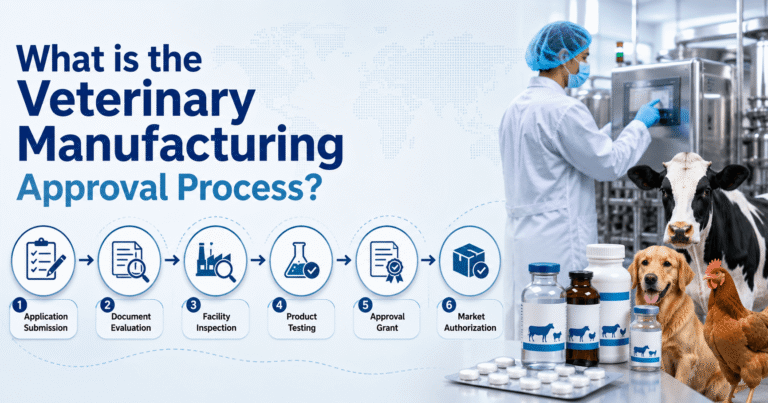
What is the Veterinary Manufacturing Approval Process?
The Veterinary Manufacturing Approval Process refers to a series of regulatory, technical, and quality assurance steps that pharmaceutical companies must complete before manufacturing veterinary medicines.
The approval process ensures that every veterinary product is manufactured under controlled conditions that consistently produce safe, effective, and high-quality medicines.
Unlike general pharmaceutical operations, veterinary manufacturing requires specialized production practices because medicines are developed for different animal species such as:
- Cattle
- Buffalo
- Poultry
- Sheep
- Goats
- Horses
- Dogs
- Cats
- Fish and aquaculture species
- Exotic animals
Each product category has unique formulation, dosage, packaging, labeling, and quality requirements.
Why is Veterinary Manufacturing Approval Important?
Obtaining manufacturing approval is more than a legal formality. It protects animal health, supports public health, and builds confidence among veterinarians, distributors, and livestock owners.
Key Reasons Why Approval Matters
1. Ensures Product Safety
Regulatory approval confirms that veterinary medicines are manufactured using validated processes that reduce contamination risks and maintain consistent product quality.
2. Maintains Product Effectiveness
Proper manufacturing controls ensure that medicines deliver the intended therapeutic effect and maintain stability throughout their shelf life.
3. Supports Legal Compliance
Only licensed manufacturers can legally produce and market veterinary medicines in India.
4. Builds Market Trust
Veterinarians, distributors, dairy farms, poultry businesses, and exporters prefer products manufactured in GMP-compliant facilities.
5. Enables Business Expansion
Regulatory compliance improves opportunities for:
- Third-party manufacturing
- Private label manufacturing
- Government tenders
- Institutional supply
- Export registrations
- International certifications
Regulatory Authorities Governing Veterinary Manufacturing in India
Several regulatory bodies oversee veterinary pharmaceutical manufacturing in India.
Regulatory Authority | Primary Responsibility |
Central Drugs Standard Control Organization (CDSCO) | National drug regulation and policy guidance |
State Licensing Authority (SLA) | Manufacturing license approval and inspections |
Drug Inspectors | Facility inspections and compliance verification |
Ministry of Health & Family Welfare | Overall pharmaceutical regulations |
NABL Accredited Laboratories | Product quality testing and validation |
BIS (where applicable) | Quality and testing standards |
These authorities work together to ensure veterinary medicines meet safety, efficacy, and quality requirements before reaching the market.
Veterinary Manufacturing License Requirements
Obtaining a manufacturing license requires fulfilling several regulatory and technical conditions.
1. Registered Business Entity
The company should be legally registered as a:
- Private Limited Company
- LLP
- Partnership Firm
- Proprietorship
- Public Limited Company
2. Suitable Manufacturing Premises
The production facility should include:
- Production area
- Raw material storage
- Finished goods storage
- Packaging section
- Quality Control laboratory
- Quality Assurance department
- Warehouse
- Quarantine area
- Documentation room
- Utility section
The layout should support smooth material flow and prevent cross-contamination.
3. Qualified Technical Staff
Manufacturers must appoint competent professionals responsible for production and quality assurance.
Common roles include:
- Production Pharmacist
- Quality Control Chemist
- Quality Assurance Manager
- Microbiologist (where applicable)
- Analytical Chemist
- Regulatory Affairs Executive
Qualified personnel ensure that manufacturing activities comply with regulatory standards.
4. Quality Control Laboratory
A dedicated QC laboratory is essential for testing:
- Raw materials
- Packaging materials
- In-process samples
- Finished products
- Stability samples
Testing verifies that products meet predefined specifications before release.
5. Standard Operating Procedures (SOPs)
Every manufacturing activity should follow written SOPs covering:
- Equipment cleaning
- Production processes
- Calibration
- Sampling
- Packaging
- Labeling
- Documentation
- Cleaning validation
- Product recalls
- Complaint handling
Well-documented SOPs improve consistency and regulatory compliance.
Step-by-Step Veterinary Manufacturing Approval Process
Understanding the approval workflow helps businesses prepare efficiently and avoid unnecessary delays.
Step 1: Business Registration
Register your pharmaceutical company under the appropriate business structure and obtain all mandatory registrations such as GST and PAN.
Step 2: Facility Planning
Design a manufacturing facility according to GMP principles.
The layout should minimize contamination risks and ensure proper movement of:
- Raw materials
- Personnel
- Equipment
- Finished products
Step 3: Infrastructure Development
Install required infrastructure, including:
- HVAC systems
- Water purification systems
- Production machinery
- Packaging equipment
- Laboratory instruments
- Warehousing facilities
Each installation should comply with pharmaceutical quality standards.
Step 4: Recruit Qualified Staff
Hire experienced professionals for:
- Manufacturing
- Quality Assurance
- Quality Control
- Warehouse management
- Regulatory compliance
- Maintenance
Proper staffing is a key requirement during regulatory inspections.
Step 5: Prepare Documentation
Compile all required documents, including:
- Site Master File
- SOPs
- Validation protocols
- Equipment qualification reports
- Water system validation
- HVAC validation
- Organization chart
- Personnel qualification records
- Product specifications
- Batch Manufacturing Records (BMR)
- Batch Packaging Records (BPR)
Accurate documentation demonstrates operational readiness.
Step 6: Apply for Manufacturing License
Submit the application to the respective State Licensing Authority along with supporting documents and prescribed fees.
The authority reviews the application before scheduling an inspection.
Step 7: Regulatory Inspection
During the veterinary pharmaceutical approval process, drug inspectors assess the facility for compliance with regulatory standards before granting manufacturing approval.
Inspection areas typically include:
- Building design
- Equipment qualification
- Documentation
- Quality systems
- Production controls
- Laboratory operations
- Personnel hygiene
- Storage practices
Any deficiencies identified during inspection must be corrected before approval.
Step 8: Corrective Actions
If observations are issued, the manufacturer should:
- Investigate the root cause
- Implement corrective actions
- Submit compliance reports
- Provide supporting evidence
Timely responses improve approval timelines.
Step 9: Manufacturing License Approval
Once all requirements are satisfied, the licensing authority grants the manufacturing license. The company can then begin commercial production while maintaining ongoing regulatory compliance.
Documents Required for Veterinary Manufacturing Approval
Preparing complete documentation significantly improves the approval process.
Document | Purpose |
Company Registration Certificate | Legal identity |
GST Registration | Tax compliance |
Factory Layout Plan | Facility approval |
Ownership or Lease Documents | Premises verification |
Site Master File | Manufacturing overview |
Equipment List | Infrastructure verification |
Machinery Qualification Reports | Equipment validation |
SOP Manual | Process control |
Quality Manual | Quality management system |
Personnel Qualification Records | Technical competency |
Water System Validation | Utility qualification |
HVAC Validation Reports | Environmental control |
Environmental Monitoring Records | Clean manufacturing |
Product Specifications | Quality standards |
Batch Manufacturing Records | Production documentation |
Common Certifications for Veterinary Pharmaceutical Manufacturers
Different certifications serve different purposes. Manufacturers may require one or more certifications depending on their product range and target markets.
Certification | Purpose | Mandatory/Voluntary |
Manufacturing License | Legal permission to manufacture veterinary medicines | Mandatory |
GMP Certification | Ensures Good Manufacturing Practices | Mandatory |
WHO-GMP Certification | Meets international GMP standards | Recommended for exports |
ISO 9001:2015 | Quality Management System | Voluntary |
ISO 14001 | Environmental Management | Optional |
ISO 45001 | Occupational Health & Safety | Optional |
NABL Accreditation | Laboratory testing competence | Recommended |
GLP Compliance | Good Laboratory Practices | Recommended |
Expert Insight: While ISO certifications improve operational efficiency, the manufacturing license and GMP compliance remain the foundation of legal veterinary pharmaceutical manufacturing in India.
Understanding Good Manufacturing Practices (GMP)
Good Manufacturing Practices (GMP) are a set of quality standards that govern every stage of pharmaceutical production. They ensure that veterinary medicines are manufactured consistently under controlled conditions.
Without GMP, even a scientifically sound formulation can become unsafe due to contamination, incorrect labeling, or poor manufacturing controls.
Core Objectives of GMP
GMP aims to:
- Produce safe medicines
- Maintain consistent product quality
- Prevent contamination
- Minimize manufacturing errors
- Ensure traceability
- Protect animal health
- Maintain regulatory compliance
Key Principles of GMP
1. Qualified Personnel
Every employee should receive proper training before performing manufacturing activities.
Training should cover:
- GMP awareness
- Hygiene practices
- SOP compliance
- Equipment handling
- Documentation
- Safety procedures
Continuous training helps maintain compliance and reduces human error.
2. Suitable Premises
The manufacturing facility should be designed to prevent contamination and support efficient workflow.
Important considerations include:
- Clean production rooms
- Controlled environmental conditions
- Proper drainage systems
- Pest control measures
- Separate storage areas
- Adequate lighting
- Controlled access to production zones
3. Validated Equipment
Production equipment should consistently perform as intended.
Validation includes:
- Installation Qualification (IQ)
- Operational Qualification (OQ)
- Performance Qualification (PQ)
Regular calibration and preventive maintenance are equally important.
4. Controlled Documentation
Documentation forms the backbone of pharmaceutical quality systems.
Manufacturers should maintain records for:
- Raw material receipts
- Batch manufacturing
- Batch packaging
- Equipment cleaning
- Calibration
- Maintenance
- Laboratory testing
- Product release
- Deviations
- Customer complaints
Regulators often say:
“If it isn’t documented, it didn’t happen.”
5. Quality Control Testing
Every batch should undergo laboratory testing before release.
Testing typically includes:
- Identity testing
- Assay
- pH testing
- Moisture content
- Sterility (where applicable)
- Microbial limits
- Stability studies
- Packaging integrity
WHO-GMP Certification for Veterinary Medicines
WHO-GMP (World Health Organization Good Manufacturing Practices) demonstrates that a manufacturing facility meets internationally accepted pharmaceutical quality standards. Although not mandatory for all domestic manufacturers, WHO-GMP significantly improves credibility.
Benefits of WHO-GMP Certification
- Easier export approvals
- Better distributor confidence
- Improved government tender eligibility
- Enhanced product quality
- Stronger international reputation
- Competitive advantage in global markets
Many multinational companies prefer contract manufacturers with WHO-GMP-compliant facilities.
Veterinary Drug Manufacturing Standards
Manufacturing standards ensure that veterinary medicines consistently meet predefined specifications for quality, safety, and efficacy. These standards apply throughout the product lifecycle—from sourcing raw materials to delivering finished products.
Important Manufacturing Standards
Manufacturers should establish controls for:
- Raw material procurement
- Vendor qualification
- Material sampling
- Production processes
- In-process quality checks
- Packaging operations
- Storage conditions
- Distribution practices
- Product recalls
- Pharmacovigilance support
Quality Control Requirements
Quality Control (QC) verifies that every product batch meets established specifications before release. A strong QC system reduces product failures, recalls, and customer complaints.
Responsibilities of the Quality Control Department
The QC team performs:
- Raw material testing
- Packaging material testing
- Finished product analysis
- Stability testing
- Microbiological analysis
- Environmental monitoring
- Water quality testing
- Instrument calibration verification
QC professionals should remain independent from production activities to ensure unbiased product evaluation.
Quality Assurance (QA): Building Quality into Every Batch
While QC tests the finished product, Quality Assurance (QA) focuses on preventing problems before they occur. QA oversees the entire quality management system.
QA Responsibilities
- SOP approval
- Batch record review
- Deviation management
- Change control
- Internal audits
- CAPA implementation
- Validation review
- Product release authorization
- Vendor qualification
- Risk management
A robust QA system helps manufacturers maintain consistent compliance and continuous improvement.
Facility & Infrastructure Requirements
A veterinary pharmaceutical manufacturing unit should be designed to support hygienic operations and efficient material flow.
Essential Areas in the Facility
- Raw material warehouse
- Quarantine area
- Dispensing room
- Manufacturing section
- Packaging area
- Quality Control laboratory
- Quality Assurance office
- Finished goods warehouse
- Rejected goods area
- Utility rooms
- Engineering workshop
- Documentation room
- Employee changing rooms
Each area should have defined access controls to prevent cross-contamination.
Environmental Control Requirements
Maintaining a controlled production environment is essential for product quality.
Manufacturers should monitor:
- Temperature
- Relative humidity
- Air pressure
- Air changes per hour
- Dust levels
- Microbial contamination
- Differential pressure between rooms
Environmental monitoring records should be reviewed regularly by the Quality Assurance team.
Utility Systems Used in Veterinary Manufacturing
Reliable utility systems support consistent manufacturing operations.
Key utilities include:
- HVAC systems
- Purified water systems
- Compressed air
- Steam generators
- Power backup
- Waste disposal systems
- Water treatment plants
Each utility should undergo qualification and routine maintenance.
Staff Qualification and Training Requirements
People remain one of the most important factors in pharmaceutical quality.
Manufacturers should recruit qualified personnel with appropriate educational backgrounds and provide regular training.
Departments That Require Specialized Training
- Production
- Quality Assurance
- Quality Control
- Warehouse
- Engineering
- Maintenance
- Regulatory Affairs
- Documentation
- Microbiology
- Validation
Training should be documented, assessed, and refreshed periodically.
Veterinary Medicine Production Approval Process
Before commercial production begins, the manufacturing facility must demonstrate that every system operates effectively.
The approval process generally includes:
- Facility readiness
- Equipment qualification
- Utility validation
- SOP implementation
- Staff training
- Process validation
- Trial manufacturing batches
- Laboratory testing
- Regulatory inspection
- Manufacturing license approval
Only after satisfactory inspection can routine production begin.
Common Challenges During Manufacturing Approval
Many new manufacturers experience delays because of avoidable mistakes.
Frequent Reasons for Regulatory Observations
Challenge | Impact |
Incomplete documentation | Application delays |
Poor facility layout | Inspection observations |
Unqualified staff | Non-compliance |
Missing SOPs | Regulatory deficiencies |
Equipment not validated | Approval delays |
Poor housekeeping | GMP violations |
Inadequate QC laboratory | Product release issues |
Weak QA systems | Repeat observations |
Calibration gaps | Compliance failures |
Incomplete training records | Inspection remarks |
Comparison: GMP-Compliant vs Non-Compliant Manufacturing Facility
Feature | GMP-Compliant Facility | Non-Compliant Facility |
Product Quality | Consistent | Variable |
Regulatory Approval | Easier | Difficult |
Customer Trust | High | Low |
Risk of Product Recall | Low | High |
Export Potential | Excellent | Limited |
Documentation | Complete | Inconsistent |
Employee Training | Regular | Limited |
Quality Control | Strong | Weak |
Inspection Outcome | Positive | Frequent observations |
Long-Term Growth | Sustainable | Challenging |
Veterinary Manufacturing Approval Timeline (2026)
The approval timeline for a veterinary pharmaceutical manufacturing unit depends on the completeness of your documentation, facility readiness, regulatory inspections, and response to compliance observations. Companies that plan their infrastructure and documentation well often receive approvals faster than those making frequent corrections during the process.
Estimated Approval Timeline
Stage | Estimated Time |
Business Registration | 1–2 Weeks |
Facility Planning & Design | 2–4 Weeks |
Construction & Infrastructure Setup | 3–6 Months |
Equipment Installation & Qualification | 2–4 Weeks |
Recruitment & Employee Training | 2–3 Weeks |
SOP Preparation & Documentation | 3–6 Weeks |
License Application Submission | 1 Week |
Regulatory Inspection | 2–6 Weeks |
Corrective Actions (if required) | 2–8 Weeks |
Manufacturing License Approval | 2–4 Weeks |
Average Total Timeline
Most veterinary pharmaceutical manufacturing facilities receive approval within:
- Small Manufacturing Unit: 6–8 Months
- Medium Manufacturing Unit: 8–12 Months
- Large WHO-GMP Manufacturing Plant: 12–18 Months
Expert Tip: Preparing documentation, validating equipment, and conducting internal GMP audits before applying can significantly reduce approval delays.
Estimated Cost of Veterinary Manufacturing Approval (2026)
The total investment depends on the product category, production capacity, automation level, and quality standards. The figures below provide an approximate estimate for planning purposes. Actual costs vary by state, facility size, equipment selection, and regulatory requirements.
Estimated Investment Breakdown
Expense | Estimated Cost (INR) |
Company Registration & Legal Documentation | ₹50,000–₹2 Lakhs |
Factory Building & Infrastructure | ₹30 Lakhs–₹2 Crores |
Production Machinery | ₹20 Lakhs–₹3 Crores |
HVAC & Utility Systems | ₹15 Lakhs–₹1 Crore |
Quality Control Laboratory | ₹10 Lakhs–₹75 Lakhs |
Validation & Qualification | ₹5–₹20 Lakhs |
License & Regulatory Fees | ₹50,000–₹5 Lakhs |
Initial Raw Material Procurement | ₹10–₹50 Lakhs |
Staff Recruitment & Training | ₹5–₹20 Lakhs |
Working Capital | ₹20 Lakhs–₹1 Crore |
Overall Estimated Investment
Manufacturing Scale | Estimated Investment |
Small Unit | ₹1–3 Crores |
Medium Unit | ₹3–8 Crores |
Large WHO-GMP Facility | ₹8–25+ Crores |
Note: These estimates are indicative and should be validated with equipment suppliers, consultants, and local regulatory authorities before making investment decisions.
Market Demand & Business Opportunities
India’s veterinary healthcare industry is expanding due to increasing livestock production, poultry farming, dairy development, pet ownership, and export-oriented animal agriculture. This growth creates strong demand for high-quality veterinary medicines and reliable manufacturing partners.
Why the Market Is Growing
Several factors are driving the veterinary pharmaceutical industry:
- Growth in dairy farming
- Expansion of commercial poultry farms
- Rising pet healthcare spending
- Government focus on animal health
- Increasing awareness of preventive veterinary care
- Demand for high-quality feed supplements
- Expansion of aquaculture
- Export opportunities for veterinary formulations
High-Demand Veterinary Product Categories
Manufacturers can explore opportunities in:
- Veterinary antibiotics
- Deworming medicines
- Calcium supplements
- Liver tonics
- Multivitamin preparations
- Mineral mixtures
- Injectable medicines
- Oral liquids
- Bolus and tablets
- Feed supplements
- Herbal veterinary products
- Mastitis management products
- Reproductive health medicines
- Pain management products
- Vaccines (subject to additional regulatory requirements)
How to Choose the Right Veterinary Manufacturing Partner
If you plan to outsource production, selecting the right manufacturing partner is one of the most important business decisions.
Checklist Before Finalizing a Manufacturer
1. Verify Manufacturing License
Ensure the company holds a valid manufacturing license for the product categories you require.
2. Confirm GMP Compliance
Choose manufacturers operating under Good Manufacturing Practices.
3. Review Product Portfolio
A broad portfolio often reflects stronger formulation and production capabilities.
4. Assess Infrastructure
Look for:
- Modern production lines
- Quality Control laboratory
- Quality Assurance systems
- Clean manufacturing environment
- Adequate warehousing
5. Evaluate Regulatory Documentation
Ask about:
- Batch Manufacturing Records
- Certificates of Analysis (CoA)
- Stability studies
- Validation reports
- Standard Operating Procedures
6. Production Capacity
Ensure the manufacturer can meet both current and future demand.
7. Packaging Capabilities
Check whether they offer:
- Customized labels
- Private branding
- Export packaging
- Multi-language artwork
8. Technical Support
Reliable manufacturers assist with:
- Product documentation
- Regulatory compliance
- Packaging development
- Product registration support
9. Industry Reputation
Review:
- Client testimonials
- Market presence
- Years of experience
- Product quality consistency
10. Transparency
Choose manufacturers who provide clear communication, realistic timelines, and complete documentation.
Expert Recommendation: Don’t select a manufacturing partner based only on price. Prioritize compliance, product quality, technical expertise, and long-term reliability.
Conclusion
The Veterinary Manufacturing Approval Process is the foundation of a safe, compliant, and sustainable veterinary pharmaceutical business. From securing a manufacturing license and implementing Good Manufacturing Practices to validating equipment, establishing robust quality systems, and maintaining detailed documentation, every step contributes to producing reliable veterinary medicines.
Manufacturers that invest in regulatory compliance, employee training, and continuous quality improvement are better positioned to earn customer trust, expand into new markets, and build long-term success. Whether you are launching a new facility or selecting a manufacturing partner, understanding the approval process will help you make informed decisions and reduce compliance risks.