
The quality of veterinary medicines depends not only on carefully selected ingredients but also on the machinery used during manufacturing. Every tablet, injection, powder, liquid, or bolus produced for animals must meet strict quality standards before reaching farms, veterinary hospitals, and distributors. This makes modern machinery an essential part of every veterinary pharmaceutical manufacturing facility.
Today’s veterinary medicine manufacturing equipment combines automation, precision, and GMP compliance to ensure consistent product quality while minimizing contamination risks. From raw material handling to final packaging, each machine performs a specific role that improves efficiency, safety, and production accuracy.
Whether you are a veterinary medicine distributor, pharma franchise owner, healthcare professional, or someone interested in pharmaceutical manufacturing, understanding the machinery used in veterinary medicine manufacturing helps you evaluate the capabilities of a manufacturer and the quality of its production process.
In this guide, we’ll explore the complete range of veterinary pharmaceutical manufacturing machinery, explain how each machine works, discuss its importance, and highlight the role of automation in modern veterinary pharmaceutical production.
Machinery Used In Veterinary Medicine Manufacturing
Veterinary medicine manufacturing uses specialized pharmaceutical machinery designed to produce safe, effective, and high-quality medicines for animals. Common veterinary drug manufacturing machines include weighing systems, mixers, granulators, fluid bed dryers, tablet compression machines, capsule fillers, liquid manufacturing vessels, injectable filling lines, sterilization equipment, blister packaging machines, and labeling systems. Modern veterinary pharmaceutical equipment also includes purified water systems, HVAC units, cleanroom technology, and quality control laboratory instruments. Together, these machines support a GMP-compliant manufacturing process that ensures product consistency, safety, and regulatory compliance.
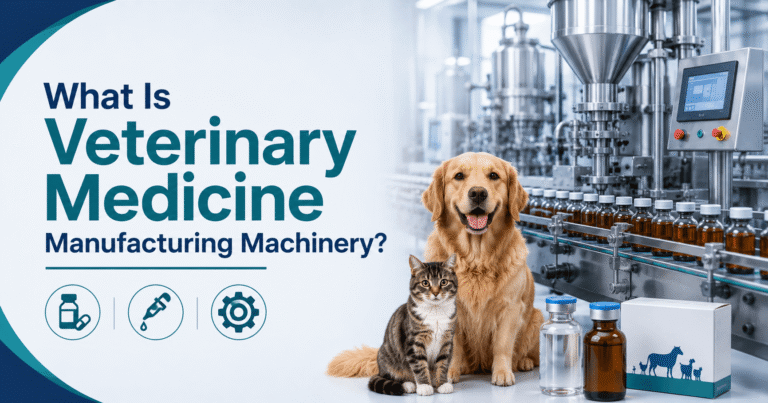
What Is Veterinary Medicine Manufacturing Machinery?
Veterinary medicine manufacturing machinery refers to the specialized equipment used to produce pharmaceutical products intended for animals. These machines help manufacturers process raw materials into finished dosage forms while maintaining strict hygiene, precision, and quality standards.
Unlike ordinary industrial equipment, veterinary pharmaceutical manufacturing machinery is specifically designed to meet pharmaceutical Good Manufacturing Practice (GMP) guidelines. Every stage of production—from weighing raw materials to final packaging—requires dedicated equipment that reduces contamination, improves accuracy, and ensures consistent product quality.
Depending on the product type, manufacturers may use different veterinary medicine production equipment for tablets, injections, oral liquids, powders, suspensions, ointments, or feed supplements.
Why Modern Machinery Matters in Veterinary Pharmaceutical Manufacturing
High-quality machinery directly affects the safety, effectiveness, and shelf life of veterinary medicines. Modern automated systems reduce human error and ensure every batch meets predefined quality standards while supporting compliance with internationally recognized manufacturing practices such as Good Manufacturing Practices (GMP).
Key reasons why advanced machinery is essential include:
- Maintains accurate dosage in every batch
- Prevents contamination during manufacturing
- Supports GMP and regulatory compliance
- Improves production speed
- Reduces product wastage
- Ensures batch-to-batch consistency
- Enhances worker safety
- Supports large-scale commercial production
- Simplifies quality monitoring
- Improves overall operational efficiency
For manufacturers supplying medicines across India or exporting internationally, investing in advanced veterinary pharmaceutical plant equipment is no longer optional—it is a competitive necessity.
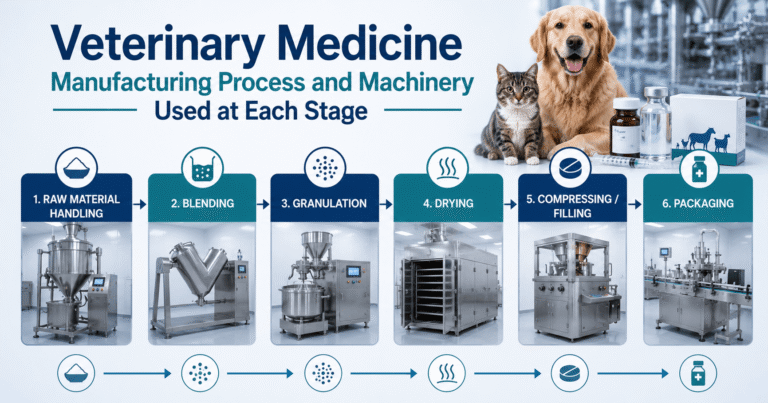
Veterinary Medicine Manufacturing Process and Machinery Used at Each Stage
Every veterinary medicine follows a structured veterinary medicine manufacturing process, where different machines handle each production stage to ensure product quality, consistency, and regulatory compliance.
Manufacturing Stage | Machinery Used | Purpose |
Raw Material Dispensing | Electronic Weighing Systems | Accurate ingredient measurement |
Mixing | Ribbon Blender, Octagonal Blender | Uniform mixing of ingredients |
Granulation | Rapid Mixer Granulator (RMG) | Forms uniform granules |
Drying | Fluid Bed Dryer (FBD) | Removes moisture efficiently |
Milling | Multi Mill | Reduces particle size |
Sieving | Vibro Sifter | Ensures uniform particle distribution |
Compression | Tablet Compression Machine | Produces veterinary tablets |
Capsule Filling | Capsule Filling Machine | Fills precise capsule doses |
Liquid Manufacturing | Mixing Vessel with Agitator | Prepares oral liquid formulations |
Injectable Production | Sterile Filling Line | Manufactures injectable medicines |
Packaging | Blister Packing Machine | Protects finished products |
Labeling | Automatic Labeling Machine | Applies accurate product labels |
Essential Machinery Used in Veterinary Medicine Manufacturing
1. Raw Material Weighing System
Every manufacturing process begins with precise ingredient measurement.
Electronic weighing systems ensure the exact quantity of active pharmaceutical ingredients (APIs) and excipients enters production. Even small measurement errors can affect medicine quality and dosage accuracy.
Benefits
- High accuracy
- Batch consistency
- Reduced formulation errors
- GMP documentation support
2. Ribbon Blender or Octagonal Blender
Mixing is one of the most important stages in pharmaceutical production.
Ribbon blenders and octagonal blenders mix powders uniformly before granulation or direct compression. Uniform mixing ensures every tablet, powder, or bolus contains the correct amount of active ingredient.
Key Features
- Stainless steel construction
- Uniform powder blending
- Easy cleaning
- Low maintenance
- Suitable for large production batches
3. Rapid Mixer Granulator (RMG)
Many veterinary tablets require granulation before compression.
The Rapid Mixer Granulator converts powder into uniform granules, improving flow properties and tablet strength.
Advantages
- Faster processing
- Better granule quality
- Improved tablet hardness
- Consistent batch production
4. Fluid Bed Dryer (FBD)
After granulation, moisture must be removed without damaging the formulation.
The Fluid Bed Dryer dries granules quickly using controlled airflow and temperature.
Benefits
- Uniform drying
- Faster production cycle
- Better product stability
- Lower moisture content
5. Vibro Sifter
Particle size plays a significant role in medicine quality.
The Vibro Sifter separates oversized particles and produces uniformly sized powder before compression or filling.
Why It Matters
- Improves flow properties
- Enhances tablet quality
- Reduces production defects
- Maintains consistency
6. Multi Mill
The Multi Mill reduces particle size and breaks lumps formed during manufacturing.
Manufacturers commonly use this machine before granulation or blending.
Features
- Uniform particle size
- High efficiency
- Low dust generation
- Easy maintenance
7. Tablet Compression Machine
The Tablet Compression Machine converts granules into veterinary tablets using controlled pressure.
It is one of the most important machines used in veterinary medicine manufacturing because tablet formulations remain among the most widely used dosage forms for livestock and companion animals.
Key Features
- High-speed production
- Uniform tablet weight
- Accurate dosage
- Automatic rejection of defective tablets
8. Capsule Filling Machine
Some veterinary formulations require capsules instead of tablets.
Automatic capsule filling machines accurately fill hard gelatin capsules with powdered formulations while maintaining dosage precision.
Benefits
- High production capacity
- Consistent filling
- Reduced product loss
- Minimal manual handling
9. Liquid Manufacturing Vessel
Veterinary syrups, suspensions, and oral solutions require specialized mixing vessels equipped with agitators and homogenizers.
These vessels help create stable liquid formulations by mixing ingredients evenly and preventing sedimentation.
Applications
- Oral suspensions
- Veterinary syrups
- Nutritional supplements
- Anthelmintic liquids
10. Injectable Manufacturing Equipment
Injectable veterinary medicines demand the highest level of sterility.
A complete sterile production line typically includes:
- Sterile mixing vessels
- Sterile filtration systems
- Vial washing machine
- Depyrogenation tunnel
- Filling and sealing machine
- Visual inspection system
These systems ensure injectable medicines remain free from microbial contamination while meeting regulatory standards.
Supporting Pharmaceutical Systems That Keep Production Safe
Apart from production machines, every GMP-certified veterinary manufacturing facility relies on several supporting systems to maintain product quality.
These include:
- HVAC System – Controls temperature, humidity, and air cleanliness inside production areas.
- Purified Water System (RO + Purified Water Plant) – Supplies pharmaceutical-grade water for manufacturing.
- Cleanroom Technology – Minimizes contamination through controlled environments.
- CIP (Clean-in-Place) System – Cleans equipment without dismantling it.
- SIP (Sterilize-in-Place) System – Sterilizes equipment using steam before production begins.
These systems play a critical role in maintaining hygiene, preventing cross-contamination, and ensuring compliance with GMP guidelines.
Benefits of Advanced Veterinary Pharmaceutical Manufacturing Machinery
Modern manufacturing equipment offers significant advantages beyond automation.
Some of the key benefits include:
- Consistent product quality across batches
- Improved manufacturing accuracy
- Faster production cycles
- Better compliance with GMP and regulatory standards
- Reduced contamination risks
- Lower operational costs over time
- Enhanced worker safety
- Greater production capacity
- Easier validation and documentation
- Improved customer confidence
By integrating advanced machinery with robust quality control systems, veterinary pharmaceutical manufacturers can deliver reliable medicines that meet the evolving needs of veterinarians, livestock farmers, and pet owners.
Key Features of Modern Veterinary Pharmaceutical Manufacturing Machinery
Today’s veterinary medicine manufacturing plants rely on advanced automation and intelligent production systems to maintain consistent quality while meeting increasing market demand. Investing in modern veterinary pharmaceutical equipment helps manufacturers improve efficiency, reduce production errors, and comply with national and international quality standards.
Some of the most important features include:
- Fully automated production lines
- GMP-compliant stainless steel construction
- PLC and touchscreen control systems
- Easy cleaning and maintenance
- High production capacity
- Precise dosage and filling accuracy
- Energy-efficient operation
- Batch recording and traceability
- Low product wastage
- Compatibility with different dosage forms
These features not only improve productivity but also ensure every batch of veterinary medicine meets strict quality specifications.
Manual vs Automated Veterinary Manufacturing Machinery
Choosing between manual and automated machinery depends on production scale, investment, and regulatory requirements. However, most modern manufacturers prefer automated systems because they offer greater consistency and efficiency.
Feature | Manual Machinery | Automated Machinery |
Production Speed | Low | High |
Human Intervention | High | Minimal |
Accuracy | Moderate | Excellent |
Batch Consistency | Variable | Highly Consistent |
Contamination Risk | Higher | Lower |
Labour Requirement | High | Lower |
Documentation | Manual | Digital |
GMP Compliance | More Difficult | Easier |
Long-Term Cost | Higher | Lower |
Suitable For | Small-scale production | Commercial manufacturing |
Expert Tip: If you are selecting a veterinary medicine manufacturing partner, choose a company that uses automated production lines along with validated quality control systems. This demonstrates a stronger commitment to product quality and regulatory compliance.
Quality Control Equipment Used in Veterinary Medicine Manufacturing
Production machinery alone cannot guarantee safe medicines. Every batch must undergo rigorous testing before it reaches the market.
A modern quality control laboratory typically includes:
- High-Performance Liquid Chromatography (HPLC)
- UV-Visible Spectrophotometer
- Dissolution Test Apparatus
- Friability Tester
- Hardness Tester
- pH Meter
- Moisture Analyzer
- Stability Testing Chambers
- Microbiology Testing Equipment
- Analytical Balances
These instruments help verify the identity, strength, purity, and stability of veterinary medicines, ensuring they meet predefined quality standards.
GMP Standards and Regulatory Compliance
Manufacturing veterinary medicines involves more than operating sophisticated machinery. Manufacturers must also follow strict regulatory guidelines to ensure product safety and effectiveness.
A GMP-compliant veterinary manufacturing facility generally follows these practices:
- Qualified and trained production staff
- Validated manufacturing processes
- Controlled cleanroom environments
- Equipment qualification and maintenance
- Standard Operating Procedures (SOPs)
- In-process quality checks
- Batch Manufacturing Records (BMR)
- Proper sanitation and hygiene practices
- Product traceability
- Regular internal quality audits
Compliance with GMP not only builds customer trust but also supports domestic approvals and export opportunities.
Market Demand for Advanced Veterinary Pharmaceutical Manufacturing
India has become one of the fastest-growing veterinary pharmaceutical manufacturing hubs due to its strong pharmaceutical infrastructure, skilled workforce, and expanding livestock sector.
Several factors continue to drive demand for advanced veterinary medicine production equipment, including:
- Rising livestock population
- Growth in dairy and poultry farming
- Increasing pet ownership
- Higher awareness of animal healthcare
- Expansion of veterinary exports
- Greater demand for preventive healthcare products
- Adoption of automated pharmaceutical manufacturing
Manufacturers equipped with modern machinery are better positioned to meet both domestic and international demand while maintaining high-quality production standards.
Expert Tips for Choosing a Veterinary Medicine Manufacturer
If you are a distributor, wholesaler, veterinary professional, or pharma franchise business, selecting the right manufacturing partner is crucial.
Before finalizing a manufacturer, consider the following:
1. Verify GMP Certification
A GMP-certified manufacturer follows standardized production, hygiene, and quality control practices to ensure veterinary medicines are safe and consistent. Certification also reflects compliance with national and international manufacturing regulations.
2. Evaluate Production Infrastructure
Modern production facilities with automated equipment improve manufacturing accuracy, reduce contamination risks, and maintain product consistency. Separate production areas for different dosage forms further support quality and safety.
3. Check Quality Control Facilities
An advanced in-house quality control laboratory ensures every batch is tested for identity, purity, potency, and safety before it reaches the market. This helps maintain consistent product performance and regulatory compliance.
4. Review Product Portfolio
A manufacturer with a broad product portfolio can meet diverse animal healthcare needs while offering flexible manufacturing solutions. It also demonstrates technical expertise across multiple veterinary dosage forms.
5. Assess Packaging Capabilities
High-quality packaging equipment protects veterinary medicines from moisture, contamination, and physical damage during storage and transportation. Proper packaging also improves shelf life and ensures accurate product labeling.
6. Confirm Documentation Support
Reliable manufacturers provide complete documentation, including Certificates of Analysis (COA), batch manufacturing records, and stability reports. Transparent documentation simplifies regulatory approvals and builds confidence in product quality.
Conclusion:
The machinery used in veterinary medicine manufacturing forms the backbone of a safe, efficient, and GMP-compliant pharmaceutical production process. From accurately weighing raw materials to blending, granulation, drying, tablet compression, sterile filling, packaging, and laboratory testing, every piece of equipment contributes to producing reliable veterinary medicines.
Modern veterinary pharmaceutical manufacturing machinery not only improves productivity but also enhances product consistency, minimizes contamination risks, and supports compliance with industry regulations. As demand for high-quality animal healthcare products continues to grow, manufacturers investing in advanced technology are better equipped to deliver safe and effective medicines for livestock, poultry, companion animals, and pets.
Whether you are a distributor, veterinary professional, pharma franchise owner, or business looking for a manufacturing partner, understanding the equipment and processes behind veterinary medicine production can help you make informed decisions and choose manufacturers that prioritize quality, safety, and innovation.
Machinery Used In Veterinary Medicine Manufacturing
1. What machinery is used in veterinary medicine manufacturing?
2. Why is GMP-compliant machinery important?
3. Which machine is used for manufacturing veterinary tablets?
4. How are veterinary injectable medicines manufactured?
5. What role does the HVAC system play in pharmaceutical manufacturing?
ABOUT THE AUTHOR

Mitesh Vyas
My name is Mitesh Vyas, and I am a Pharma Franchise Consultant and Industry Research Analyst specializing in India’s PCD pharma business ecosystem. My work focuses on helping beginners, distributors, and small pharma entrepreneurs understand the real-world functioning of the pharma franchise model. Unlike theoretical content, my insights are based on ground-level observations from Indian pharmaceutical markets, including Tier-1, Tier-2, and Tier-3 cities such as Ahmedabad, Indore, Lucknow, and surrounding business hubs. I regularly share insights on how the pharma franchise business in India works in real market conditions, including investment, product strategy, and growth challenges.