The veterinary pharmaceutical industry plays a vital role in protecting animal health, ensuring food safety, and supporting livestock productivity. However, manufacturing high-quality veterinary medicines requires much more than advanced production facilities. Companies must also follow internationally recognized quality standards that guarantee consistency, safety, and regulatory compliance.
This is where ISO Certification In Veterinary Manufacturing becomes essential. ISO certification demonstrates that a manufacturer follows globally accepted quality management systems, maintains strict production controls, and continuously improves its manufacturing processes.
Whether you are a distributor, exporter, veterinary healthcare professional, or business looking for a reliable manufacturing partner, choosing an ISO certified veterinary manufacturer helps reduce risks while ensuring consistent product quality and long-term business success.
Everything You Need to Know About ISO Certification In Veterinary Manufacturing
ISO Certification In Veterinary Manufacturing refers to internationally recognized certification that verifies a veterinary pharmaceutical manufacturer follows standardized quality management systems throughout production.
An ISO-certified veterinary manufacturer focuses on:
- Consistent product quality
- Regulatory compliance
- Customer satisfaction
- Process improvement
- Product traceability
- Risk management
- Continuous quality monitoring
When combined with GMP certification, ISO standards help manufacturers produce safe, effective, and reliable veterinary medicines that meet both domestic and international market requirements.
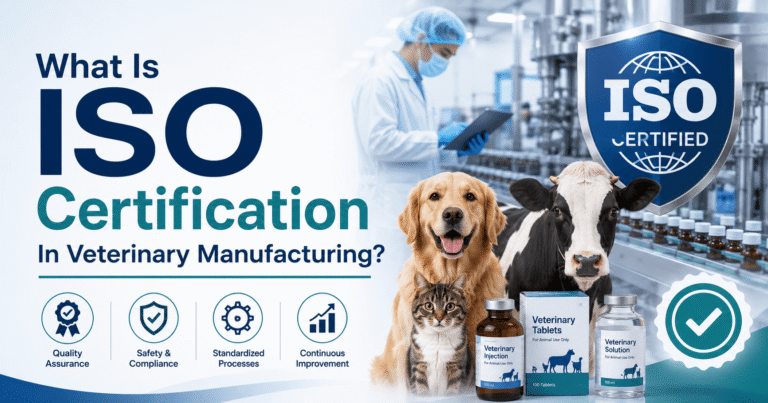
What Is ISO Certification In Veterinary Manufacturing?
ISO (International Organization for Standardization) develops globally accepted standards that help organizations improve quality, efficiency, and customer confidence. To learn more about ISO standards and certification frameworks, visit the International Organization for Standardization (ISO).
In veterinary pharmaceutical manufacturing, ISO certification confirms that a company has established documented systems for:
- Manufacturing control
- Quality assurance
- Process monitoring
- Risk management
- Documentation
- Corrective actions
- Customer feedback management
- Continuous improvement
Unlike product-specific certifications, ISO certification evaluates the entire quality management system used during manufacturing.
For veterinary medicine manufacturers, this means every stage—from raw material procurement to packaging and dispatch—operates under controlled procedures that reduce errors and maintain consistent quality.
Why ISO Certification Matters in Veterinary Manufacturing
Veterinary medicines directly affect animal health, livestock productivity, dairy production, poultry farming, and food safety. Any compromise in quality can lead to treatment failure, economic losses, and reduced customer trust.
ISO certification helps manufacturers build a reliable quality framework that minimizes these risks.
1. Ensures Consistent Product Quality
One of the biggest advantages of ISO certification is process consistency.
Instead of depending on manual inspections alone, manufacturers establish standardized operating procedures that ensure every production batch follows the same quality requirements.
This consistency results in:
- Uniform formulations
- Reliable potency
- Stable product performance
- Better shelf life
- Reduced manufacturing deviations
2. Improves Customer Confidence
Distributors, veterinary doctors, wholesalers, and exporters often prefer working with certified manufacturers because ISO certification demonstrates a commitment to quality.
Customers know that certified companies:
- Maintain documented procedures
- Conduct regular quality checks
- Record production activities
- Handle complaints effectively
- Continuously improve manufacturing systems
This creates long-term trust in the business relationship.
3. Supports Regulatory Compliance
Veterinary pharmaceutical companies must comply with multiple national and international regulations.
ISO certification strengthens compliance by ensuring:
- Proper documentation
- Standardized processes
- Internal quality audits
- Risk assessments
- Employee training
- Corrective action systems
These practices make regulatory inspections smoother and reduce compliance-related issues.
4. Enhances Export Opportunities
Many international buyers evaluate manufacturing certifications before selecting suppliers.
Although ISO certification alone may not satisfy every country’s regulatory requirements, it demonstrates that a manufacturer follows internationally accepted quality management practices.
For exporters, this offers several advantages:
- Improved buyer confidence
- Better market reputation
- Easier supplier qualification
- Competitive advantage
- Higher acceptance in global markets
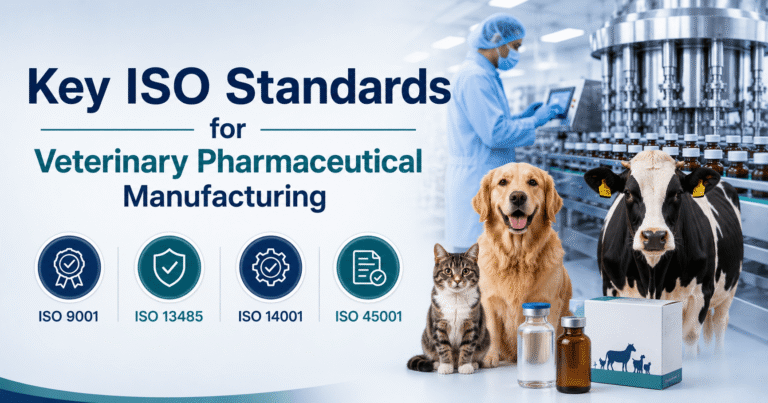
Key ISO Standards for Veterinary Pharmaceutical Manufacturing
Different ISO standards focus on different aspects of quality, environmental responsibility, occupational safety, and laboratory competence.
The following certifications are commonly associated with veterinary pharmaceutical manufacturing.
ISO 9001: Quality Management System
ISO 9001 is the most widely recognized quality management standard.
It helps veterinary manufacturers establish systems for:
- Quality planning
- Process control
- Customer satisfaction
- Continuous improvement
- Risk-based thinking
- Documentation
- Internal audits
For most veterinary medicine manufacturers, ISO 9001 forms the foundation of quality management.
ISO 14001: Environmental Management
Veterinary pharmaceutical manufacturing involves chemical handling, waste generation, and resource consumption.
ISO 14001 helps companies:
- Reduce environmental impact
- Improve waste management
- Control pollution
- Optimize energy use
- Meet environmental regulations
This certification reflects a company’s commitment to sustainable manufacturing.
ISO 45001: Occupational Health and Safety
Manufacturing facilities must protect employees from workplace hazards.
ISO 45001 focuses on:
- Worker safety
- Hazard identification
- Risk prevention
- Emergency preparedness
- Safe manufacturing practices
A safer workplace also contributes to better productivity and operational efficiency.
ISO/IEC 17025 (Testing Laboratories)
Many veterinary pharmaceutical companies operate quality control laboratories.
ISO/IEC 17025 demonstrates laboratory competence by ensuring:
- Accurate testing methods
- Equipment calibration
- Reliable analytical results
- Technical competence
- Measurement accuracy
This strengthens confidence in product quality and testing reliability.
Veterinary GMP and ISO Certification: Understanding the Difference
Many people assume GMP and ISO certification are the same. In reality, they serve different purposes while complementing each other.
Feature | GMP | ISO 9001 |
Primary Focus | Safe manufacturing practices | Quality management system |
Purpose | Product quality and safety | Process improvement |
Regulatory Requirement | Often mandatory | Usually voluntary but highly valuable |
Documentation | Manufacturing procedures | Business-wide quality systems |
Customer Satisfaction | Indirect | Direct focus |
Continuous Improvement | Limited | Core requirement |
The strongest veterinary pharmaceutical companies implement both veterinary GMP and ISO certification to build comprehensive quality systems.
Benefits of Choosing an ISO Certified Veterinary Manufacturer
Selecting a quality-certified veterinary manufacturer provides advantages beyond regulatory compliance while ensuring reliable products and long-term business confidence.
Higher Manufacturing Standards
Certified manufacturers operate using documented procedures that improve production consistency while reducing manufacturing errors.
Better Product Traceability
Every production batch receives complete documentation.
This enables manufacturers to:
- Track raw materials
- Identify production records
- Investigate quality issues
- Improve recall management if necessary
Traceability significantly strengthens customer confidence.
Reduced Operational Risks
ISO emphasizes preventive action rather than corrective action. Manufacturers regularly identify potential risks before they become major quality problems.
Examples include:
- Equipment maintenance
- Supplier evaluation
- Process validation
- Employee competency assessment
Stronger Customer Satisfaction
ISO-certified companies actively collect customer feedback and use it to improve products and services.
This customer-focused approach helps businesses build long-term relationships with:
- Veterinary distributors
- PCD pharma partners
- Export buyers
- Veterinary hospitals
- Livestock healthcare providers
Greater Global Trust
International buyers increasingly prefer manufacturers that follow globally recognized quality systems.
An ISO-certified veterinary pharmaceutical manufacturer demonstrates professionalism, accountability, and long-term commitment to quality.
This becomes especially important when entering new export markets or establishing strategic partnerships.
Signs of a Reliable ISO Certified Veterinary Manufacturer
Before choosing a manufacturing partner, evaluate more than just the ISO certificate.
Consider the following factors:
 Valid ISO certification from an accredited certification body
WHO-GMP or GMP-compliant manufacturing facility
Well-equipped quality control laboratories
Experienced regulatory and quality assurance teams
Transparent documentation practices
Strong product portfolio
Batch traceability systems
Timely production and delivery
Proven export capabilities
Positive market reputation
Selecting a manufacturer with these qualities helps ensure consistent product quality and reliable long-term business support.
Expert Insight
ISO certification is not simply a marketing credential—it reflects a manufacturer’s commitment to building a structured quality management system. In the veterinary pharmaceutical industry, where product consistency, safety, and compliance directly impact animal health and business reputation, ISO-certified manufacturers are better positioned to meet customer expectations and compete in both domestic and international markets. However, businesses should verify that ISO certification is supported by GMP compliance, robust quality assurance processes, and experienced manufacturing practices before entering into long-term partnerships.
Market Demand for ISO-Certified Veterinary Manufacturers
The global veterinary pharmaceutical market continues to expand due to rising pet ownership, increasing livestock production, growing awareness of animal diseases, and stricter regulatory requirements. As demand grows, buyers are becoming more selective about the manufacturers they partner with.
Today, distributors, importers, exporters, and veterinary healthcare companies often prioritize manufacturers that can demonstrate strong quality management systems. An ISO certified veterinary manufacturer stands out because it shows a commitment to consistent production, customer satisfaction, and continuous improvement.
Why Market Demand Is Increasing
Several factors are driving demand for certified veterinary pharmaceutical manufacturers:
- Growth in the livestock and dairy industries
- Rising demand for companion animal healthcare products
- Expansion of veterinary exports from India
- Increasing regulatory scrutiny in global markets
- Higher expectations for product quality and traceability
- Growing preference for long-term manufacturing partnerships
For veterinary companies aiming to expand internationally, implementing ISO standards for veterinary pharmaceutical manufacturing is no longer just an advantage—it has become an important business differentiator.
How ISO Certification Supports Global Exports
Exporting veterinary medicines requires more than competitive pricing. International buyers look for manufacturers that consistently produce high-quality products while following recognized quality systems.
ISO certification strengthens export readiness by helping manufacturers:
- Build credibility with overseas buyers
- Maintain standardized production processes
- Improve documentation for regulatory reviews
- Reduce manufacturing deviations
- Enhance customer confidence
- Demonstrate commitment to quality management
Although different countries have their own import regulations, ISO certification often supports supplier qualification and helps manufacturers establish trust during business negotiations.
How to Verify an ISO Certified Veterinary Manufacturer
Not every manufacturer claiming ISO certification maintains the same level of quality. Before selecting a manufacturing partner, conduct a careful evaluation.
Check the Validity of the Certificate
Ensure the certificate:
- Is current and not expired
- Covers the relevant manufacturing facility
- Is issued by an accredited certification body
- Matches the manufacturer’s scope of operations
Review Manufacturing Infrastructure
A reliable veterinary manufacturer should have:
- Modern production facilities
- Dedicated quality control laboratories
- Qualified technical professionals
- Proper warehousing systems
- Hygienic manufacturing environment
Evaluate Documentation Practices
Good manufacturers maintain complete records for:
- Batch manufacturing
- Raw material sourcing
- Equipment calibration
- Quality testing
- Product release
- Customer complaints
Proper documentation reflects a mature quality management system
Assess Customer Support
Strong manufacturers provide support beyond production. Look for partners that offer:
- Regulatory documentation
- Technical guidance
- Prompt communication
- Packaging customization
- Timely deliveries
- After-sales assistance
Expert Recommendations for Choosing the Right Manufacturing Partner
Choosing a veterinary manufacturing partner is a long-term business decision. Beyond ISO certification, evaluate the company’s overall quality culture and operational capabilities.
1. Look Beyond the Certificate
ISO certification confirms that a quality management system exists, but you should also assess how effectively the company implements it in day-to-day operations.
2. Verify GMP Compliance
The best manufacturers combine veterinary GMP and ISO certification to ensure both manufacturing excellence and quality management.
3. Review Product Portfolio
A diversified product range often indicates stronger research capabilities and better manufacturing expertise.
4. Ask About Quality Control
Discuss testing procedures, stability studies, batch release protocols, and documentation practices before finalizing a partnership.
5. Evaluate Industry Experience
Manufacturers with years of experience in veterinary pharmaceuticals are generally better equipped to manage regulatory requirements, production challenges, and export expectations.
Conclusion:
Quality has become one of the most important factors in veterinary pharmaceutical manufacturing. Buyers, distributors, exporters, and healthcare professionals increasingly expect manufacturers to follow internationally accepted quality systems that ensure consistency, safety, and regulatory compliance.
ISO Certification In Veterinary Manufacturing reflects a manufacturer’s commitment to structured quality management, continuous improvement, and customer satisfaction. When combined with GMP compliance, experienced technical teams, and robust quality assurance practices, ISO certification helps build long-term trust in both domestic and global markets.
Whether you are sourcing veterinary medicines, planning an export business, or selecting a third-party manufacturing partner, choosing an ISO certified veterinary manufacturer can reduce business risks while supporting sustainable growth and stronger customer confidence.
ABOUT THE AUTHOR

Mitesh Vyas
My name is Mitesh Vyas, and I am a Pharma Franchise Consultant and Industry Research Analyst specializing in India’s PCD pharma business ecosystem. My work focuses on helping beginners, distributors, and small pharma entrepreneurs understand the real-world functioning of the pharma franchise model. Unlike theoretical content, my insights are based on ground-level observations from Indian pharmaceutical markets, including Tier-1, Tier-2, and Tier-3 cities such as Ahmedabad, Indore, Lucknow, and surrounding business hubs. I regularly share insights on how the pharma franchise business in India works in real market conditions, including investment, product strategy, and growth challenges.