
Drug License Requirements For Ayurvedic Products : In India, Ayurvedic products generally require licensing under the Ministry of AYUSH and state AYUSH authorities before manufacturing, marketing, wholesale distribution, or retail sale. The exact license depends on the business model — manufacturing, third-party marketing, wholesale trading, or retail pharmacy operations. Compliance usually includes GMP standards, product formulation approval, labeling rules, storage conditions, and documentation verification.
The type of Ayurvedic drug license required depends on the nature of the business. A manufacturer producing classical or proprietary Ayurvedic medicines requires a manufacturing license, while wholesalers and franchise distributors may need wholesale drug authorization and GST compliance. Companies using third-party manufacturing arrangements must also ensure formulation approvals, legal agreements, and labeling compliance are properly managed.
In practice, licensing is not just a legal formality. Retail chemists, hospitals, modern trade chains, and institutional buyers increasingly verify whether products come from compliant manufacturing facilities with valid documentation, batch records, and GMP certification. Businesses operating without proper approvals may face supply restrictions, inspection issues, product seizures, or difficulties building long-term credibility in the market.
What Is an Ayurvedic Drug License?
An Ayurvedic drug license is a legal authorization issued by the AYUSH department or relevant state licensing authority that permits the manufacturing, sale, distribution, or marketing of Ayurvedic medicines and herbal formulations in India.
The license ensures:
- product safety
- formulation compliance
- manufacturing accountability
- labeling accuracy
- traceability
- storage standards
- public health protection
Unlike cosmetics or general FMCG products, Ayurvedic medicines fall under regulated medicinal categories under the Drugs and Cosmetics Act, 1940.
Why Drug Licensing Matters in the Ayurvedic Industry
Many first-time distributors assume Ayurvedic products operate with “less regulation” than allopathic medicines. That assumption creates serious operational problems later.
Retail chemists increasingly ask for:
- GST-compliant invoices
- proper batch documentation
- AYUSH-approved products
- manufacturer credentials
- expiry replacement policies
Hospitals, institutional buyers, and modern trade chains are even stricter.
Without proper licensing and compliance documentation, distributors often face:
- stock rejection
- retailer trust issues
- payment delays
- interstate supply restrictions
- legal notices during inspections
The Ayurvedic sector has grown commercially, but regulatory scrutiny has also increased, especially around misleading claims, immunity products, chronic disease positioning, and online sales.
Understanding the Different Types of Ayurvedic Licenses
One of the biggest misconceptions in the market is that a single license covers every activity. It does not.
The required authorization depends entirely on your role in the pharma supply chain.
1. Ayurvedic Manufacturing License
This license is required for companies manufacturing Ayurvedic medicines directly.
Applicable for:
- classical Ayurvedic medicines
- proprietary Ayurvedic formulations
- herbal syrups
- tablets
- oils
- powders
- capsules
2. Ayurvedic Wholesale Drug License
This applies to distributors, stockists, and pharma franchise operators dealing in bulk medicine supply.
Commonly required when:
- supplying chemists
- distributing across districts
- operating B2B pharma business
- handling prescription-oriented Ayurvedic products
Authorities generally verify:
- storage conditions
- invoice systems
- pharmacist supervision requirements (state-dependent)
- commercial premises
- GST registration
Many new pharma franchise seekers overlook this step because some companies market “license-free” business opportunities. In reality, licensing requirements vary by state and product category.
In Gujarat, Punjab, Maharashtra, and several other states, enforcement practices may differ operationally, but wholesale compliance checks are becoming more common.
3. Retail Ayurvedic Drug License
Required for:
- Ayurvedic medical stores
- retail pharmacies
- offline medicine counters
This license focuses heavily on:
- consumer-facing sales
- storage standards
- prescription handling
- product traceability
Retail inspections may include:
- temperature conditions
- batch visibility
- expired stock handling
- invoice maintenance
4. Loan License / Third-Party Manufacturing Authorization
Many Ayurvedic PCD companies do not manufacture products themselves.
Instead, they use third-party manufacturing arrangements.
In such cases:
- the actual manufacturer holds the manufacturing license
- the marketing company operates under agreement-based authorization
- product branding rights are contractually managed
This model is extremely common in the monopoly pharma franchise market.
However, distributors should verify:
- actual manufacturing source
- GMP certification validity
- ownership of product permissions
- consistency of batch quality
Some companies change manufacturers frequently to reduce costs, which can affect product consistency and doctor trust.
Ayurvedic Drug License Requirements in India
Identity and Business Documents
- PAN card
- Aadhaar card
- business registration proof
- partnership deed or company incorporation documents
- GST registration
Premises Documents
- rent agreement or ownership proof
- electricity bill
- property tax receipt (sometimes)
Operational Documentation
- storage details
- refrigerator details (if applicable)
- layout plan
- affidavit/declaration forms
Technical Documentation
- pharmacist details (where applicable)
- competent person certificates
- manufacturing formulas
- testing protocols
Regulatory Documents
- GMP certification
- AYUSH approvals
- labeling samples
- product composition details
Ayurvedic Product Registration Process
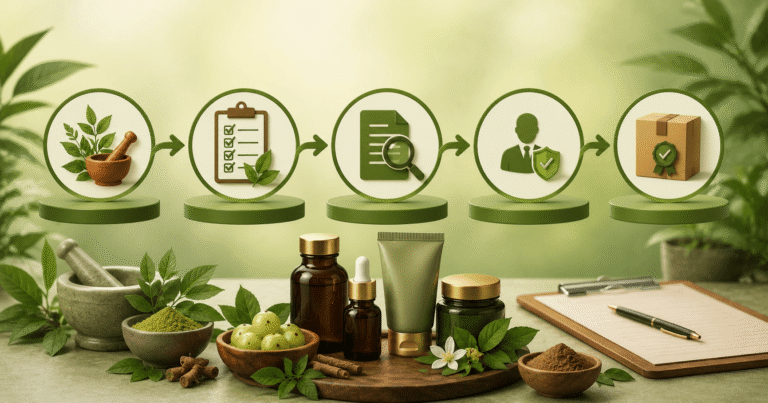
Step 1 — Business Structure Finalization
Choose the operational model first.
Examples:
- distributor
- marketing company
- manufacturer
- third-party marketer
- retailer
Before applying for any license, choose your operational model clearly. Your business structure decides which registrations, approvals, and compliance requirements you actually need. Understanding the licensing requirements for Ayurvedic products early in the planning stage helps businesses identify whether they need manufacturing approvals, wholesale permissions, or retail authorizations. For example, a manufacturer requires production licenses, while a distributor or retailer mainly needs trading and distribution permissions.
Step 2 — Premises Preparation
Licensing authorities inspect infrastructure seriously now compared to earlier years.
Poor storage conditions create:
- moisture damage
- label deterioration
- fungal contamination risk
- batch rejection issues
Even Ayurvedic powders and syrups require proper handling.
Step 3 — Documentation Submission
Applications are submitted through:
- state AYUSH departments
- drug control departments
- offline regulatory offices (in some states)
Documentation inconsistencies are among the most common approval delays.
Step 4 — Inspection and Verification
Authorities may inspect:
- storage
- records
- equipment
- labeling
- sanitation
- technical supervision
For manufacturers, inspections are much stricter.
Step 5 — Approval and License Issuance
The approval timeline varies significantly.
In practice:
- wholesale licenses may move faster
- manufacturing approvals can take several months
- incomplete documentation creates repeated follow-ups
Consultants often help speed procedural compliance, but many overpromise unrealistic timelines.
What Most Distributors Don’t Realize
A valid drug license is only the starting point. Most first-year failures happen because of operational problems, not documentation.
Common ground realities include:
Doctor Conversion Is Slow
Many new distributors expect immediate prescriptions after product launch.
In reality:
- doctors take time to trust brands
- repeat prescriptions matter more than first orders
- sample conversion rates are unpredictable
Stock Expiry Is a Serious Risk
Companies aggressively push inventory loading.
Unsold stock becomes a financial burden if:
- doctor movement is weak
- retailer pull is low
- replacement policies are unclear
Always ask:
- expiry replacement terms
- damage return policy
- near-expiry support
before investing heavily.
Monopoly Rights Are Often Misunderstood
“Monopoly” usually means limited internal distributor allocation — not total market exclusivity.
A company may still:
- supply nearby districts
- appoint online sellers
- operate through institutional channels
Distributors should request:
- written territory policy
- invoice mapping clarity
- conflict resolution terms
Payment Cycles Can Damage Cash Flow
Retail chemists and hospitals often operate on delayed payments.
Typical challenges:
- 30–90 day credit cycles
- slow recovery from clinics
- blocked capital in inventory
- pressure to maintain stock availability
This becomes difficult for small distributors with limited working capital.
Ayurvedic Manufacturing Compliance: What Companies Must Follow
GMP and Quality Standards
WHO-GMP certification is frequently used in marketing, but distributors should understand what it practically indicates.
WHO-GMP generally reflects:
- standardized manufacturing systems
- hygiene protocols
- process consistency
- documentation systems
- quality auditing
WHO-GMP certification generally reflects standardized manufacturing systems, hygiene protocols, process consistency, documentation systems, and quality auditing practices followed under pharmaceutical regulatory frameworks associated with authorities like the Central Drugs Standard Control Organization. However, certification alone does not guarantee strong market demand, as some companies invest heavily in compliance credentials but provide weak field support and inconsistent distributor assistance.
Others focus only on aggressive marketing while neglecting:
- batch consistency
- packaging quality
- supply stability
Balanced operational capability matters more.
Labeling and Packaging Compliance
Ayurvedic product labels typically require:
- ingredient declaration
- manufacturing details
- batch number
- expiry date
- dosage guidance
- caution statements
- license number
Misleading therapeutic claims can attract regulatory scrutiny.
This is especially important for:
- diabetes claims
- cancer claims
- sexual wellness positioning
- immunity claims
Authorities have become more active regarding unsupported advertisements.
Difference Between Ayurvedic and Allopathic Drug Licensing
| Aspect | Ayurvedic Products | Allopathic Products |
|---|---|---|
| Governing Authority | Ministry of AYUSH | CDSCO / DCGI |
| Product System | Traditional medicine | Modern medicine |
| Formula Basis | Classical/proprietary | Clinical formulations |
| Manufacturing Control | AYUSH guidelines | Strict pharmaceutical protocols |
| Prescription Dependency | Moderate | High |
| Market Entry Barrier | Lower comparatively | Higher |

Common Mistakes New Ayurvedic Pharma Entrepreneurs Make
1. Choosing Products Only on High Margins
Very high-margin products sometimes indicate:
- poor movement
- overpricing
- weak doctor acceptance
Consistent repeat demand matters more than printed margin percentages.
2. Ignoring Supply-Chain Reliability
Delayed deliveries destroy retailer confidence quickly.
Frequent operational complaints include:
- partial dispatches
- unavailable fast-moving products
- inconsistent packaging
- batch shortages
Retailers prioritize dependable supply more than promotional brochures.
3. Depending Completely on Company Marketing Promises
Many companies advertise:
- “full doctor support”
- “100% monopoly”
- “guaranteed business growth”
Actual field execution is usually limited.
Distributors still need:
- relationship-building
- fieldwork
- retailer engagement
- prescription generation efforts
4. Overstocking in the First Three Months
New entrants often purchase excessive inventory due to incentive schemes.
That creates:
- expiry risk
- cash blockage
- storage pressure
- weak product rotation
Smaller controlled inventory cycles are safer initially.
Realistic Investment Expectations
Approximate Startup Costs
| Expense Area | Estimated Range |
|---|---|
| Licensing & documentation | ₹10,000–₹50,000 |
| GST and registration | ₹2,000–₹15,000 |
| Initial inventory | ₹30,000–₹3 lakh+ |
| Storage setup | Variable |
| Field marketing | Ongoing expense |
| Doctor promotion | Continuous investment |
Actual investment depends on:
- city
- product category
- prescription focus
- business scale
A rural-focused distributor may spend differently compared to an Ahmedabad urban franchise operator.
How to Verify an Ayurvedic Pharma Company Before Partnership
Manufacturing Transparency
Ask:
- Who manufactures the products?
- Is the facility owned or outsourced?
- Is the GMP certification current?
Product Stability
Review:
- packaging consistency
- repeat availability
- market feedback
- doctor acceptance
Replacement Policies
Clarify:
- expiry replacement
- breakage handling
- transport damage policy
Territory Clarity
Avoid verbal promises.
Request:
- written distributor terms
- district allocation policy
- online selling policy
Supply Performance
Speak with existing distributors if possible.
Ask about:
- dispatch timelines
- shortage frequency
- customer support quality
This often reveals more than brochures or sales presentations.
Conclusion
The Ayurvedic medicine market in India continues to expand, but the business is no longer as unstructured as it once was. Regulatory oversight, distributor competition, doctor expectations, and supply-chain discipline have all increased.
A drug license should not be viewed as a paperwork formality. It directly affects:
- operational legitimacy
- retailer confidence
- institutional supply opportunities
- long-term business sustainability
Before investing in an Ayurvedic pharma business, evaluate:
- licensing obligations
- product quality consistency
- replacement policies
- supply-chain reliability
- realistic market demand
Careful verification usually prevents bigger problems later.
Compare companies carefully before making investment decisions.
Drug License Requirements For Ayurvedic Products - FAQs
Is an Ayurvedic drug license mandatory in India?
Can I start an Ayurvedic PCD pharma franchise without a drug license?
Who issues Ayurvedic manufacturing licenses?
What is the difference between GMP certification and a drug license?
How long does Ayurvedic drug license approval take?
ABOUT THE AUTHOR

Mitesh Vyas
My name is Mitesh Vyas, and I am a Pharma Franchise Consultant and Industry Research Analyst specializing in India’s PCD pharma business ecosystem. My work focuses on helping beginners, distributors, and small pharma entrepreneurs understand the real-world functioning of the pharma franchise model. Unlike theoretical content, my insights are based on ground-level observations from Indian pharmaceutical markets, including Tier-1, Tier-2, and Tier-3 cities such as Ahmedabad, Indore, Lucknow, and surrounding business hubs. I regularly share insights on how the pharma franchise business in India works in real market conditions, including investment, product strategy, and growth challenges.