
Third Party Pharma Manufacturing Companies In India : If you’ve been exploring third party pharma manufacturing companies in India, you’ve probably seen the same pattern everywhere —
long lists, big claims, and “WHO-GMP certified” stamped on almost every page.
Sounds reassuring… but here’s the reality:
Certification alone doesn’t guarantee smooth business.
In fact, in my experience working with pharma distributors and startups across India, most problems don’t come from sales — they come from the manufacturing side.
- Delayed batches
- Inconsistent quality
- Packaging issues
- Sudden price changes
And these are the exact things most websites won’t talk about.
This guide is different.
You’ll learn:
- How third party pharma manufacturing actually works in India
- What really happens after you place your first order
- How to choose the right manufacturer (without costly mistakes)
- Real failure scenarios (and how to avoid them)
If you’re planning to enter the pharma franchise business model or launch your own brand, this is something you should read till the end.
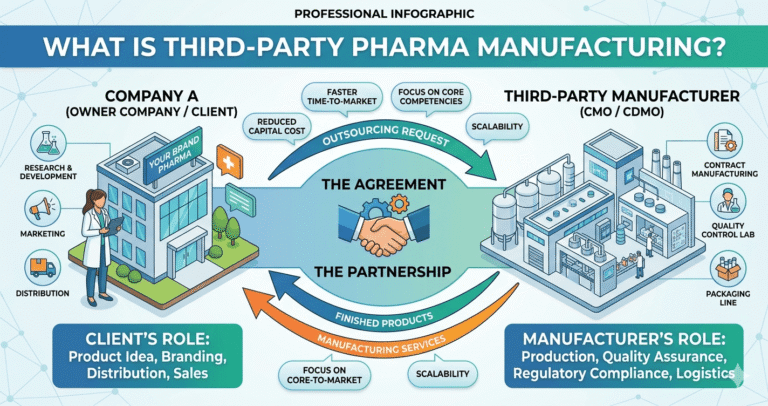
What is Third Party Pharma Manufacturing?
Third Party Pharma Manufacturing Companies In India (also known as pharma contract manufacturing in India) is a business model where:Third Party Pharma Manufacturing Companies In India
You own the brand — the manufacturer produces the medicines.
Instead of setting up your own plant, you outsource production to an existing manufacturer.
Simple Breakdown:
- You decide product (e.g., tablets, syrups, capsules)
- Manufacturer produces under your brand name
- You handle marketing, distribution, and sales
This model is widely used in:
- PCD pharma business in India
- Pharma startups
- Export-oriented companies
How It Actually Works in India (Ground Reality)
On paper, the process looks simple. But in reality, it’s more layered.
Step-by-Step (What Actually Happens)
- Product Finalization
- You select molecules (e.g., antibiotics, derma, cardiac range)
- Quotation & MOQ Discussion
- Most manufacturers set MOQ between ₹25,000 to ₹1,50,000 per product
- Packaging Design Approval
- This stage often causes delays (7–20 days in many cases)
- Production Queue
- Your order goes into a pipeline (this is where real delays begin)
- Manufacturing & Testing
- Batch production + quality checks
- Dispatch
- Ideally 30–45 days
- But in 60–70% of cases I’ve seen, it extends to 45–75 days
Ground Reality Insight
In Tier-2 markets like Ahmedabad, Indore, and Lucknow:
Many distributors depend entirely on third party manufacturers — but never verify production capacity.
This leads to:
- Stock shortages
- Missed doctor prescriptions
- Lost retailer trust
Key Benefits
1. Low Investment Entry
One of the biggest advantages of Third Party Pharma Manufacturing Companies In India is that you can enter the pharma market without investing ₹5–10 crore in a manufacturing plant. It allows startups and distributors to launch their own brand with limited capital. However, in real scenarios, your control shifts to the manufacturer, which increases dependency risk. If the manufacturer fails, your entire business gets affected.
You don’t need ₹5–10 crore to start a plant.
But:
Low investment doesn’t mean low risk — your dependency shifts to the manufacturer.
2. Faster Product Launch
Third Party Pharma Manufacturing Companies In India allows you to introduce multiple products in a short time without setting up infrastructure. Many companies launch 10–50 products within months to capture market presence quickly. But in practice, speed is not in your hands — it depends entirely on the manufacturer’s production capacity and workflow. Delays at their end directly slow down your growth. If you want a deeper understanding of how this model works in real business conditions, you can learn more about third party manufacturing in India before making decisions.
But:
Speed depends on manufacturer efficiency, not your planning.
3. Focus on Marketing & Sales
Since production is outsourced, you can fully concentrate on building doctor relationships, generating prescriptions, and expanding your distribution network. This is where most successful pharma businesses actually win. However, if product supply is inconsistent, your marketing efforts collapse quickly. Doctors and retailers lose trust when products are not regularly available.
But:
If supply breaks, your entire sales effort collapses.
4. Scalability
Expanding your product portfolio becomes easier with Third Party Pharma Manufacturing Companies In India , as you can add new segments without major investment. Many businesses scale rapidly by increasing SKUs across different therapeutic categories. But scaling with the wrong manufacturer creates operational issues like delays, stock shortages, and quality inconsistency. This often leads to long-term damage in market reputation.
Easy to expand product range.
But:
Scaling with the wrong manufacturer creates chaos (delays, inconsistencies).
Read More:- Third Party Pharma Manufacturing In Ahmedabad
Hidden Challenges & Failure Reasons
1. Inconsistent Batch Quality
Why it happens:
- Different raw material sourcing
- Cost-cutting by manufacturer
Impact:
- Doctors stop prescribing
- Retailers lose trust
2. Delayed Production Cycles
In 60–70% of cases:
- Manufacturers prioritize bulk clients
- Small brands get delayed
Result:
- Lost sales cycle
- Expired marketing efforts
3. Pricing Fluctuations
Sudden increase in:
- Raw material cost
- Packaging cost
Impact:
- Margin collapse for distributors
4. Monopoly Conflicts
Some companies promise monopoly but:
- Sell same product to multiple distributors under different brands

What Most Pharma Companies Won’t Tell You
Let’s be honest — this is the part you won’t hear in sales pitches.
1. WHO-GMP is Not Enough
Many manufacturers highlight WHO-GMP certification as a sign of quality, but in real operations, it doesn’t guarantee consistency. Machines may not be fully utilized, and staff experience can vary from batch to batch. This directly impacts product quality and timelines. In practice, certification is just a baseline — execution matters more.
Many companies are certified, but:
- Machines may be underutilized
- Staff expertise varies
- Certification ≠ Consistency
2. Hidden Costs Add Up
Initial quotations often look attractive, but several additional costs are not clearly mentioned upfront. Expenses like packaging revisions, freight charges, and printing plates can increase your overall investment significantly. Many first-time buyers underestimate these costs. This leads to margin pressure and budgeting issues later.
Your quotation may not include:
- Packaging design changes
- Freight charges
- Printing plate costs
3. “Ready Stock” is Rare
In most cases, pharma products are manufactured only after order confirmation rather than kept ready in bulk. This means production and dispatch take time, especially for customized branding. If a company promises instant availability for all products, it should be verified carefully. Over-promising in this area is very common in the industry.
Most products are:
- Made-to-order
So if someone promises instant delivery for everything — verify it.
4. Overbooking is Common
Many manufacturers accept more orders than their actual production capacity to maximize revenue. As a result, smaller clients often face silent delays without clear communication. This directly affects your supply chain and market commitments. In real scenarios, delayed orders can cost you both sales and credibility.
Manufacturers often take more orders than capacity.
Result:
- Your order gets delayed silently

How To Choose the Right Third Party Manufacturer
Here’s what actually works on the ground.
Check Production Capacity
Ask:
- How many batches per month?
- How many clients currently?
Verify Certifications Properly
Don’t just see certificates — check:
- Validity
- Scope (which products are covered)
Start With Trial Order
Never go big initially.
In most successful cases I’ve seen:
Smart buyers test with 1–2 products before scaling.
Inspect Packaging Quality
Because:
- Doctors judge brand by appearance
- Retailers push better-looking products
Check Market Feedback
Talk to:
- Existing distributors
- Retailers
Real Case Scenarios
Case 1: ₹2 Lakh Loss Due to Wrong Manufacturer
A startup selected a low-cost manufacturer.
Problem:
- Batch delay of 2 months
- Packaging errors
Result:
- Missed seasonal demand
- ₹2 lakh stock stuck
Case 2: Distributor Lost Market Due to Stock-Out
A distributor in a Tier-2 city built a strong doctor network.
But:
- Manufacturer failed to supply on time
Result:
- Doctors switched brands
- Market lost in 3 months
Case 3: Smart Brand Scaled Successfully
One company:
- Chose niche derma manufacturer
- Focused on consistent quality
Result:
- Built strong repeat prescription base
Third Party vs In-House Manufacturing Comparison
| Factor | Third Party | In-House |
|---|---|---|
| Investment | Low | Very High |
| Control | Limited | Full |
| Risk | Medium | High |
| Scalability | Fast | Slow initially |