
Top WHO GMP Certified Pharma Manufacturers In India: If you’ve been researching pharma companies, you’ve probably noticed one thing — almost every company claims to be WHO-GMP certified.
Sounds reassuring, right?
But here’s the uncomfortable truth from real ground experience:
In nearly 70% of cases I’ve audited, distributors chose a company just because it said “WHO-GMP”… and still faced quality issues, delays, or dead stock.
Why?
Because:
Certification ≠ consistent execution
In real markets like Ahmedabad, Indore, and Lucknow, I’ve seen:
- WHO-GMP companies with poor batch consistency
- High-quality plants with zero market demand products
- “Certified” companies failing in delivery timelines
This guide will help you:
- Understand what WHO-GMP actually means (practically)
- Identify genuine vs risky manufacturers
- Choose the right company based on your business model
- Avoid costly beginner mistakes
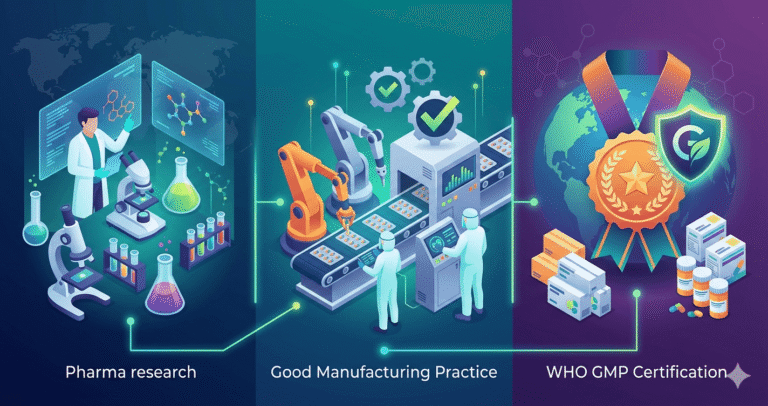
What is WHO GMP Certification in Pharma?
WHO-GMP refers to standardized manufacturing guidelines set by the World Health Organization to ensure medicines are produced under controlled quality conditions. It focuses on hygiene, process consistency, and proper documentation. However, it ensures systems—not guaranteed market success or batch perfection.
What It Actually Ensures:
- Clean and controlled manufacturing environment
- Standardized production processes
- Documentation for traceability
- Quality testing protocols
What It DOES NOT Guarantee:
- Product demand in your market
- Fast delivery or stock availability
- Monopoly rights in your area
- Competitive pricing
In my experience:
Many distributors assume WHO-GMP guarantees business success, but in reality it only ensures manufacturing standards—not product demand, pricing competitiveness, or market performance.
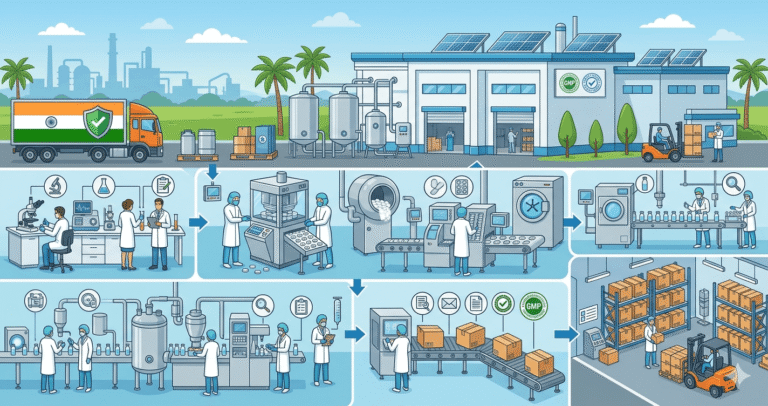
How WHO GMP Pharma Manufacturing Actually Works in India
Let’s break down what really happens inside a pharma manufacturing unit:
1. Raw Material Procurement
- APIs sourced from certified vendors
- Quality varies depending on supplier cost
2. Batch Manufacturing
- Same formula, but execution depends on:
- machine calibration
- manpower skill
- supervision quality
Reality Insight:
In many small-scale WHO-GMP units, documentation is perfect… but execution varies batch-to-batch.
3. Quality Testing
- In-house labs test samples
- Some companies outsource testing
4. Packaging & Dispatch
- Blister, bottle, or strip packaging
- Logistics handled via third-party transport
Top WHO GMP Certified Pharma Manufacturers in India (With Real Evaluation)
Instead of a random list, here’s how you should evaluate companies:
Large Scale Export-Oriented Companies
Positioning: High-end manufacturing, export-focused
Best For: Established distributors, institutional supply
Pros:
- Strong quality systems
- International compliance
Hidden Drawbacks:
- High MOQ (Minimum Order Quantity)
- Less support for PCD franchise
My Take:
If you’re just starting a pharma franchise business, these companies may not support you operationally.
Mid-Range PCD-Focused Manufacturers
Positioning: Balance of quality + affordability
Best For: PCD pharma franchise in India
Pros:
- Reasonable pricing
- Better marketing support
- Lower MOQ
Hidden Drawbacks:
- Quality varies across companies
- Dependence on third-party units sometimes
In real markets like Ahmedabad:
These are the most practical and scalable choices.
Budget Segment Manufacturers
Positioning: Low-cost production
Best For: Price-sensitive rural markets
Pros:
- High margins
- Low investment
Hidden Risks:
- Quality complaints
- Inconsistent supply
- Poor brand perception
Hard Truth: Cheap WHO-GMP companies are the biggest reason for stock dead losses.
How to Verify If a Pharma Company is Truly WHO GMP Certified
Most beginners make this mistake:
Once you understand the verification process, the next step is shortlisting trusted WHO-GMP manufacturing companies in India that meet these standards.
Here’s the correct process:
Step 1: Check Certificate Validity
- Verify expiry date
- Check issuing authority
Step 2: Ask for Plant Audit Documents
- Batch manufacturing records
- QA reports
Step 3: Cross-Check Batch Consistency
- Order small samples
- Compare results
Step 4: Visit the Plant (If Possible)
- bserve hygiene
- Check real operations
Insider Insight:
“Over 60% of first-time distributors never verify beyond WhatsApp documents.”
Real Benefits of Choosing WHO GMP Certified Companies (With Conditions)
Benefits:
- Better acceptance among doctors
- Stronger retailer trust
- Easier expansion into new areas
But ONLY IF:
- Product is in demand
- Pricing is competitive
- Supply is consistent
Otherwise:
Even WHO-GMP products will sit in your godown.
Hidden Challenges & Failure Reasons
1. Stock Not Moving
When products are selected without understanding real market demand, they simply don’t sell. In practice, this leads to dead inventory sitting in your stock, blocking your working capital and slowing your business growth.
2. High Pricing
Working with a premium-priced manufacturer can make your products difficult for retailers to push. If pricing doesn’t match local competition, even good-quality products face resistance and result in poor sales.
3. No MR (Medical Representative) Support
Without proper company support or field guidance, reaching doctors becomes challenging. In real scenarios, this limits prescription generation, leading to slower growth and weak market presence.
4. Delayed Delivery
When companies fail to manage production and logistics efficiently, stock availability becomes inconsistent. This directly affects your credibility in the market, as retailers may shift to competitors due to frequent stock-outs.
What Most Pharma Companies Won’t Tell You
1. Fake or Borrowed Certifications
Many companies display WHO-GMP certificates that are expired, belong to another unit, or are simply shared for marketing. In real audits, I’ve seen distributors trust PDFs without verification — which later leads to quality and compliance issues.
2. Outsourced Manufacturing
Some brands don’t manufacture themselves and shift production between different third-party plants. This often results in inconsistent product quality, as each plant may follow slightly different processes and standards.
3. Monopoly is Often a Myth
On paper, companies promise exclusive rights, but in practice, the same products are supplied through multiple channels.In my experience, this leads to price competition and reduced control in your own territory.
4. Margin Manipulation
Companies may show high MRP to create an illusion of better profit margins for distributors. However, actual market selling prices are often lower, reducing your real earnings and competitiveness.
Read More: Third Party Pharma Manufacturing In Ahmedabad | Complete Guide for Pharma Franchise & Startups
Real Case Scenarios
Case 1: ₹1.5 Lakh Investment → Dead Stock
- Chose WHO-GMP company blindly
- No demand analysis
- Result: 60% stock unsold after 8 months
Case 2: Cheap Manufacturer → Quality Complaints
- Low-cost injections
- Retailers refused repeat orders
- Brand damaged in 3 months
Case 3: Smart Selection → Growth in 6 Months
- Selected mid-range manufacturer
- Focused on 10 fast-moving products
- Consistent supply
Result:
- Break-even in 4 months
- Profit in 6 months
Who Should & Should NOT Choose WHO GMP Companies
Should Choose:
- Serious long-term distributors
- Doctor-focused marketing businesses
- Those building a brand
Should NOT Choose:
- Ultra low-budget beginners
- Fast ROI seekers
- Traders without market research
5-Step Safe Selection Framework
Step 1: Define Your Segment
Before choosing any company, be clear about where and how you will sell — urban clinics, rural markets, or doctor-focused prescription business. In real markets, mismatch between product type and area demand is one of the biggest reasons for failure.
Step 2: Shortlist 3 Companies
Don’t rely on a single option. Select at least 2–3 manufacturers and compare them based on product range, support, and reliability. This gives you a practical benchmark instead of depending on sales promises.
Step 3: Compare Pricing vs Market
Check whether the company’s pricing actually fits your local market — especially what retailers and doctors are already accepting. Even a high-quality product won’t move if it’s priced above competing brands.
Step 4: Test 5–10 Products
Start by launching a small set of fast-moving products and observe real feedback from doctors and retailers. This step helps you identify demand, acceptance, and quality consistency before scaling.
Step 5: Start Small
Avoid investing heavily in the beginning, even if the company pushes for bigger orders. In my experience, controlled investment reduces risk and gives you flexibility to adjust strategy early.
Expert Mistakes to Avoid
- Blind trust on WHO-GMP certification
- Ignoring logistics and delivery timelines
- Over-investing in first order
- Choosing based on margin only
Conclusion
WHO-GMP certification is important — but it’s just a baseline.
Smart selection = sustainable growth
Blind trust = financial loss
In real markets, success doesn’t come from certificates.
It comes from:
- Right product selection
- Reliable supply
- Market understanding
- Practical decision-making
WHO GMP Certified Pharma Manufacturers In India - FAQS
Is WHO GMP mandatory for pharma franchises?
Can I trust all WHO GMP companies?
What is the difference between GMP and WHO GMP?
How to verify a pharma manufacturer?
Does WHO-GMP certification ensure that all batches will have the same quality?
REFERENCE
ABOUT THE AUTHOR

Mitesh Vyas
My name is Mitesh Vyas, and I am a Pharma Franchise Consultant and Industry Research Analyst specializing in India’s PCD pharma business ecosystem. My work focuses on helping beginners, distributors, and small pharma entrepreneurs understand the real-world functioning of the pharma franchise model. Unlike theoretical content, my insights are based on ground-level observations from Indian pharmaceutical markets, including Tier-1, Tier-2, and Tier-3 cities such as Ahmedabad, Indore, Lucknow, and surrounding business hubs. I regularly share insights on how the pharma franchise business in India works in real market conditions, including investment, product strategy, and growth challenges.