
If you are planning to enter the pharma business in India through a low-investment model like contract manufacturing, Ahmedabad will always come up in your research. And for good reason.
Ahmedabad is one of India’s strongest pharmaceutical manufacturing hubs after Hyderabad and Baddi. But here is what most online articles will not tell you:
Not all “Ahmedabad manufacturers” are actually manufacturers. Pricing varies drastically for the same product. MOQ (Minimum Order Quantity) is often misunderstood by beginners. Quality consistency is not as uniform as brochures suggest.
In my experience working with 50+ distributors and pharma startups across Gujarat, one pattern is clear:
Success in third party pharma manufacturing in Ahmedabad depends less on investment and more on selection intelligence.
This blog breaks down the real ground-level reality of third party pharma manufacturing in Ahmedabad, not theory or marketing claims.
You will learn:
- How the system actually works
- Where most beginners fail
- What manufacturers never disclose
- How to safely enter this business
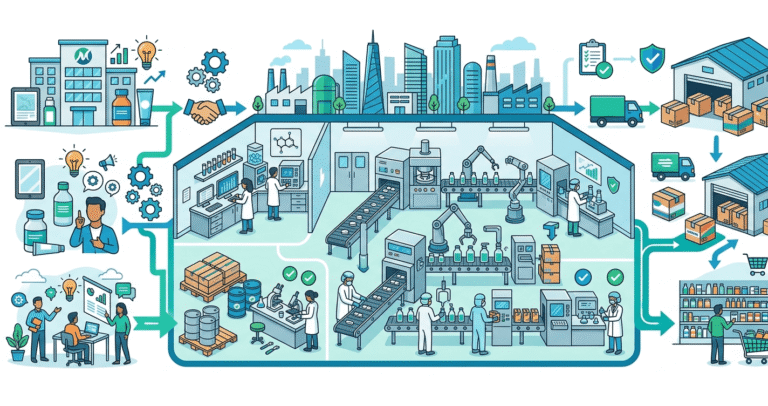
How Third Party Pharma Manufacturing Actually Works in Ahmedabad
On paper, third party manufacturing looks simple:
You give your brand name, the manufacturer produces medicine, and you sell it.
But in Ahmedabad’s pharma ecosystem, the structure is more layered.
1. Types of Manufacturing Units
In Ahmedabad industrial zones like Changodar, Sanand, Vatva, and Naroda, manufacturers generally fall into four categories:
- Full-fledged GMP-certified manufacturers
- Loan license manufacturers (shared facilities)
- Aggregator companies (outsourcing production)
- Labeling and trading units (not actual manufacturers)
The last category is where most beginners get trapped.
2. Real Workflow
Actual process in genuine manufacturers:
- Product selection from approved list
- Quotation (base + packaging + taxes)
- Batch manufacturing
- Quality testing
- Packaging and branding
- Dispatch
In aggregator models:
- Orders are passed to third-party units
- Pricing changes midway
- Delivery timelines are less controlled
This difference directly impacts business stability.

Key Industrial Zones for Pharma Manufacturing in Ahmedabad
Ahmedabad pharma ecosystem is distributed across multiple industrial zones.
1. Changodar Industrial Area
High concentration of tablet and capsule manufacturers. Better infrastructure. Moderate to high pricing.
2. Sanand GIDC
A fast-growing pharma hub with modern GMP-compliant facilities, ideal for long-term partnerships and quality-focused manufacturing.
3. Vatva GIDC
One of the oldest industrial zones offering mixed-quality manufacturers, often chosen for budget-friendly or entry-level pharma production.
4. Naroda GIDC
A strong industrial zone for intermediates, formulations, and packaging units, supporting diverse pharma manufacturing operations.
In real market conditions, Changodar and Sanand are preferred for serious brands, while Vatva is often used for low-cost entry.

Benefits of Third Party Pharma Manufacturing in Ahmedabad
1. Strong Manufacturing Ecosystem
Ahmedabad has a well-developed pharma ecosystem with nearby suppliers, packaging units, and logistics support, helping reduce production delays and overall costs.
2. Wide Product Range Availability
Manufacturers offer a complete range including tablets, capsules, syrups, injectables, and ointments, making it easier to build a full product portfolio.
3. Competitive Pricing
High competition among manufacturers keeps pricing attractive, but cost structures may vary and are not always fully transparent.
4. Faster Market Entry
With ready infrastructure and documentation support, pharma brands can typically launch their products within 30–60 days.

Hidden Risks & Challenges in Ahmedabad Pharma Manufacturing Market
1. MOQ Misunderstanding
MOQ is not fixed.
- Tablets: 500–5000 boxes
- Syrups: 300–2000 bottles
- Capsules: 500–3000 strips
Manufacturers often reduce MOQ initially to attract clients and later adjust pricing indirectly.
2. Price Fluctuation After Confirmation
In many cases, final billing differs due to:
- Packaging changes
- GST adjustments
- Label revisions
3. Batch Quality Variation
First batch is often better than subsequent batches, affecting:
- Doctor trust
- Prescription continuity
- Brand reputation
4. Dependency on Manufacturer Schedule
Delays occur when large clients are prioritized, affecting your market entry timing.
What Most Pharma Companies Won’t Tell You
- Not all GMP certificates guarantee daily production quality
- Some “manufacturers” are actually aggregators
- Hidden charges appear after order confirmation
- Shelf-life and stability shortcuts exist in low-cost production models
- Credit cycles of 30–90 days can create cash flow risk for beginners
Real Case Scenarios from Gujarat Market
Case 1: Startup Loss Due to Wrong Selection
A new entrepreneur invested ₹1.2 lakh in antibiotics.
- Promised premium packaging
- Delivered average quality
- Doctors rejected samples
Result: 60% unsold inventory within 3 months.
Case 2: Hidden Cost Increase
Initial quote was ₹22 per strip, final cost became ₹31 due to:
- Labeling charges
- Packaging revision
- Urgent dispatch fees
Case 3: Market Delay Impact
A brand missed seasonal demand due to a 25-day production delay, allowing competitors to capture market share.
How to Choose the Right Third Party Pharma Manufacturer in Ahmedabad
Step 1: Verify Manufacturing Ownership
Confirm that the company is a genuine manufacturer and not an intermediary or trader to avoid pricing and quality inconsistencies.
Step 2: Check GMP Compliance Physically
Always visit or verify the facility in person instead of relying only on certificates to ensure real production standards.
Step 3: Request Samples
Check product samples for packaging quality, uniformity, and correct labeling before placing bulk orders.
Step 4: Match MOQ with Market Demand
Select MOQ based on your actual market potential to avoid unnecessary inventory burden and stock blockage.
Step 5: Evaluate Credit Terms
Carefully assess payment cycles, as shorter credit periods help maintain healthier cash flow and reduce business risk.
Step-by-Step Entry Strategy for Beginners
Step 1: Start with 10–15 Fast-Moving Products
Begin with high-demand categories like antibiotics, pain relief, and multivitamins to ensure quicker market acceptance and faster sales movement.
Step 2: Select One Reliable Manufacturer
Work with a single trusted manufacturer initially to maintain quality consistency and avoid operational confusion.
Step 3: Build Doctor Network
Develop strong relationships with doctors, as prescription flow is the backbone of long-term pharma business success.
Step 4: Control Inventory
Manage stock carefully and avoid overstocking slow-moving products to reduce financial pressure and expiry risk.
Step 5: Reinvest in Branding
Focus on packaging and brand building, as strong branding improves trust and increases repeat prescriptions over time.
Common Mistakes to Avoid
- Choosing manufacturer based only on price
- Ignoring packaging quality
- Overloading product range initially
- Not verifying batch consistency
- Relying fully on credit purchases
Expert Insights from Field Experience
From working in Gujarat pharma markets:
- Around 70% of new entrants fail due to poor manufacturer selection
- 60–70% of retailers prefer fast-moving brands
- Break-even takes 4–9 months in most small cities
- Ahmedabad manufacturers are strong in production but inconsistent in communication
Success depends more on supply reliability and execution than cost.
Who Should and Should NOT Enter This Business
Suitable For:
- Pharma distributors
- Medical sales professionals
- Entrepreneurs with local network
- Investors with ₹50,000–₹3 lakh budget
Not Suitable For:
- Passive income seekers
- People without sales experience
- Those expecting guaranteed returns
Conclusion:
Third party pharma manufacturing in Ahmedabad is one of the strongest entry points into India’s pharmaceutical ecosystem.
But the reality is simple:
It is not just a manufacturing decision, it is a business survival decision.
Choosing the right manufacturer, controlling product selection, and understanding ground-level market behavior determines long-term success.
Ignoring these factors can lead to losses even in a strong market like Ahmedabad.
Third Party Pharma Manufacturing In Ahmedabad: FAQs
Is Ahmedabad good for third party pharma manufacturing?
What is MOQ in Ahmedabad pharma manufacturing?
How much investment is required?
Is it profitable?
How long does it take to start?
Reference:
ABOUT THE AUTHOR

Mitesh Vyas
My name is Mitesh Vyas, and I am a Pharma Franchise Consultant and Industry Research Analyst specializing in India’s PCD pharma business ecosystem. My work focuses on helping beginners, distributors, and small pharma entrepreneurs understand the real-world functioning of the pharma franchise model. Unlike theoretical content, my insights are based on ground-level observations from Indian pharmaceutical markets, including Tier-1, Tier-2, and Tier-3 cities such as Ahmedabad, Indore, Lucknow, and surrounding business hubs. I regularly share insights on how the pharma franchise business in India works in real market conditions, including investment, product strategy, and growth challenges.