
Pharma Contract Manufacturers In Gujarat: Gujarat is often called the backbone of India’s pharmaceutical manufacturing, but here’s the truth most blogs won’t tell you:
Not every manufacturer in Gujarat is reliable.
Not every WHO-GMP certified plant delivers consistent quality.
And most importantly — choosing the wrong partner can block your entire business for 3–6 months.
In my experience working with distributors across cities like Ahmedabad, Indore, and Nagpur, I’ve seen one common pattern:
“Most beginners focus on product price and packaging — but ignore manufacturing reliability. That’s where 70% of failures begin.”
This blog is not another generic list.
You’ll learn:
- How to actually evaluate top pharma contract manufacturers in Gujarat
- Which companies are suitable for your business model
- And what really happens after you place your first order

Why Gujarat is the Hub for Pharma Contract Manufacturing
There’s a reason why serious pharma businesses prefer Gujarat over other states.
1. Strong Manufacturing Clusters
- Ahmedabad → Formulations + marketing companies
- Ankleshwar & Vapi → Bulk drugs & APIs
- Vadodara → Export-oriented manufacturing
In real operations, this cluster advantage reduces raw material delays and production downtime
2. WHO-GMP Infrastructure
Most reputed plants here follow:
- WHO-GMP
- ISO certifications
- DCGI compliance
But here’s the reality:
“In 30–40% of cases I’ve audited, companies had certifications — but poor batch consistency.”
Certification ≠ consistency.
3. Cost Advantage
Compared to states like Himachal or Maharashtra:
- Lower labor cost
- Better vendor ecosystem
- Faster turnaround
This directly impacts your margins in a PCD pharma business in India
4. Export Capability
Many Gujarat manufacturers:
- Export to Africa, Asia, CIS countries
- Follow stricter compliance
These companies are generally more process-driven and reliable
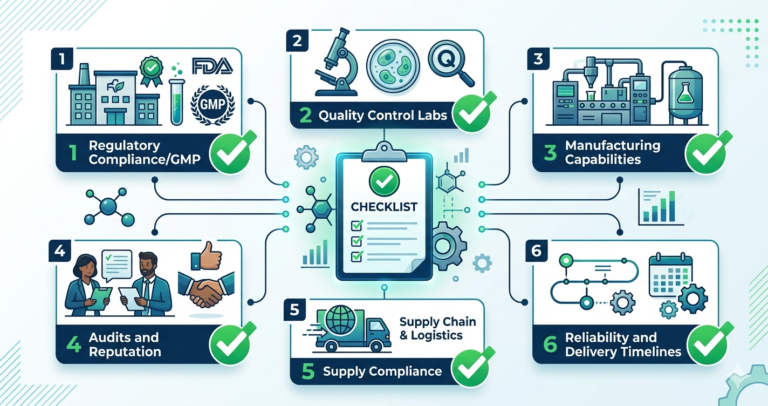
How to Identify a Reliable Pharma Contract Manufacturer (REAL CHECKLIST)
Most distributors don’t fail because of the market — they fail because of wrong manufacturer selection.
Here’s how you evaluate properly:
1. Certifications (But Verify Them)
Certifications like WHO-GMP and ISO are important, but they don’t guarantee real quality. Always go beyond documents by checking audit reports and export history. In many cases, paperwork looks perfect, but ground reality tells a different story.
Check:
- WHO-GMP
- ISO
- Drug license
But don’t stop there.
Ask:
- “Can I see your last audit report?”
- “Which markets do you export to?”
2. Batch Consistency
Inconsistent batches are one of the biggest hidden risks in pharma manufacturing. Even small variations can break doctor trust and reduce repeat prescriptions. Over time, this directly impacts your brand credibility and sales.
This is where real problems start.
In 60% of complaints I’ve seen:
- Same product, different batches → different results
Result:
- Doctors lose trust
- Retailers stop pushing your brand
3. MOQ Flexibility
MOQ plays a crucial role, especially for new businesses testing the market. Flexible manufacturers allow smaller initial orders, while rigid ones push bulk stock without demand validation. This often leads to unsold inventory.
Good manufacturers:
- Allow low MOQ for startups
Bad ones:
- Force bulk orders without demand validation
4. Delivery Timeline Reality
Most companies promise faster delivery, but actual timelines often stretch beyond expectations. Delays of 15–30 days can disrupt your entire supply chain and block working capital. Reliable timelines matter more than low pricing.
Claim: 30 days
Actual: 45–60 days (in many cases)
This delay directly affects your cash flow cycle
5. Monopoly Ethics
Monopoly rights are often promised but not always honored in practice. Some companies supply the same products to multiple distributors in the same area. This creates price competition, confusion, and long-term market instability.
This is rarely discussed.
Some companies:
- Sell same composition to multiple distributors in same area
Result:
- Price wars
- Market confusion
Top Pharma Contract Manufacturers In Gujarat (Detailed Analysis)
1. Torrent Pharmaceuticals
A well-established pharma leader known for strong R&D and high-quality, export-grade formulations. Best suited for large-scale and export-focused businesses, but high MOQ and strict processes make it less suitable for beginners.
Overview: One of the most established pharma companies in Gujarat
Strengths:
- Strong R&D
- High-quality formulations
- Export-grade manufacturing
Product Range:
- Tablets, capsules, cardiovascular, CNS drugs
Best For:
- Established brands
- Export-focused businesses
Reality Insight:
Not ideal for small PCD distributors due to high MOQ and strict processes
2. Zydus Lifesciences
A globally recognized company with USFDA-approved plants and a wide therapeutic portfolio. Ideal for large pharma marketers, though smaller businesses often struggle to get priority support.
Overview: Global presence with strong manufacturing base in Gujarat
Strengths:
- WHO-GMP, USFDA plants
- Wide therapeutic segments
Product Range:
- Tablets, injectables, biologics
Best For:
- Large-scale pharma marketers
Reality Insight:
In most cases, small businesses don’t get priority orders
3. Intas Pharmaceuticals
Known for its strong international presence and high compliance standards, especially in regulated markets. Delivers excellent quality, but typically not beginner-friendly due to its focus on high-end segments.
Overview: Known for export-quality production
Strengths:
- Strong EU & US presence
- High compliance
Product Range:
- Injectables, oncology, tablets
Best For:
- High-end product segments
Reality Insight:
Excellent quality, but not beginner-friendly
4. Lincoln Pharmaceuticals
A reliable mid-sized manufacturer offering a wide product range with balanced MOQ flexibility. A practical choice for PCD distributors and growing pharma businesses seeking manageable entry.
Overview: Mid-sized company with strong domestic presence
Strengths:
- Balanced MOQ
- Wide product portfolio
Product Range:
- Tablets, syrups, capsules
Best For:
- PCD distributors
- Mid-level pharma businesses
Reality Insight:
In 70% of cases, distributors find them more flexible than large companies
5. West Coast Pharmaceuticals Works Ltd.
A supportive third-party manufacturer with flexible options and diverse dosage forms. Well-suited for startups, though success largely depends on selecting the right product portfolio.
Overview: Known for third-party manufacturing support
Strengths:
- Custom manufacturing
- Wide dosage forms
Product Range:
- Tablets, syrups, ointments
Best For:
- Startups and franchise businesses
Reality Insight:
Good entry-level partner, but product selection matters
Comparison Table (Decision-Making View)
| Company | Certifications | Product Range | Best For | Risk Level |
|---|---|---|---|---|
| Torrent Pharma | WHO-GMP, Global | Tablets, CNS | Large players | Low |
| Zydus Lifesciences | USFDA, WHO-GMP | Wide range | Exporters | Low |
| Intas Pharma | EU-GMP | Injectables | High-end | Low |
| Lincoln Pharma | WHO-GMP | General range | PCD distributors | Medium |
| West Coast Pharma | WHO-GMP | Multi-dosage | Startups | Medium |
What Most Pharma Companies Won’t Tell You
1. Hidden Costs
What looks like a low quotation often increases due to additional charges like packaging upgrades, freight, and GST variations. These hidden costs directly reduce your profit margin if not clarified upfront.
- Packaging upgrades
- Freight charges
- GST variations
2. Delayed Dispatch
Delivery delays are more common than expected, especially in initial orders. When timelines stretch beyond commitment, it disrupts your supply chain and blocks working capital.
“In 70% of first-time deals, delivery timelines are not met exactly as promised.”
3. Batch Issues
Even minor inconsistencies in batches can create major problems in the market. Poor product performance leads to loss of doctor trust and reduced repeat orders.
Small variation → big market loss
4. Monopoly Conflicts
Some manufacturers supply the same products to multiple distributors in the same area. This creates price competition, reduces margins, and leads to long-term market instability.
Same product sold to:
- Multiple distributors
- Same geographic area
Leads to price crash
Real Case Scenarios
Case 1: ₹1.5 Lakh Stock Stuck
A distributor from Indore:
- Chose cheapest manufacturer
- Got delayed delivery + poor packaging
Result: Retailers rejected stock
Case 2: Smart Selection → Fast Growth
Ahmedabad-based distributor:
- Chose mid-sized reliable company
- Focused on 10 fast-moving products
Result:
- Break-even in 5 months
Case 3: Credit Cycle Trap
Nagpur distributor:
- Took credit-based supply
- Sales slow → payment pressure
Result:
- Business shutdown in 8 months
Who Should Choose Contract Manufacturing in Gujarat
- PCD pharma distributors
- Export-focused businesses
- Startup pharma brands with strategy
Who Should Avoid It
Low budget beginners (<₹50K)
- No marketing plan
- Expecting quick profits
5-Step Safe Selection Framework
Step 1: Shortlist 3–5 companies
Start by selecting a few reliable manufacturers instead of randomly choosing. Focus on reputation, product range, and market feedback to reduce risk and confusion.
This step helps you avoid time loss and eliminates low-quality suppliers early.
Step 2: Verify certifications (don’t trust brochures)
Don’t rely only on brochures or sales claims. Always independently verify WHO-GMP, ISO, and drug licenses before moving ahead.
This ensures the company is genuinely compliant and not just marketing credibility.
Step 3: Order samples
Check product quality through real samples before committing. This helps you evaluate consistency, packaging, and market acceptability.
It also gives a real idea of how the product will perform in the market.
Step 4: Negotiate MOQ
Discuss minimum order quantity based on your budget and demand. A flexible MOQ helps reduce inventory risk in the initial stage.
It prevents overstocking and protects your working capital from unnecessary pressure.
Step 5: Start with trial order
Begin with a small trial order to test delivery, quality, and reliability. This reduces risk before scaling up long-term partnership.
It also helps you understand how smoothly the company handles real-time business operations.
Never go all-in initially
Common Mistakes to Avoid
- Choosing cheapest manufacturer
- Ignoring logistics timelines
- Not checking batch history
- Overloading inventory
- Blind trust in sales reps
Expert Insights (From Real Market)
- In Tier-2 cities like Ahmedabad, doctor trust takes 3–6 months to build
- Retailers prefer fast-moving brands over high-margin products
- MR activity matters more than pricing in early stage
Conclusion:
Choosing from the top pharma contract manufacturers in Gujarat is not about picking the biggest name.
- It’s about:
Matching your business stage - Understanding ground realities
- Starting small and scaling smart
“In this industry, survival is not about margins — it’s about consistency.”
Top Pharma Contract Manufacturers In Gujarat: FAQs
1. Which is the best pharma contract manufacturer in Gujarat?
2. What is the minimum order quantity (MOQ)?
3. Is WHO-GMP enough?
4. How to verify a pharma company?
Reference:
ABOUT THE AUTHOR

Mitesh Vyas
My name is Mitesh Vyas, and I am a Pharma Franchise Consultant and Industry Research Analyst specializing in India’s PCD pharma business ecosystem. My work focuses on helping beginners, distributors, and small pharma entrepreneurs understand the real-world functioning of the pharma franchise model. Unlike theoretical content, my insights are based on ground-level observations from Indian pharmaceutical markets, including Tier-1, Tier-2, and Tier-3 cities such as Ahmedabad, Indore, Lucknow, and surrounding business hubs. I regularly share insights on how the pharma franchise business in India works in real market conditions, including investment, product strategy, and growth challenges.