
Most people enter the PCD pharma franchise in India thinking it’s a “simple distribution business with high margins.”
On paper, that’s true. On the ground, it’s very different. In real markets, this business depends less on margins and more on doctor trust, product movement, and consistency—things most beginners underestimate.
If you’re planning on starting a pharma franchise, this guide will give you what typical blogs won’t:
- What actually happens after you invest
- Why many distributors fail in the first 6 months
- And how to enter this business safely in 2026

What is the PCD Pharma Franchise in India? (Clear Definition)
A PCD pharma franchise is a business model where a pharmaceutical company gives you the rights to market and sell its products in a specific area, usually on a monopoly basis.
Simple Definition (Google-friendly):
You promote a company’s medicines to doctors and supply them to retailers in your area to earn profit margins.
But Here’s the Real Market Reality:
What it looks like on paper:
- You get monopoly rights
- You buy products at low rates
- You sell at higher MRP
- You earn profit
What actually happens in India:
- Doctors don’t prescribe your brand immediately
- Retailers don’t stock unknown products easily
- Stock movement is slow in the beginning
- Repeat orders depend entirely on prescriptions
In 60–70% of cases I’ve seen, beginners struggle not because of low margins—but because their products don’t move.
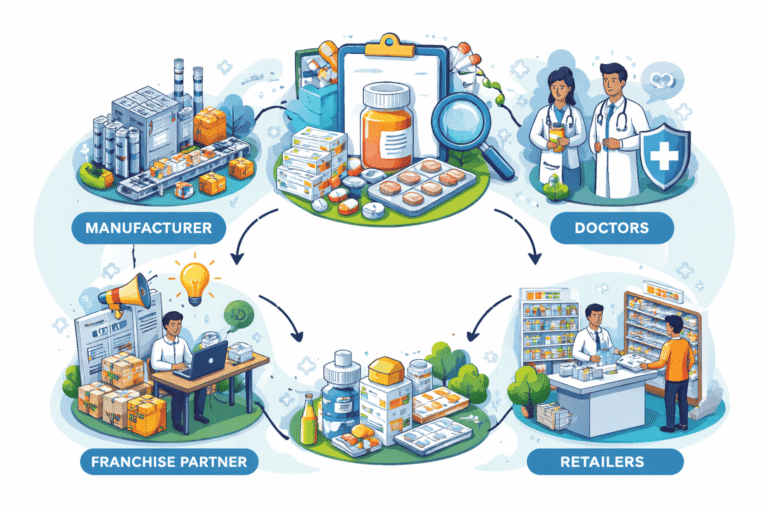
How the PCD Pharma Business Model Actually Works
This is where most blogs fail—they don’t explain the real flow:
Company → Distributor (You) → Doctor → Retailer → Patient
1. Company
The pharma company acts as the supplier, providing you with product lists, pricing, and promotional materials to start your operations. On paper, they also promise monopoly rights and marketing support. However, in reality, the level of support varies widely, and not all products in their portfolio have real market demand.
2. Distributor (You)
As a distributor, you invest in initial stock (typically ₹1–3 lakh) and take responsibility for generating demand. Your main job is to promote products to doctors and ensure supply to retailers. In most cases, you are also handling fieldwork, follow-ups, and relationship building yourself.
3. Doctor (Key Decision Maker)
Doctors are the most critical part of this chain because they decide which brand gets prescribed. Their trust directly controls product demand in the market. If your brand is not prescribed, it won’t move—no matter how good your margins or schemes are.
4. Retailer (Chemist)
Retailers act as the bridge between prescription and final sale, but their priority is always fast-moving products. They usually stock new brands only if there is consistent demand from doctors. Without repeat prescriptions, they are unlikely to reorder your products.
5. Patient
The patient is the end consumer who buys medicines based entirely on the doctor’s prescription. In most cases, they don’t ask for specific brands and rely on what is prescribed. This is why the entire business ultimately depends on influencing prescription behavior.
Role of Medical Representative (MR):
Many companies promise MR support.
Reality:
- In most cases, YOU become the MR
- Or MR visits are irregular
In cities like Ahmedabad, Indore, and Lucknow:
- 80% of successful distributors actively visit doctors themselves

Benefits of PCD Pharma Franchise (With Conditions)
Low Entry Barrier
Compared to setting up a manufacturing unit, starting a PCD pharma franchise requires relatively lower investment and fewer regulatory complexities. If you’re new to this model, this complete guide to PCD pharma franchise in India can help you understand the basics before getting started. You don’t need to handle production, machinery, or large staff, which makes it accessible for beginners or small investors entering the pharma business.
High Margin Products
One of the biggest attractions of this model is the margin structure, which can range between 30% to 60% depending on the product. However, these margins are only meaningful when products actually move in the market. Without prescriptions, even high-margin products won’t generate real income.
Scalability
The business offers good expansion potential once you establish a stable base in one area. You can gradually add more products, increase doctor coverage, or expand into nearby locations. Over time, this allows you to build a larger distribution network and grow your revenue consistently.
But Here’s the Condition:
These benefits work ONLY IF:
- Products are in demand
- Doctors start prescribing
- You maintain consistent follow-ups
Without prescription generation, even 70% margin is useless.

Challenges & Why Many Beginners Fail
1. Doctors Don’t Easily Change Brands
Cause: Doctors trust known companies
Effect: They ignore new brands
Outcome: No prescriptions for 2–3 months
Most beginners assume doctors will “try new products.” In reality, trust-building takes 3–6 months minimum.
2. Slow Stock Movement
Cause: No prescriptions
Effect: Retailers don’t reorder
Outcome: Inventory gets stuck
The first 2 months often generate zero repeat orders.
3. Retailer Psychology
Around 60% of retailers prefer fast-moving, well-known brands because they ensure quick sales and lower risk of unsold stock. New or unknown brands are always given low priority, especially when shelf space is limited. In most cases, a retailer may try your product once, but without consistent doctor prescriptions, they won’t place repeat orders.
4. Cash Flow Pressure
Cause: Credit cycle (15–30 days)
Effect: Money stuck in market
Outcome: Reinvestment becomes difficult

What Most Pharma Companies Won’t Tell You
False Monopoly Claims
Many companies promise exclusive monopoly rights for a specific area, but in reality, they often appoint multiple distributors through different channels. This creates hidden competition, leading to price clashes and reduced margins. Beginners usually realize this only after entering the market.
Overloaded Product Lists
Companies often showcase 200+ products to appear strong, but in actual market conditions, only 10–15 products generate consistent demand. New distributors end up investing in slow-moving or irrelevant items. This results in blocked capital and unsold inventory.
No Real MR Support
Although companies claim to provide Medical Representative (MR) support, in most cases it is either limited or inconsistent. Field visits are irregular, and follow-ups are weak. Eventually, the distributor has to handle doctor visits and promotion independently.
Unrealistic Profit Promises
Sales pitches often include claims like “earn ₹1 lakh per month easily,” which rarely reflect ground reality. The initial months usually involve slow movement, relationship building, and minimal returns. Without consistent effort, such income expectations are unrealistic.

Real Case Studies
Case 1: ₹1.5 Lakh Stock Stuck
A beginner invested heavily in 25 products.
Problem: Doctors didn’t prescribe them
Result: 70% stock expired or moved at heavy discount
Case 2: Wrong Product Selection
The distributor chose low-demand molecules.
Outcome: Retailers refused repeat orders
Case 3: Credit Cycle Trap
- Supplied goods on credit
- Payments delayed
Result: Cash flow collapsed within 5 months

Who Should Start & Who Should Avoid This Business
Ideal for
- People with medical field experience
- Existing pharma sales network
- Willing to do doctor visits regularly
Avoid If:
- You think it’s passive income
- You don’t want fieldwork
- You expect fast profits
Step-by-Step Safe Entry Strategy (2026)
Step 1: Market Research
Start by understanding what actually sells in your local market instead of relying on company product lists. Identify top-prescribed medicines by talking to doctors and observing retailer demand patterns. Retailers can give you practical insights into which brands move fast and which products are already saturated.
Step 2: Company Verification
Before investing, verify the company’s legal and market credibility to avoid future issues. Check essential documents like GST registration and drug license, and research their reputation among existing distributors. Speaking to current partners can reveal the real level of support and transparency.
Step 3: Product Selection
Avoid the common mistake of buying a large product range in the beginning. Start with 8–12 high-demand products that are already being prescribed in your area. This focused approach reduces risk, improves stock movement, and helps you manage investment more efficiently.
Step 4: Doctor Approach Strategy
Instead of targeting too many doctors, focus on building strong relationships with 5–10 doctors initially. Regular weekly follow-ups, product explanation, and sample distribution are key to gaining trust. Consistency matters more than quantity in the early phase.
Step 5: First 90-Day Execution Plan
Instead of targeting too many doctors, focus on building strong relationships with 5–10 doctors initially. Regular weekly follow-ups, product explanation, and sample distribution are key to gaining trust. Consistency matters more than quantity in the early phase.

Expert Insights & Mistakes to Avoid
Common Mistakes
- Buying too many products
- Trusting company promises blindly
- Ignoring doctor relationships
- Expecting quick returns
What Actually Works
- Focus on 1–2 strong segments
- Build doctor trust slowly
- Track product movement weekly
Conclusion
The PCD pharma business in India is not a scam—but it’s also not easy money. It’s a relationship-driven, consistency-based business.
If you:
- Understand ground realities
- Stay consistent for 6–8 months
- Focus on demand-driven products
Then this business can become stable and profitable. Otherwise, it quickly turns into unsold stock and blocked capital