If you talk to anyone entering the pharma business today, contract manufacturing (third-party manufacturing) is one of the first models they consider. Low investment, no factory setup, faster product launch — it sounds like a shortcut to success.
But here’s the ground reality from real market exposure:
In nearly 70% of cases I’ve seen, businesses don’t fail because the model is wrong — they fail because they misunderstand how the system actually works.
In Tier-2 markets like Ahmedabad, Indore, or Lucknow, the scope of pharma contract manufacturing in India is huge, but only for those who understand:
- Product movement
- Doctor behavior
- Distributor psychology
- Credit cycles
This guide will break down not just the “scope,” but the real, operational truth behind it — what works, what doesn’t, and how to enter smartly.
What is Pharma Contract Manufacturing?
Pharma contract manufacturing means:
- You own the brand
- A WHO-GMP certified manufacturer produces medicines
- You handle marketing, distribution, and sales
This is the backbone of the pharma franchise business model and is widely used in PCD pharma business in India.
Scope Of Pharma Contract Manufacturing In India
Let’s not talk theory — let’s talk about the real drivers behind the growth. In real markets, growth is driven by rising demand from smaller cities, increasing outsourcing by pharma companies, and the rapid expansion of distribution networks. More importantly, businesses that understand doctor behavior and product movement are the ones actually capturing this growth.
1. Low Entry Barrier
You can start with ₹50,000 to ₹2 lakh depending on product range.
But here’s the catch:
Low entry cost = High competition
In most cities, you’ll find:
- 200+ small pharma brands
- Same compositions, different brand names
- Doctors already loyal to 5–10 companies
Scope exists, but positioning matters more than entry
2. Explosion of PCD Pharma Franchise in India
The rise of PCD pharma franchise in India has directly increased demand for contract manufacturing.
Why?
- Every new distributor needs products
- Every small company outsources manufacturing
In my experience, 60–70% of new pharma businesses rely entirely on third-party manufacturers
3. Increasing Demand in Semi-Urban & Rural Markets
Tier-2 and Tier-3 markets are expanding fast:
- More clinics opening
- More generic prescriptions
- Less brand loyalty compared to metros
But here’s the nuance:
Doctors in smaller cities are easier to approach — but harder to retain.
Why?
- They experiment initially
- But stick only if results + MR follow-up are consistent
4. Product Expansion Opportunities
You can easily expand into:
- Tablets (antibiotics, painkillers)
- Syrups (pediatric range)
- Capsules (nutraceuticals)
- Injections (higher margin, but tougher entry)
The scope is not just entry — it’s scaling your product basket
How It Actually Works in the Real Market
This is where most beginners get it wrong.
Step-by-Step Ground Flow:
- You select products (usually 10–30 SKUs)
- Manufacturer produces and delivers stock
- You appoint:
- Distributors
- Medical representatives (MRs)
- MRs generate prescriptions
- Retailers supply based on doctor demand
But Here’s the Reality:
- No prescriptions = No movement
- No MR follow-up = No repeat orders
- No retailer margin = No push
In 80% of failed cases, the issue is not product quality — it’s lack of field execution
Real Benefits
1. Fast Market Entry
You can launch your pharma products within 30–45 days through contract manufacturing, which makes it attractive for new entrants. However, in real market conditions, quick entry only gives you presence — actual success depends on how effectively you build doctor trust and generate prescriptions over time.
2. No Manufacturing Hassle
You don’t need to invest in factory setup, machinery, or manufacturing licenses, which significantly reduces your initial burden. From my experience, this allows you to focus where the real game is — building relationships with doctors, managing distributors, and ensuring consistent product movement.
3. Scalability
Once a few of your products start getting regular prescriptions, scaling becomes much easier compared to traditional businesses. But practically, growth only happens when you track what’s actually selling in the market and expand based on demand — not assumptions.
Hidden Challenges & Failure Reasons
1. Doctor Dependency
Doctors rarely switch to new brands quickly because their reputation depends on patient outcomes. In real practice, it takes consistent follow-ups and proven results over 2–6 months to earn their trust and start getting regular prescriptions.
2. Credit Cycle Trap
In most markets, retailers expect 15–30 days credit and distributors push for margins and schemes. Many beginners struggle not due to lack of sales, but because their cash gets stuck in the market, affecting their ability to reorder and grow.
3. Wrong Company Selection
Choosing the wrong manufacturer can quietly damage your business from the start. Issues like delayed supply, inconsistent quality, or poor packaging can break doctor and retailer confidence — sometimes after just one bad batch.
4. Overloaded Product Range
Launching too many products initially may seem like a strong strategy, but it often backfires. In reality, only a small portion of products generate demand, while the rest sit as unsold stock, locking your investment unnecessarily.
What Most Pharma Companies Won’t Tell You
This is the point where marketing promises and ground reality start to differ. If you don’t understand these gaps early, you may enter the business with the wrong expectations.
1. We Provide Monopoly Rights
Monopoly rights are often presented as a major advantage, but in real markets, they are rarely strict or fully controlled. The same products can still reach your area through other distributors or online channels, reducing the exclusivity you were promised.
2. High Margin = High Profit
High margins look attractive on paper, but they don’t guarantee sales. In actual market conditions, fast-moving products with moderate margins generate more consistent income than high-margin products that rarely get prescribed.
3. Full Marketing Support
Most companies highlight marketing support as a key benefit, but in practice, it usually includes only basic materials like visual aids or samples. Real growth comes from your own fieldwork — regular doctor visits, follow-ups, and building trust.
4. Easy Success Model
The business is often promoted as simple and low-effort, but that’s misleading. In reality, pharma runs on relationships — with doctors, retailers, and distributors — and without consistent effort, even good products fail to move.
Real Case Scenarios
Case 1: ₹1.5 Lakh Investment – No Movement
A beginner in Ahmedabad:
- Invested in 25 products
- No MR appointed
- Relied on distributor
Result:
- Stock stuck for 6 months
- 70% products expired risk
Mistake: No demand generation
Case 2: Wrong Manufacturer Choice
A distributor in Indore:
- Chose cheapest manufacturer
- Faced delayed supply
Result:
- Lost doctor trust
- Retailers stopped stocking
Mistake: Cost over quality
Case 3: Smart Starter Strategy
A small player in Surat:
- Started with 8 products
- Focused on 2 doctors per area
- Regular MR visits
Result:
- Break-even in 5 months
- Gradual expansion
Strategy beats scale
Who Should & Should NOT Enter This Business
Ideal For:
- People ready for fieldwork
- Existing medical reps
- Distributors with doctor network
Not Ideal For:
- Passive investors
- People expecting quick returns
- Those avoiding sales activity
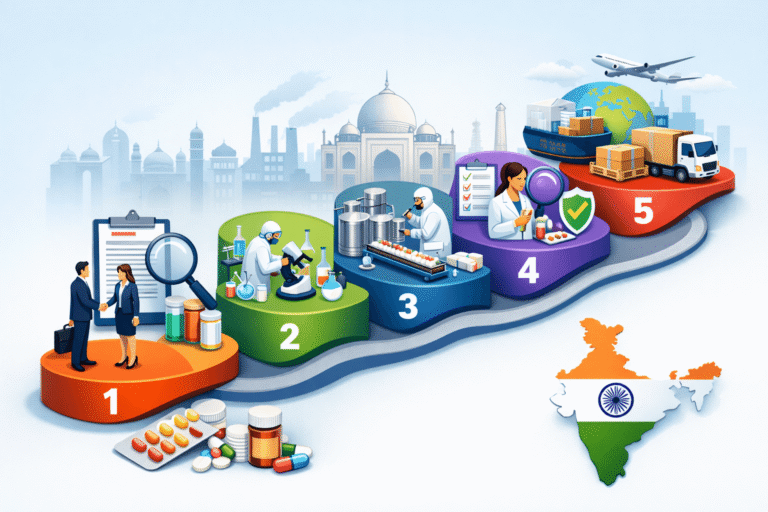
5-Step Safe Entry Strategy
Step 1: Start Small (10–15 Products)
Focus on:
- High-demand molecules
- Doctor-friendly categories
Step 2: Choose Manufacturer Carefully
Check:
- WHO-GMP certification
- Delivery timeline
- Packaging quality
Step 3: Hire or Act as MR Initially
You must:
- Visit doctors
- Build relationships
- Generate prescriptions
Step 4: Focus on One Area First
Don’t expand too fast.
Control one territory → then scale
Step 5: Monitor Product Movement
Track:
- Which product sells
- Which doesn’t
Remove dead stock early
Expert Insights: Mistakes to Avoid
- Launching too many products
- Ignoring MR activity
- Choosing cheapest manufacturer
- Giving excessive credit
- Expecting fast returns
In my experience, consistency beats aggression in the pharma business.
Conclusion
The scope of pharma contract manufacturing in India is undeniably strong, driven by:
- Growing healthcare demand
- Expansion of PCD pharma business in India
- Low entry barriers
But here’s the honest truth:
This is not a “set and forget” business — it’s a daily execution game
If you treat it like a system:
- Build doctor relationships
- Control distribution
- Manage cash flow
You can build a stable, scalable business.
If you treat it like a shortcut:
You’ll struggle like most beginners.
Scope Of Pharma Contract Manufacturing In India-FAQS
REFERENCE